
Agentic AI vs Generative AI: What’s the Difference and What Should You Learn
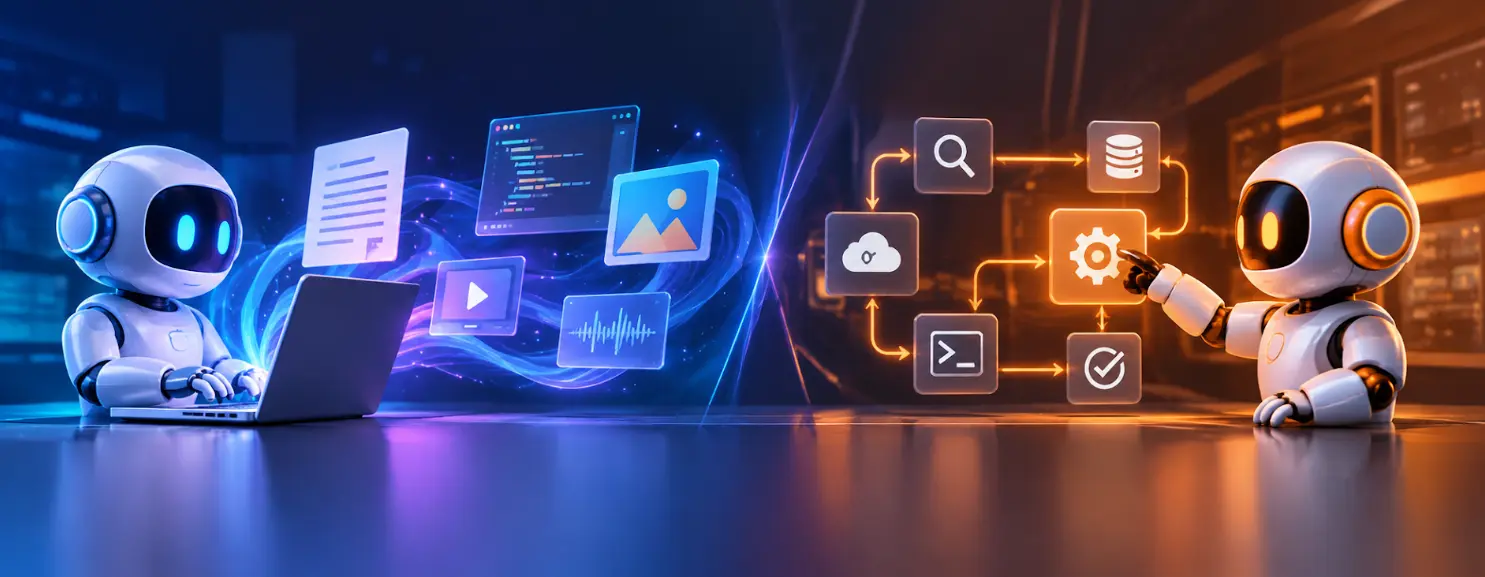
Agentic AI vs Generative AI comes down mainly to what the system is designed to do. Generative AI is primarily used to create content such as text, code, images, summaries, and other outputs from a user's prompt. Agentic AI goes a step further by using AI models within a system that can work toward a goal, use tools, make decisions, and complete multiple steps.
For example, you can ask Generative AI to explain why a deployment failed and suggest a solution. An agentic system could be designed to inspect approved logs, check deployment information, analyze the results, and prepare a report.
The two are not completely separate. Generative AI can actually be one of the core capabilities used inside an AI agent.
Table of Contents
▼What Is Generative AI?
Generative AI is AI designed to create new content based on an input or prompt.
That content can take many forms. A model can generate text, write code, summarize information, create images, or help produce other types of content.
For a developer, this could mean asking an AI tool to generate a Python function. A QA engineer might ask it to create test scenarios from a requirement. A DevOps engineer could provide an error message and ask for possible causes.
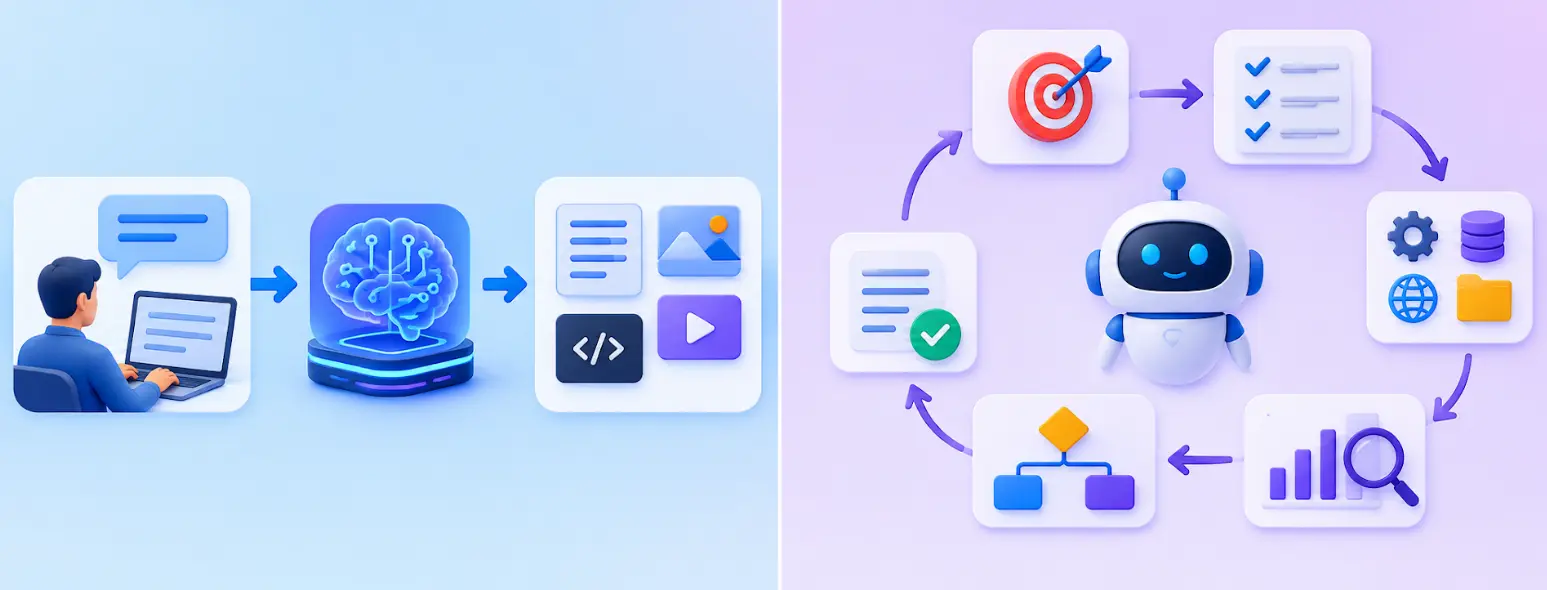
The interaction is often straightforward: Prompt → AI model → Response
You provide an instruction, the model processes it, and you receive an output.
Generative AI can be extremely useful even when no autonomous action is involved. It can save time on tasks that involve writing, analysis, explanation, brainstorming, or code generation.
If you want to build a stronger foundation in this area, explore MicroDegree’s Free Learning.
However, the model generally does not automatically carry out every step required to complete a larger task unless it has been connected to tools and an application workflow that allows it to do so.
A simple example: Suppose you ask, “Write a SQL query to find customers who placed more than five orders.” Generative AI can produce the SQL query. You then decide whether to run it, check the result, modify it, or use it somewhere else. That is a useful distinction when comparing Generative AI vs Agentic AI.
What Is Agentic AI?
Agentic AI refers to AI-powered systems designed to work toward a goal by deciding what actions to take, using available tools, observing results, and continuing until the task is completed or a stopping condition is reached.
The important part is not simply that the system uses an AI model. It is the surrounding system that gives the model access to context, tools, instructions, memory, permissions, and workflows.
A simple interaction might look like: Question → Answer
An agentic workflow can look more like: Goal → Decide → Act → Observe → Decide again → Complete
For example, imagine an IT support workflow. A user reports that an application is not working. An agent could be designed to understand the request, search internal documentation, check approved system information, identify a likely solution, and record the result.
The exact behavior depends on how the agent has been built and what permissions it has.
This is why an AI agent should not simply be thought of as “a smarter chatbot.” An agent is better understood as an application or system that combines an AI model with tools and a workflow for completing goals.
Agentic AI vs Generative AI: What’s the Difference?
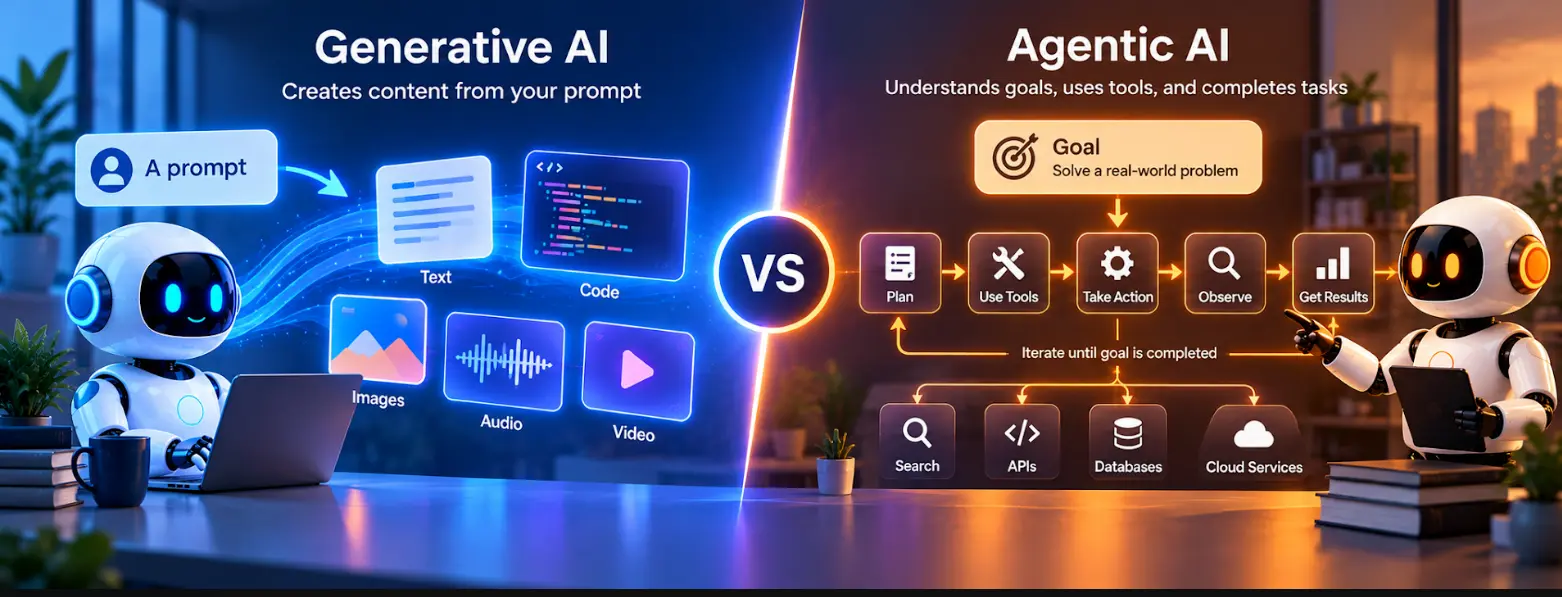
The easiest way to understand the difference between Agentic AI and Generative AI is to look at their primary role.
Generative AI is mainly concerned with producing an output. Agentic AI is concerned with working toward an outcome.
| Feature | Generative AI | AI Agents | Agentic AI |
|---|---|---|---|
| Primary Function | Generates new content such as text, images, videos, and code. | Performs specific tasks automatically based on predefined instructions. | Plans, reasons, and takes actions toward a defined goal. |
| Dependency | Primarily works from its trained model and the context provided in the prompt. | Depends on predefined instructions, workflows, rules, and APIs. | Uses reasoning, planning, tools, context, and feedback to determine the next action. |
| Tool Access | May work without external tools, depending on the application. | Has limited or predefined access to specific tools and APIs. | Can dynamically use multiple tools, APIs, databases, and external systems. |
| Learning / Adaptation | Generates responses based on its training and provided context. | Typically follows predefined instructions and workflows rather than continuously learning. | Can use feedback, tool results, and changing context to adapt its actions within the workflow. |
| Example Use Case | Writing articles, generating code, creating images, or summarizing information. | Fetching flight data, sending alerts, or performing a predefined support task. | Booking a flight based on user preferences, checking availability, comparing options, and completing the approved workflow. |
| Autonomy Level | Low | Medium | High, depending on system design and permissions. |
| Example Tools / Systems | ChatGPT, DALL·E, Midjourney | Customer service bots, workflow automation systems | AI systems with planning, tool use, and multi-step execution capabilities |
Practical example: Suppose a DevOps engineer wants to investigate an application outage. With Generative AI, the engineer might provide logs and ask, “What could have caused this error?” The model can analyze the information and provide possible explanations. With an agentic system, the workflow could be designed to retrieve relevant logs, inspect approved monitoring data, compare information from different sources, and organize the findings. The second workflow involves more than generating an answer. It involves actions and decisions across multiple steps.

How Do Generative AI and Agentic AI Work?
Generative AI and Agentic AI can use similar underlying AI models, but they work differently depending on what the system is designed to accomplish. Generative AI generally follows a straightforward interaction where a user provides a prompt, the AI model processes the request, and the system produces an output. For example, a developer might ask Generative AI to write a Python function, explain an error message, generate a SQL query, or summarize technical documentation. The basic flow can be represented as Prompt → AI Model → Generated Output. The user then reviews the response and decides what to do with it.
Agentic AI involves a more extended workflow because the system is designed to work toward a specific goal rather than simply return an answer. An agentic application can receive an objective, determine what information or actions are required, use available tools, observe the results, and decide what to do next. A simplified workflow can be represented as Goal → Plan or Decide → Use Tools → Observe → Evaluate → Act → Complete. The exact workflow can vary depending on how the application is designed and what tools and permissions are available to it.
Consider an application that is experiencing errors after a deployment. With Generative AI, you could provide the relevant logs and ask the model to explain the possible cause of the error. The model can analyze the information and provide suggestions, but the next action generally remains with the user or application. An agentic system, on the other hand, could be designed to retrieve approved logs, inspect deployment information, compare available monitoring data, evaluate what it finds, and prepare an investigation report. If the system has the required permissions and safeguards, it may also perform an approved action as part of the workflow.
The main difference is therefore not simply the AI model being used. It is the workflow built around the model. Generative AI is primarily focused on generating or transforming content in response to an input, while Agentic AI combines AI capabilities with tools, context, decision-making, and workflows to work toward a defined outcome. An agent may also use Generative AI as one of its capabilities to understand requests, generate queries, summarize information, or produce a final response.
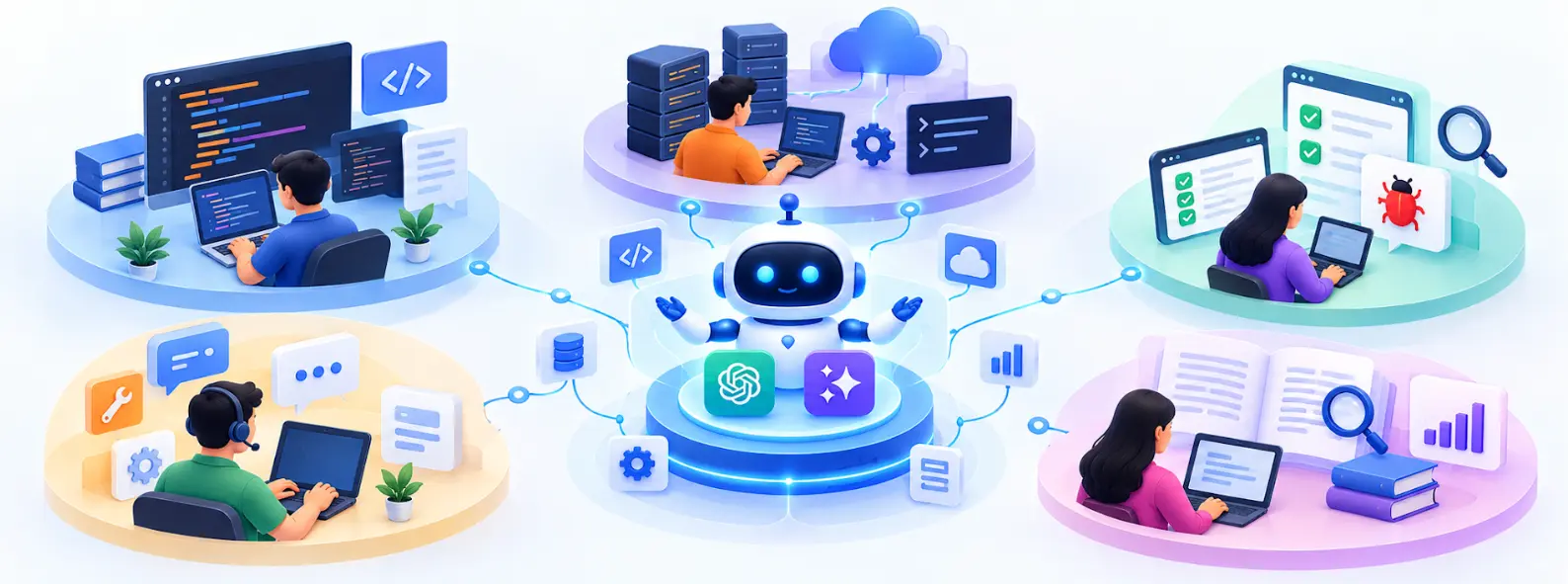
Where Are Generative AI and Agentic AI Used in the Real World?
1. Software Development
Code generation: Helps developers write code based on requirements. Code explanation: Explains existing code and suggests improvements. Documentation: Generates technical documentation automatically. Testing: Creates test cases and helps identify potential errors. Debugging: Suggests possible solutions to programming issues. Agentic workflows: Can inspect repositories, modify relevant files, run tests, analyze results, and prepare changes for review.
Key difference: Generative AI assists with individual tasks, while agentic systems can connect multiple development activities toward a specific goal.
2. DevOps and Cloud
Log analysis: Explains logs and error messages to identify possible issues. Command generation: Generates useful commands and configuration examples. Incident support: Summarizes incidents and suggests possible causes. Troubleshooting: Helps investigate deployment and infrastructure problems. Agentic workflows: Can retrieve logs, inspect deployment data, compare information, and prepare an investigation report.
Key difference: Generative AI assists with individual tasks, while agentic AI can connect multiple tools and steps into an investigation workflow.
3. QA & Testing
Test case generation: Creates positive and negative test cases from requirements. Test scenarios: Helps QA teams identify relevant testing scenarios. Test data: Generates sample data for testing. Documentation: Creates test documentation and bug descriptions. Failure analysis: Summarizes test failures and organizes findings. Agentic workflows: Can read requirements, generate test scenarios, execute approved tests, analyze failures, and compile results.
Key difference: Generative AI supports individual testing tasks, while agentic workflows connect multiple testing steps into one workflow.
4. IT Support
Technical assistance: Answers technical questions and explains error messages. Troubleshooting: Suggests possible solutions and troubleshooting steps. Documentation: Summarizes relevant internal documentation. Support workflow: Can receive requests, search approved documentation, retrieve system information, and follow defined troubleshooting steps. Outcome tracking: Records the troubleshooting process and results.
Key difference: Generative AI assists with individual support tasks, while agentic systems can connect multiple support activities into a workflow.
5. Research & Knowledge Work
Document summarization: Summarizes documents and technical information. Content organization: Organizes supplied information into a clear structure. Report writing: Helps draft reports and synthesize information. Information gathering: Agentic AI can gather information from approved sources and compare findings. Multi-step research: Organizes findings and prepares structured results.
Key difference: Generative AI focuses on creating or transforming information, while Agentic AI connects multiple steps toward a specific goal.
What Should IT Professionals Learn?
If you are a developer, QA engineer, Cloud Engineer, DevOps Engineer, or another IT professional, you do not need to learn every AI technology before starting with AI agents.
A practical learning path is easier to manage. Start with programming fundamentals and APIs. You should understand how applications communicate with external services before trying to build complex agentic workflows.
Next, learn the basics of LLMs and Generative AI. Understand prompts, model capabilities, context, structured outputs, and common limitations.
Then move toward tool calling, RAG, agent architecture, memory, evaluation, and security.
For someone working in Cloud or DevOps, existing technical knowledge becomes useful here. Linux, APIs, containers, CI/CD, cloud services, monitoring, and automation can all help you understand how AI systems interact with real engineering environments.
A simple learning path could look like: Programming → APIs → LLM Fundamentals → Generative AI → Tool Calling → RAG → AI Agents → Evaluation → Security
If you are building these skills alongside your existing IT background, practical learning resources across AI, Cloud, and DevOps can help you connect the concepts instead of studying them in isolation. MicroDegree is one place where you can explore these technology areas in a structured way.
The goal should not be to simply know the definition of an AI agent. You should gradually become comfortable with designing, building, testing, and evaluating AI-powered workflows.
Building Reliable AI Agents: Best Practices and Career Impact
Not every task needs an AI agent. If a process follows the same steps every time, a traditional script, workflow, or automation may be simpler, more predictable, and easier to maintain.
When an agent does need to interact with databases, production systems, APIs, or business applications, its access should be carefully controlled. Give it only the permissions required for the task rather than allowing unrestricted access.
Reliability also matters. An agent may make an incorrect decision or receive unexpected information from a tool. Adding validation, logging, monitoring, clear stopping conditions, and well-defined tool boundaries can help reduce the impact of these situations. For sensitive actions, a human approval step can provide an additional layer of control.
Security should be considered from the beginning. Since agents can process external content and interact with connected systems, developers need to account for risks such as prompt injection, unauthorized tool use, data exposure, and excessive permissions.
A practical way to build an agent is to start with one well-defined workflow. Test it with both normal and unexpected inputs, review the actions it takes, and monitor its results. Once the workflow is reliable, you can gradually introduce additional tools and capabilities.
Practical Examples
Example 1: Writing SQL
Generative AI: You ask the model to write a SQL query.
Agentic AI: You give the system a goal such as finding unusual order activity. The system could be designed to query an approved database, analyze the returned information, and prepare a summary.
Example 2: Deployment Troubleshooting
Generative AI: You provide an error log and ask for an explanation.
Agentic AI: The system could retrieve approved logs, inspect deployment information, compare relevant data, and prepare an investigation report.
Example 3: QA
Generative AI: Generate test cases for a login feature.
Agentic AI: A system could be designed to read the requirement, generate test cases, execute approved tests, analyze failures, and organize the results.
These examples show that the key difference is not simply the AI model being used. It is the workflow around the model.
Agentic AI is creating new technical areas around AI application development, automation, orchestration, evaluation, and AI-assisted engineering.
For existing IT professionals, this does not necessarily mean starting from zero. A developer can combine software engineering with AI application development. A DevOps engineer can explore AI-powered operations and automation. QA professionals can work with AI-assisted testing and evaluation. Cloud engineers can learn how AI applications connect to infrastructure and services.
The useful approach is to build AI skills on top of your existing technical foundation.
Conclusion
The main difference in Agentic AI vs Generative AI is the role the AI plays in the overall system.
Generative AI is primarily focused on producing content or responses from an input. Agentic AI uses AI capabilities within a broader system that can work toward a goal, interact with tools, evaluate results, and continue through multiple steps.
That does not make the two competing technologies. Generative AI can actually be an important part of an AI agent.
For IT professionals, a practical learning path is to understand Generative AI first, then move into APIs, tool calling, RAG, agent architecture, evaluation, and security.
The more valuable skill is not simply knowing what an AI agent is. It is understanding how to build reliable AI-powered workflows that solve real technical problems.
If you want to continue developing these skills, explore practical learning resources across AI, Cloud, DevOps, and related technologies through MicroDegree.
FAQs
1. What is Generative AI used for?▼
Generative AI can create text, images, code, and other types of content from user instructions. It can also summarize information, answer questions, and assist with content creation. Developers and IT professionals commonly use it for coding, documentation, analysis, and other productivity tasks.
2. What are some examples of Agentic AI?▼
Agentic AI can be used for tasks that involve multiple steps and decisions. Examples include software development, IT support, research, workflow automation, and interacting with business applications. These systems can use connected tools to work toward a specific goal.
3. What are the benefits of Agentic AI?▼
Agentic AI can help automate workflows that require multiple actions instead of a single response. It can coordinate different tools, reduce repetitive manual work, and support tasks such as troubleshooting, testing, and research. The level of automation depends on how the system is designed and what permissions it has.
4. What are the limitations of Generative AI?▼
Generative AI can sometimes produce inaccurate, incomplete, or misleading information. It also does not automatically perform actions in external systems unless it is connected to appropriate tools and workflows. Human review and validation may therefore be needed for important tasks.
5. Is Agentic AI the future of AI?▼
Agentic AI is an emerging approach that allows AI systems to work toward goals through multiple steps and tool interactions. It can be useful for workflows that require planning, decisions, and actions beyond generating a response. Its practical value depends on the use case, system design, and available technology.
Ready to move from understanding AI concepts to building practical AI workflows?
Explore MicroDegree’s FREE e-learning platform to continue developing skills in Generative AI, Agentic AI, Cloud, DevOps, and related technologies.