
Backend Developer to DevOps Engineer: Skills, Tools and Career Roadmap (2026)
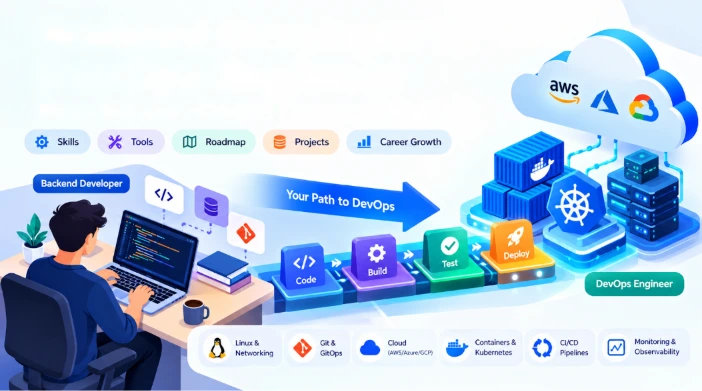
If you write backend code for a living, a backend developer to devops engineer transition is closer than you might think. APIs, databases and Git are already part of your day, and so is the dread when production breaks at night. What you have likely touched less is what happens after the code is written: how it gets built, shipped, watched and repaired once real users depend on it.
Moving to DevOps keeps you in development: cloud infrastructure, containers, pipelines, automation and monitoring get added to what you already know. If you want a faster route, read AWS Lambda vs EC2, CI/CD pipeline best practices using GitHub Actions and Linux for cloud before you build your plan. The rest covers what to study, in what order, and how to prove it to a hiring manager.
Table of Contents
▼Why Backend Developers Transition Well Into DevOps
People entering DevOps from other fields first have to learn how software misbehaves once it is live. You already know: ugly stack traces, slow queries, long arguments about log formats and release nights where everyone goes quiet are all familiar.
The question you carry changes. A developer asks whether a feature works. In DevOps you ask whether it can be released safely, scaled, noticed when it fails and restored fast. That shift is the hard part, and the tools are easier to pick up afterwards.
- You know how an application fits together and how services rely on each other.
- Git is a daily habit, and code review is routine.
- You have spent plenty of time in logs, errors and performance problems.
- Databases, authentication and APIs are familiar ground.
- You have seen first-hand why deployments hurt developers.

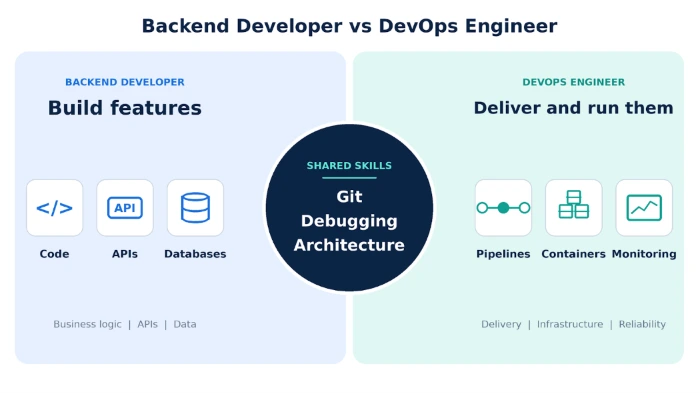
Backend Developer vs DevOps Engineer: What Changes
| Area | Backend Developer | DevOps Engineer |
|---|---|---|
| Focus | Business logic, APIs, data | Delivery, infrastructure and reliability |
| Deployment | Writes code that gets deployed | Designs and automates how it is deployed |
| Debugging | Application code | Code, networks, pipelines and infrastructure |
| Typical tools | Frameworks, databases | Docker, Kubernetes, Terraform, CI/CD |
| Success looks like | Working, fast features | Fast releases, high uptime, quick recovery |
The two roles share a large part of the work. What takes getting used to is owning everything from a commit until the code is running in production.
Core DevOps Skills You Need in 2026
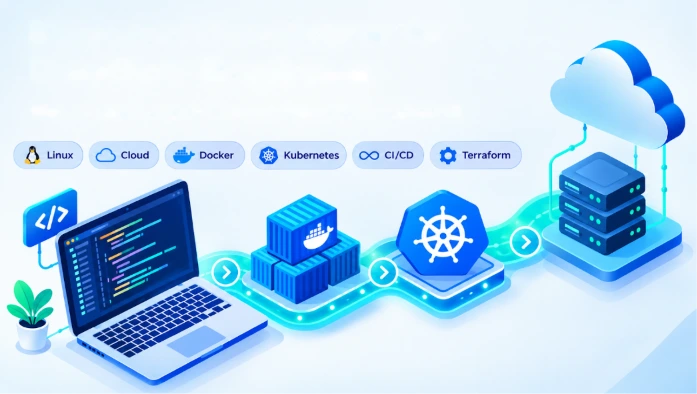
Collecting tool names gets you little. Choose a few areas and go deep on the parts that matter in real systems: Linux, networking, cloud basics, containers, pipeline automation, infrastructure as code, monitoring and security.
- Linux and networking: learn permissions, processes, systemd, SSH, package management, DNS, HTTP, TLS, firewalls, load balancers and the basic troubleshooting mindset used in production.
- Git workflows and GitOps: branch strategy, code review, environment configuration, and a source-of-truth model where Git controls changes to infrastructure and deployment state.
- One cloud, learned properly: choose AWS, Azure or GCP and go deep on compute, storage, databases, IAM and cost visibility before branching into a second provider.
- Containers and Kubernetes: Docker, image layers, registries, Compose, Pods, Deployments, Services, ConfigMaps, Secrets, Ingress, health probes and rolling updates.
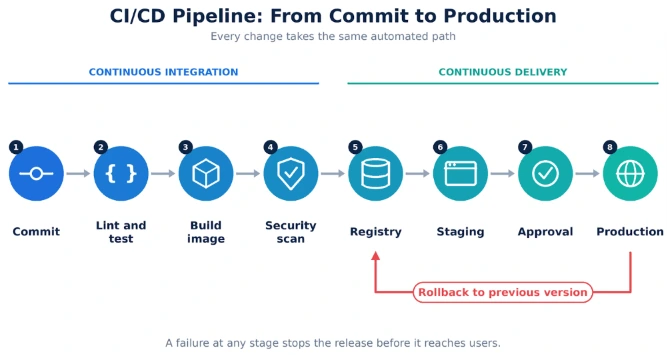
- CI/CD: build, test, scan, push, deploy, gate and approve across environments with confidence.
- Infrastructure as Code: Terraform and similar tools where servers, networks and permissions are described in files and reviewed like application code.
- Observability and reliability: logs, metrics, traces, SLOs, alerts, incident response and rollback habits.
- Security: least privilege, secrets handling, image scanning, patching and safe pipelines.
Essential DevOps Tools for Backend Developers
| Category | Tools |
|---|---|
| Version control | Git, GitHub, GitLab |
| CI/CD | GitHub Actions, GitLab CI, Jenkins |
| Containers | Docker, Podman |
| Orchestration | Kubernetes |
| Cloud | AWS, Azure, Google Cloud |
| IaC | Terraform, OpenTofu, Pulumi |
| Observability | Prometheus, Grafana, OpenTelemetry, Loki |
| Security | Trivy, Snyk, Vault |
| Scripting | Bash, Python |
For one sensible stack, take Linux, Git, Docker, Kubernetes, one cloud, Terraform, GitHub Actions and Prometheus with Grafana. It covers what most backend developers need to learn.
A 6-Month Backend to DevOps Transition Roadmap
- Months 1-2: Linux, shell scripting, networking and a good cloud-free-tier setup. Learn how to debug services, inspect processes and read logs without guessing.
- Months 2-3: choose one cloud and learn compute, storage, networking, IAM, load balancers and cost visibility. Build small, working systems rather than reading theory only.
- Months 3-4: Docker, containerization, Compose and Kubernetes basics. Deploy a service, expose it, scale it and troubleshoot a failed pod.
- Months 4-5: GitHub Actions or GitLab CI, Terraform and environment setup. Automate deployments and treat infrastructure as versioned code.
- Months 5-6: monitoring, alerts, logs, incident drills and security hardening. Add a portfolio project that shows deployment, rollback, cleanup and observability in one flow.
Practical Projects That Prove Your DevOps Skills
A good DevOps portfolio is a small set of systems that show how you think when a service is broken, overloaded or misconfigured.
- Deploy a backend app with a database, HTTPS and a load balancer in one cloud.
- Build a CI/CD pipeline that tests code, creates a container image and deploys to staging automatically.
- Write Terraform for a real environment and show the plan before applying changes.
- Run a containerized app in Kubernetes with health checks, resource limits and a rollback path.
- Add Prometheus or Grafana dashboards and a basic alert for latency or error rate.
The best project mirrors your current work. If you already build APIs, deploy that app to a cloud environment, then add the missing pieces: networking, IAM, logs and automation. It makes the most believable story on a résumé.
How to Position Yourself for DevOps Roles
Knowing Docker does not make you a DevOps engineer, and employers want proof that you can manage the path from commit to production. Reframe your backend experience in terms of release readiness, troubleshooting, service reliability and automation.
A better way to write your resume
Instead of saying, 'Built Node.js APIs and managed PostgreSQL,' say, 'Built and deployed backend services with CI/CD automation, environment configuration, log analysis and service health monitoring in production.'
If your current role includes a pipeline, deployment task, incident response or environment setup, call that out clearly. A backend developer already has several of the skills DevOps teams want, especially when they can show them in public projects or real work.
Conclusion
The move from backend developer to DevOps engineer extends the same engineering thinking to the system around the application: delivery, reliability, security and automation. If you know the app layer, you have the right starting point. Learn the operating layer, build a project that proves it, and talk about outcomes as well as tools.
FAQs
1. Can a backend developer become a DevOps engineer without starting from scratch?▼
Yes. In many cases, backend developers already have the biggest advantage: they understand how services behave under load, how logs and errors matter, and how systems fail in production. The missing knowledge is mainly around cloud setup, automation, release flow and operations work.
2. Do I need to learn Kubernetes right away?▼
Not necessarily. A good first plan is Linux, networking, one cloud, containers and CI/CD. Kubernetes belongs in the roadmap once you can deploy and debug a containerized application without relying on the platform to hide everything.
3. Should I focus on AWS, Azure or Google Cloud first?▼
Pick one and finish real work on it. AWS and Azure are common choices in India because of documentation, hiring volume and learning material. Choose based on the job market where you live and the toolchain your teams already use.
4. Is a DevOps role mostly scripting and infrastructure?▼
It is partly that, but it is also product thinking. You are designing systems that help code deploy safely, recover quickly and stay observable. Backend developers already understand the application side of that conversation.
5. How long does the transition usually take?▼
A focused six-month path is realistic for a backend developer who already has strong coding and troubleshooting habits. The main requirement is consistency.
Want a first look at how this path fits your current role?Click here to take a free Cloud & DevOps demo