
Can You Prepare for AWS, Azure, Kubernetes & AI Certifications Through One Learning Path?
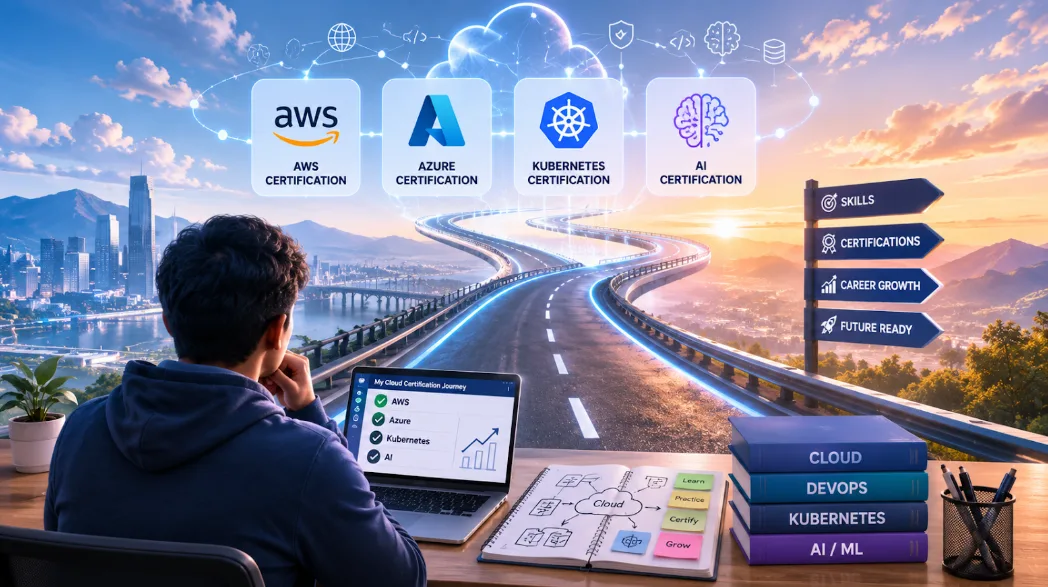
Four certification tabs open. AWS. Azure. Kubernetes. Some kind of AI credential. And one question: do you really need four separate plans?
No. You need one Cloud Certification Path — a single roadmap where AWS Certification, Azure Certification, Kubernetes Certification, and AI Certification are checkpoints, not competing destinations.
Here's that roadmap: a 12–24 month plan, a look at how much these four areas actually overlap, and sample paths by role — so you stop guessing and start studying.
Table of Contents
▼1. Why a Unified Cloud Certification Path Makes Sense in 2026
Most companies aren't single-cloud anymore. AWS here, Azure there — often just because of mergers or history. Know only one platform, and you're only useful for half the conversation.
Kubernetes sits underneath most of it. EKS, AKS, self-managed — pods and deployments work the same everywhere. Learn it once, work across clouds.
AI rides the same rails. Models get trained, served, and deployed as containerized workloads — not isolated data-science side projects.
That's the case for one combined path instead of four:
- Less duplicated effort — learn a concept once, reuse it everywhere
- Faster time to job-ready — no restarting from zero each time
- A stronger resume story — "multi-cloud, cloud-native, AI-aware" beats "passed one exam in 2023"
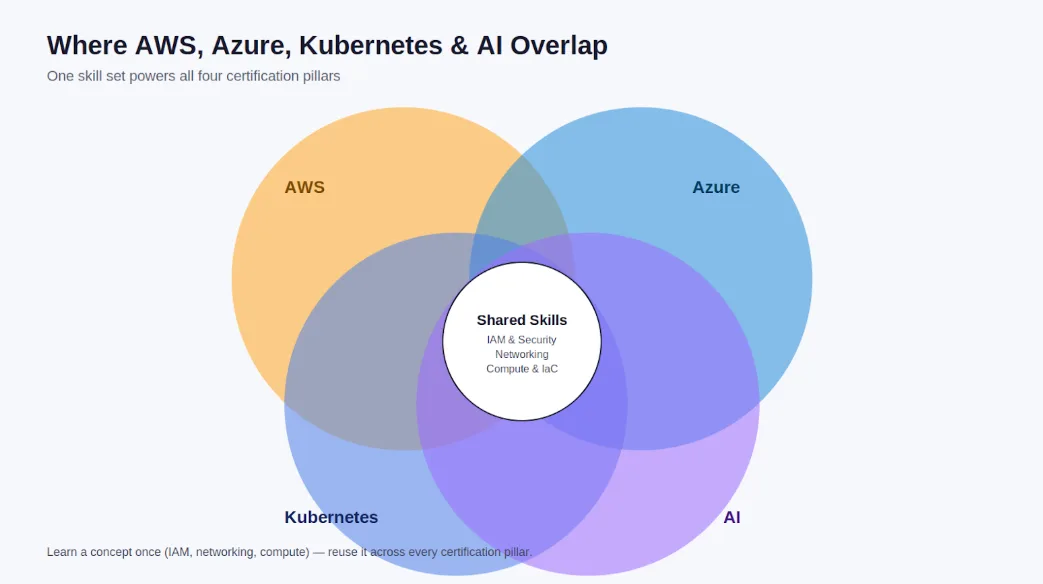
2. The Four Pillars: AWS, Azure, Kubernetes, and AI Certifications
Four pillars, one roof. Build them in sequence, not isolation.
AWS Certification Pillar
- Foundational: Cloud Practitioner (CLF-C02), or AI Practitioner (AIF-C01) if you're AI-first
- Core: Solutions Architect – Associate (SAA-C03) — the real starting line for most engineers. If you're prepping for interviews around this stage, MicroDegree's AWS services cloud engineer interview guide is worth a read.
- Advanced/specialty: Developer – Associate, DevOps Engineer – Professional, Machine Learning Engineer – Associate (MLA-C01), Generative AI Developer – Professional
⚠️ Heads up: the old Machine Learning – Specialty exam retired March 31, 2026. The current AI route is AI Practitioner → ML Engineer Associate → Generative AI Developer Professional.
Azure Certification Pillar
- Foundational: AZ-900, AI-900
- Core: AZ-104 (Administrator) or AZ-305 (Architect)
- Specializations: AZ-400 (DevOps), AI-103 (AI Apps and Agents Developer)
⚠️ Two exams are mid-transition: AI-102 retired June 30, 2026 (replaced by AI-103, built around agents and generative AI), and AZ-500 retires August 31, 2026 (replaced by SC-500). Study the current exams, not the outgoing ones.
Azure mirrors AWS closely enough that adding it second is much faster than starting cold.
Kubernetes Certification Pillar
CNCF runs five exams — two multiple-choice, three hands-on:
- Entry: KCNA — Kubernetes and Cloud Native Associate (general fundamentals) or KCSA — Kubernetes and Cloud Native Security Associate (security-focused)
- Hands-on: CKA (administration), CKAD (application development), CKS (security — requires a valid CKA first)
- Bonus: under CNCF's CARE program (Certification Advancement & Recertification Experience, fully live by June 2026), passing or recertifying CKA or CKAD auto-renews KCNA. Passing or recertifying CKS auto-renews KCSA, and since June 18, 2026, it can also extend or reinstate CKA — which then renews KCNA too. One less set of expiry dates to track.
This pillar is the bridge: the same skills apply whether you're running EKS or AKS. Once you're past the exam and running real workloads, MicroDegree's guide on Kubernetes in production best practices is a useful next read.
AI Certification Pillar
- Concepts: AI Practitioner (AWS), AI-900 (Azure)
- Implementation: ML Engineer – Associate, Generative AI Developer – Professional (AWS); AI-103 (Azure)
The connective thread is deployment — models increasingly ship as containerized workloads, which loops straight back to Kubernetes.
Together: one backbone, four labels.
3. A Practical Certification Roadmap
Phase 1: Foundations
Pick a primary cloud based on your job or job market. Do Cloud Practitioner or AZ-900, add AI-900/AI Practitioner if AI is on your radar. Brush up on Linux, networking, and Git alongside it.
Phase 2: Core Engineer or Architect
Go deep: SAA-C03 or AZ-104. Build 2–3 real projects — Terraform, a CI/CD pipeline, a containerized app. Start poking at EKS or AKS.
Phase 3: Kubernetes + DevOps
KCNA first if Kubernetes is new, then CKA. Learn Helm, GitOps, monitoring, basic security. Maps directly to DevOps Engineer Professional or AZ-400.
Phase 4: AI & Specialization
ML Engineer Associate or Generative AI Developer Professional (AWS), or AI-103 (Azure). Practice deploying models on Kubernetes, basic MLOps, RAG — the stuff interviews actually ask about.
Phase 5: Cross-Cloud & Advanced
Add your second cloud's core cert (AZ-104/AZ-305 if you started AWS, or vice versa). Optional: Solutions Architect Professional, an Azure Expert cert, or CKS.
Five phases in sequence: not four certificates — one connected skill set.
4. How Skills Overlap Across AWS, Azure, Kubernetes, and AI
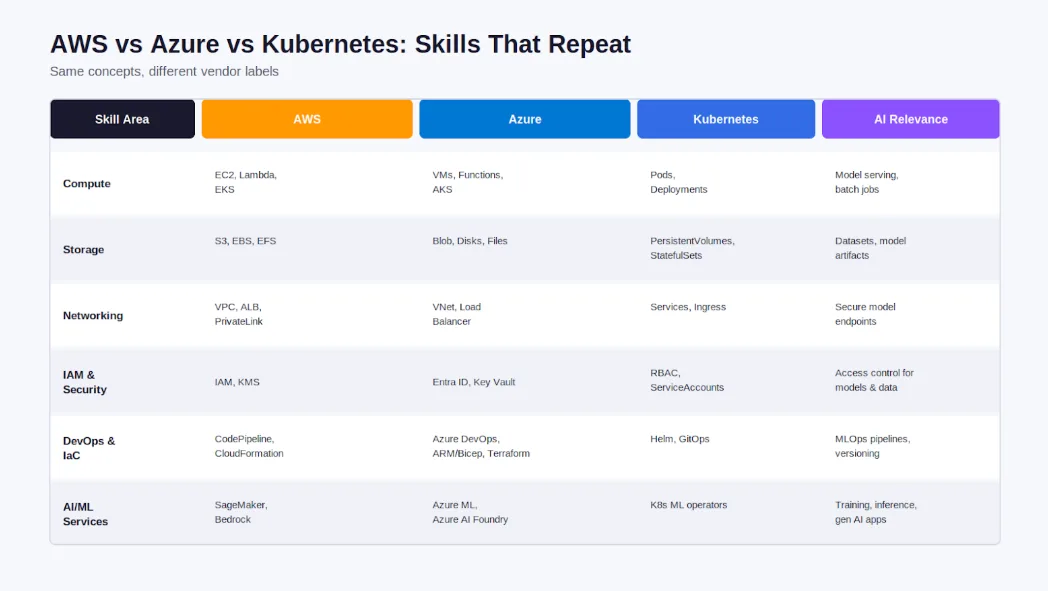
Learn AWS IAM, and Entra ID clicks almost instantly — same model, different name. Same story with VPCs → VNets → Kubernetes Services.
One path, four vendor labels on the same ideas.
5. Sample Learning Paths by Role
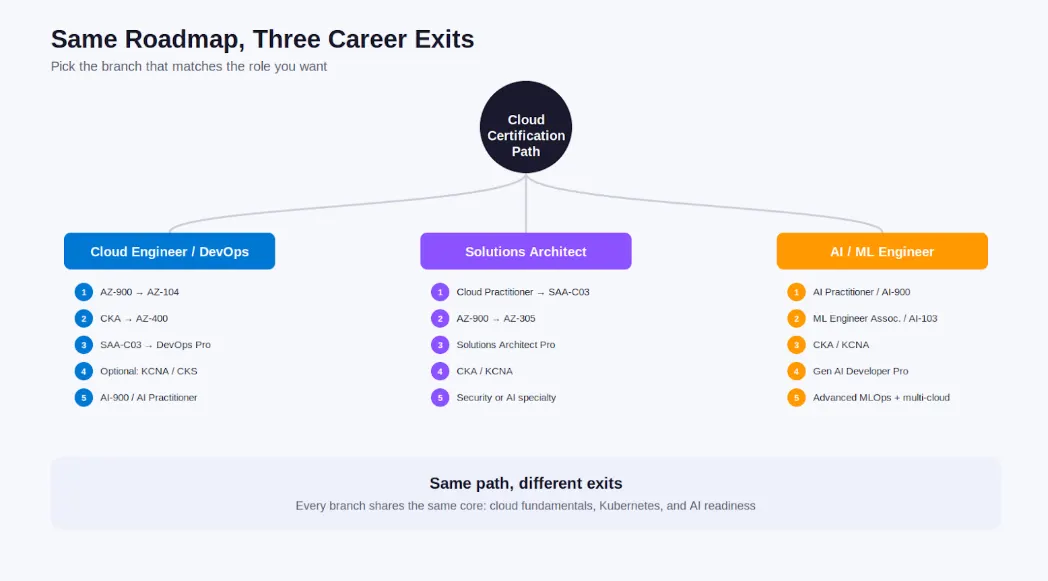
- Cloud Engineer / DevOps: AZ-900 → AZ-104 → CKA → AZ-400 → SAA-C03 → DevOps Engineer Professional → (optional) KCNA/CKS. Sprinkle in AI-900 or AI Practitioner plus a small MLOps project.
- Solutions Architect: Cloud Practitioner → SAA-C03 → AZ-900 → AZ-305 → Solutions Architect Professional → CKA/KCNA → a security or AI specialty. Heavy on design, lighter on hands-on build.
- AI/ML Engineer: AI Practitioner or AI-900 → ML Engineer Associate or AI-103 → CKA/KCNA → Generative AI Developer Professional → advanced MLOps + multi-cloud deployment.
Same path, different exits.
6. Career Impact
Multi-cloud shops want engineers who move between AWS and Azure without a ramp-up. This roadmap signals exactly that — plus Kubernetes fluency and AI readiness on top. If you're still weighing which cloud to prioritize, MicroDegree's comparison of AWS vs Azure vs GCP career growth in 2026 breaks down where the demand is headed.
Result: you're not "the AWS person" boxed into one lane. You're qualified for cloud engineer, DevOps, solutions architect, platform engineer, and increasingly AI/ML engineer roles — the profile most senior positions actually want.
7. Conclusion
Four certifications, one road. Start with the foundations, go deep on one cloud, use Kubernetes as your bridge layer in AI, then extend into cloud number two.
Follow that order, and 24 months from now you won't just have four credentials — you'll have one skill set employers are actually hiring for.
8. FAQs
Q1: Is there really a single Cloud Certification Path for AWS, Azure, Kubernetes, and AI?▼
Yes — the exams differ, but concepts like IAM, networking, and IaC overlap enough that one roadmap covers all four.
Q2: Which certification should I start with: AWS or Azure?▼
Whichever your employer uses or your job market demands. The second cloud always comes faster.
Q3: Do I need Kubernetes Certification if I already have AWS or Azure certs?▼
Yes, if cloud-native or DevOps roles interest you — Kubernetes is the common runtime layer across both clouds.
Q4: Are AI certifications worth it for cloud engineers who aren't data scientists?▼
Yes. AI Practitioner and AI-103 validate skills now showing up in cloud engineering job descriptions, not just data science ones.
Q5: Can I prepare for AWS, Azure, Kubernetes, and AI certifications at the same time?▼
It's better not to prepare for all four simultaneously. Start with one primary cloud, build your core cloud skills, then move to Kubernetes and AI. Once your fundamentals are strong, adding a second cloud becomes much easier because many concepts overlap.
Not sure where to start? Explore MicroDegree's Cloud, DevOps, and AI Agents paths to find the sequence that fits your background — or drop a comment with your current role and target certification, and we'll help map out a personalized version of this roadmap.
Know someone stuck choosing between AWS, Azure, Kubernetes, and AI certs? Send this their way.