
Cloud Certification Roadmap 2026: Which Global Certification Should You Take First?
If you're trying to move into cloud computing and you've started researching which exam to take first, you've probably noticed that every guide points somewhere different. Pick the wrong one first, and you waste months of study time and a few hundred dollars in exam fees on something that doesn't match the job you actually want.
This cloud certification roadmap 2026 lays out exactly which platform to pick, which certification comes first, and what order to take exams in — whether you're headed toward cloud administration, DevOps, security, or architecture.
Table of Contents
▼Why Your First Certification Choice Matters
Many recruiters and hiring managers read certification names as signals — an AWS Certified Solutions Architect suggests a different profile than an Azure Administrator, even if the underlying skills overlap.
Most professionals don't fail because they picked a "bad" certification. They fail because it didn't match the job they were applying for, or because they jumped to an associate-level exam before they had the foundational knowledge to make sense of it.
A proper roadmap fixes both: it matches your path to your target role, and it sequences exams so each one builds on the last.
The Cloud Certification Roadmap at a Glance
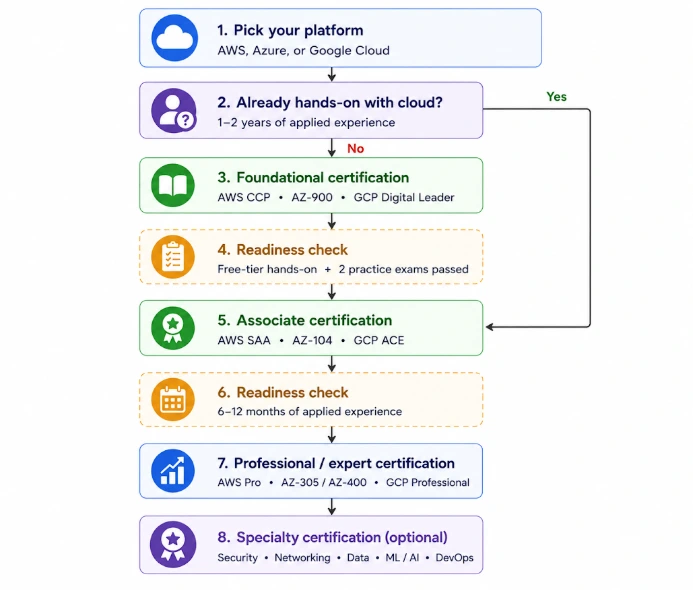
Everything below walks through that exact path, one step at a time.
Step 1: Decide Your Platform
Before comparing exam names, decide which cloud platform to commit to first. Chasing certifications across three platforms at once dilutes your effort thin and makes your resume harder to read.
Use these signals to decide:
- Job postings in your target market. Search for the roles you want and note which platform appears most — AWS, Azure, or Google Cloud (GCP).
- Your current employer's stack. If your company already runs on Azure, an Azure certification pays off immediately at work, not just on your resume.
- Consider market share. AWS still holds the largest share of enterprise cloud workloads globally; Azure leads in organizations already built around Microsoft tools. GCP has strong traction in data engineering, analytics, and Kubernetes-heavy environments.
If none of that points clearly in one direction, AWS is the safest default — it has the broadest job market presence and the most mature certification ecosystem.
Step 2: Which Cloud Certification Should You Take First?
If you're new to cloud, start with a foundational-level certification on your chosen platform. If you already have 1-2 years of hands-on experience administering cloud infrastructure, skip it and go straight to an associate-level certification instead.
| Your Experience Level | Start Here |
|---|---|
| New to cloud / No hands-on experience | Foundational certification: AWS Certified Cloud Practitioner (CLF-C02) for AWS, Microsoft Certified: Azure Fundamentals (AZ-900) for Azure, Google Cloud Digital Leader for GCP |
| 1–2 years hands-on cloud experience | Associate certification: AWS Solutions Architect – Associate, Azure Administrator Associate (AZ-104), or GCP Associate Cloud Engineer |
Foundational exams are built to validate conceptual knowledge for people who haven't touched the platform, not for people who already operate the platform daily.
Is a foundational certification a waste of time if I already know the basics?
Not necessarily. If you can pass it in one attempt without dedicated study, it's a low-cost signal that takes a weekend to prepare for. It only becomes a waste of time if you need weeks of study for content you'll rarely use day-to-day — in that case, put that time into the associate-level exam instead.
Readiness check before moving on: you're ready to leave the foundational tier once you've spent hands-on time in the platform's free tier and passed at least two full-length practice exams above the passing threshold.
Here's the foundational tier broken down by exam:
| Certification | Exam Code | Cost (USD) | Format | Validity |
|---|---|---|---|---|
| AWS Certified Cloud Practitioner | CLF-C02 | $100 | 65 questions, 90 min | 3 years |
| Microsoft Certified: Azure Fundamentals | AZ-900 | Varies by region | ~45 minutes, assessment-based | Never expires |
| Google Cloud Digital Leader | — | ~$99 | 50–60 questions, 90 min | 3 years |
Exam fees and formats are set by AWS, Microsoft, and Google and can change. Always confirm current pricing on the official certification pages before scheduling.
Step 3–5: Associate, Professional, and Specialty
Once you're past the foundational tier — or you've skipped it because you already qualified — here's how the rest of the roadmap breaks down by platform and tier.
| Platform | Associate | Professional / Expert | Specialty (optional) |
|---|---|---|---|
| AWS | Solutions Architect – Associate, CloudOps Engineer – Associate (SOA-C03), or Developer – Associate | Solutions Architect – Professional, or AWS Certified DevOps Engineer – Professional | Security, Networking, Machine Learning, or Data Analytics Specialty |
| Administrator Associate (AZ-104). For a developer or security path, check Microsoft Learn's current certifications — AZ-204 and AZ-500 are retiring in 2026 (see note above) | Solutions Architect Expert (AZ-305), or DevOps Engineer Expert (AZ-400) | Security, networking, or data specialty tracks | |
| GCP | Associate Cloud Engineer | Professional Cloud Architect, Professional Cloud DevOps Engineer, Professional Data Engineer, Professional Cloud Security Engineer, or Professional Cloud Network Engineer | Not applicable — Google Cloud doesn't have a separate specialty tier; security, networking, and data roles sit within the Professional tier |
Two Azure exams are in transition as of August 2026: AZ-204 (Developing Solutions for Microsoft Azure) retired on July 31, 2026. Its replacement is AI-200: Developing AI Cloud Solutions on Azure, which leads to the Microsoft Certified: Azure AI Cloud Developer Associate credential. AI-200 has a stronger focus on AI/LLM integration and AI pipelines than the old AZ-204.
AZ-500 (Security Engineer Associate) retires on August 31, 2026 — its replacement is SC-500 (Cloud and AI Security Engineer Associate). If you're mid-prep for either, check Microsoft Learn's retired exams page before you commit further study time.
Two checkpoints to hold yourself to as you move through this table:
- Foundational → Associate: give yourself 6–10 weeks between exams if you're studying part-time around a full-time job.
- Associate → Professional: spend 6–12 months actually applying the associate-level skills on the job before you book the professional exam. Don't stack certifications back-to-back without applying what you learned; hands-on practice between exams is what makes the knowledge stick.
- Specialty certifications are the one optional branch in the roadmap for AWS and Azure. Pursue one only if a specific role demands it; most professionals get their strongest career return by stopping at professional or expert level.
How Much Do Cloud Certifications Cost in 2026?
Foundational certifications cost around $99–$100, though Azure exam prices vary by country or region. Associate certifications run $125–$165, with Azure again varying by region. Professional and expert-level exams cost the most, at roughly $200–$300.
| Tier | Typical Cost (USD) | Typical Validity | Before You Move to the Next Tier |
|---|---|---|---|
| Foundational | $99–$100 (Azure varies by region) | 3 years (AWS/GCP); never expires (Azure Fundamentals) | Free-tier hands-on + 2 practice exams passed |
| Associate | $125–$165 (Azure varies by region) | 3 years (AWS/GCP), annual renewal assessment (Azure role-based) | 6–12 months of applied, on-the-job experience |
| Professional / Expert | $200–$300 | 3 years (AWS), 2 years (GCP Professional), annual renewal assessment (Azure role-based) | Only add a specialty exam if your role requires it |
Exam fees and formats are set by AWS, Microsoft, and Google and can change. Always confirm current pricing on the official certification pages before scheduling.
Real-World Career Paths Mapped to Certifications
| Current Role | Recommended Certification Path |
|---|---|
| Application Support Engineer → Cloud Operations | AWS Cloud Practitioner → CloudOps Engineer Associate → DevOps Engineer Professional |
| System Administrator → Azure Infrastructure | AZ-900 → AZ-104 → AZ-305 |
| QA Engineer → DevOps | AWS Cloud Practitioner or AZ-900 → DevOps Engineer Professional or AZ-400, paired with hands-on CI/CD tooling practice |
| Network Engineer → Cloud Networking | AWS Cloud Practitioner → Advanced Networking Specialty, or AZ-900 → Network Engineer Associate (AZ-700) |
| Developer → Cloud-Native Development | AWS Developer Associate or Microsoft's current developer certification (AZ-204 retired July 31, 2026 — check Microsoft Learn for the AI-200 replacement path) — skip the foundational exam if you already code against cloud SDKs |
Best Practices for Building Your Roadmap
- Commit to one platform before collecting certifications. Switching platforms after every exam resets your credibility with recruiters instead of building on it.
- Treat the readiness checkpoints above as gates, not suggestions — don't book the next exam until you've actually hit the applied-experience bar.
- Space certifications out rather than cramming two exams back-to-back. The gap between exams is where the skills transfer from "passed a test" to "can do the job."
- Add a specialty certification only once a specific job description asks for it, not before.
- Before booking any exam, verify its current name, exam code, and retirement date on the official certification page. Several Azure and AWS exams changed or retired in 2025–2026.
- For Google Cloud specifically, remember that Professional certifications are valid for 2 years from the date you certify, while Foundational and Associate certifications are valid for 3 years.
Career Impact of Cloud Certifications
Cloud certifications don't guarantee a job on their own, but they consistently do two things: they get your resume past automated applicant tracking filters that screen for specific credentials, and they give you a structured way to close skill gaps before you're tested on them in an interview. Professionals who pair a certification with genuine hands-on practice on projects tend to see the clearest career movement — not the certification badge by itself.
Conclusion
The right cloud certification roadmap isn't about collecting badges — it's about matching each exam to the role you're actually building toward, on the platform your target employers already use. Start with a foundational certification on one platform, move to the associate-level exam that fits your role, and only then consider professional or specialty credentials.
If you're still unsure where to begin, default to the AWS Certified Cloud Practitioner or Azure Fundamentals (AZ-900) — both are affordable, respected across the industry, and structured to prepare you for the associate-level exam that follows. Whichever cloud certifications you choose to start a cloud career in 2026, consistency in one direction will get you further than switching platforms every few months.
Ready to put this roadmap into action? Start with a free skills assessment on the MicroDegree platform to see which cloud path fits your current experience, or explore our AWS and Azure certification prep courses built specifically for working IT professionals. Have questions about your own certification path? Drop them in the comments — we read every one.
FAQs
1. Which cloud certification should I take first in 2026?▼
For most working IT professionals, a foundational certification on one platform — AWS Certified Cloud Practitioner or Azure Fundamentals (AZ-900) — is the right starting point. Choose the platform used most in your target job market or current employer's stack, then move to an associate-level certification once you've built hands-on experience. Before you register, check the official certification pages for exam retirements or replacements — Azure's developer and security paths changed in 2026.
2. Is AWS, Azure, or GCP certification better for a cloud career?▼
No single platform is universally "better." AWS has the broadest job market presence, Azure fits organizations already using Microsoft tools, and GCP suits data engineering and Kubernetes-focused roles. The best choice depends on the job market and tech stack you're targeting.
3. How long does it take to complete a full cloud certification roadmap?▼
A foundational-to-associate path typically takes 3–6 months of part-time study for working professionals. Reaching professional or expert level usually takes 12–18 months total, including hands-on project work between exams.
4. Do cloud certifications expire?▼
AWS certifications are generally valid for three years and require recertification to maintain status. Google Cloud's Foundational and Associate certifications are valid for three years, while Professional certifications are valid for two years. Microsoft's Azure Fundamentals (AZ-900) doesn't expire, and most role-based Azure certifications (Associate and Expert) are renewable annually via a free online assessment.
5. Can I skip the foundational exam and go straight to an associate-level certification?▼
Yes, if you already have hands-on cloud experience. Foundational exams like AWS Cloud Practitioner and AZ-900 are designed for conceptual learners; if you already administer cloud resources at work, an associate-level exam is a better use of your study time.