
DevOps Interview Questions Every Working Professional Should Practice
You already know the tools — you've deployed pipelines, fixed 2 a.m. build failures, and kept production running while everyone else slept. So why does the interview still throw you off? Usually, it's not a skills gap — it's that most people never practice saying what they know out loud, under pressure.
This guide pulls together the DevOps interview questions that actually come up at product companies, service companies, and fast-hiring cloud-first shops, written for people already working in IT. Go through it once, and you'll know what's coming, how to frame your answers, and where candidates usually trip up.
Table of Contents
▼What Interviewers Actually Look For
Before memorizing a single answer, it helps to know what's actually being evaluated.
Most interviewers don't care whether you can recite a textbook definition. What they're really probing for is:
- Whether you're explaining your own reasoning, or just naming a tool and hoping that's enough
- Whether you've actually touched the pipeline, or only read about it in a blog post
- How you behave when something breaks, because in DevOps, something always eventually breaks
Keep that lens on as you go through the questions below. A technically correct answer with zero context rarely lands well with someone who's been on-call themselves.
Core DevOps Interview Questions and Answers
1. What is DevOps, and why does it matter to your organization?
At its core, DevOps is a way of working that pulls development and operations closer together — automating the repetitive parts, feeding feedback back into the process quickly, and making sure no single team owns "success" or "failure" alone. Don't answer this with a dictionary definition. Talk about what it actually changes: faster releases, fewer 3 a.m. pages, and teams that used to throw work over a wall now actually talking to each other.
2. What's the real difference between Continuous Integration, Continuous Delivery, and Continuous Deployment?
This one trips up more candidates than it should.
- Continuous Integration is about merging code often and letting automated tests catch problems early.
- Continuous Delivery gets every change ready to ship, but a human still has to click "go."
- Continuous Deployment removes that click — anything that passes the pipeline goes live on its own.
That last distinction, delivery versus deployment, is exactly where most people fumble in an interview. Say it out loud a few times before you walk in.
3. What is Infrastructure as Code, and why does it actually matter?
Instead of clicking through a console to set up servers by hand, you write configuration files that describe what the infrastructure should look like — and tools like Terraform or AWS CloudFormation build it for you. The real payoff isn't the automation itself; it's that changes get reviewed, versioned, and repeated exactly, so environments stop quietly drifting apart from each other over time.
4. How is configuration management different from orchestration?
They sound similar but solve different problems. Configuration management — think Ansible, Chef, or Puppet — keeps individual servers in a known, consistent state. Orchestration, which is really Kubernetes' job, decides how containers and services run, scale, and talk to each other across a whole system. Most real environments use both, not one instead of the other.
CI/CD, Containers, and Kubernetes Interview Questions
5. Walk me through how you'd design a CI/CD pipeline for a microservices application.
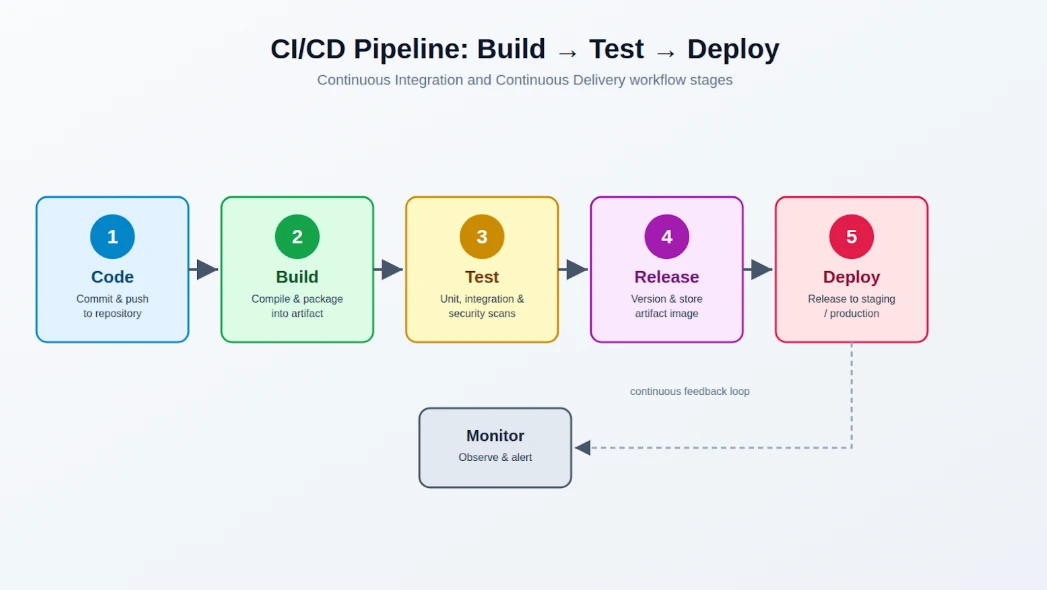
Don't just list tool names. A good answer moves through the actual flow: something triggers a build from source control, tests run, an artifact gets packaged, it gets scanned for security issues, and then it moves through staged environments with a rollback plan sitting in the background the whole time. If you've used Jenkins, GitHub Actions, GitLab CI, or Azure DevOps, say so — and better yet, mention one real trade-off you made, like picking blue-green deployment over a slower rolling update.
If you want to strengthen your understanding before the interview, review this CI/CD fundamentals guide from MicroDegree.
6. A deployment just failed in production. What do you do?
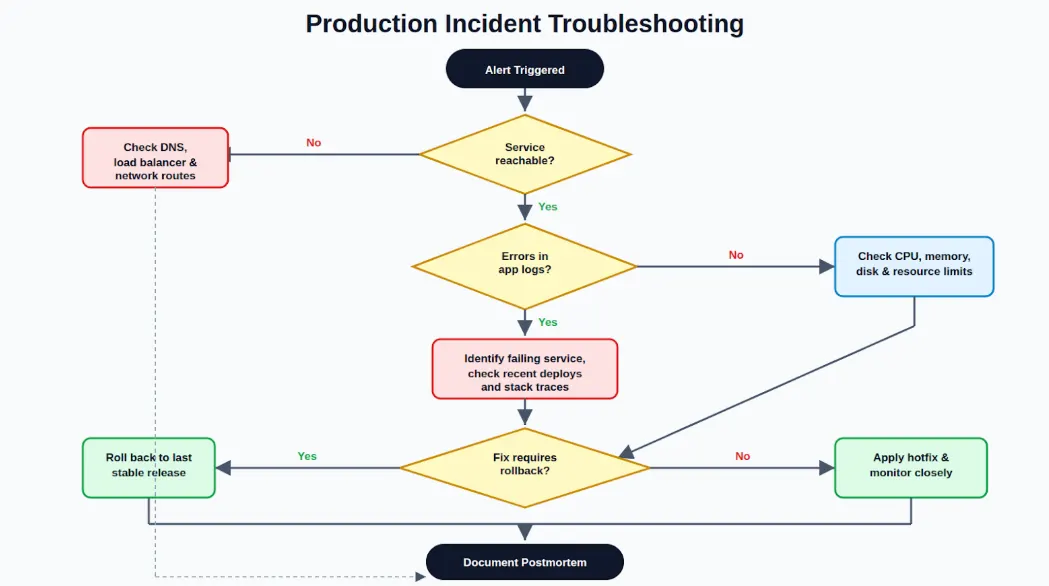
Roll back first, investigate second. That order matters, and interviewers are listening for it specifically — they want to know you'll restore service before you start chasing the root cause.
7. What's a build artifact, and why shouldn't it be rebuilt separately for every environment?
It's the packaged output of a build — the thing that actually gets tested and deployed. If you rebuild it fresh for staging and again for production, you're no longer testing what you're shipping. The same artifact should move through every stage untouched.
8. What's the difference between a container and a virtual machine?
Containers share the host's operating system kernel and only package the app plus its dependencies, which keeps them light and quick to start. VMs bring along a full guest OS, so they're heavier but more isolated. It's usually the opening question in this section, and it's mostly checking whether you understand that trade-off.
9. Explain Kubernetes Pods, Deployments, and Services — in plain terms.
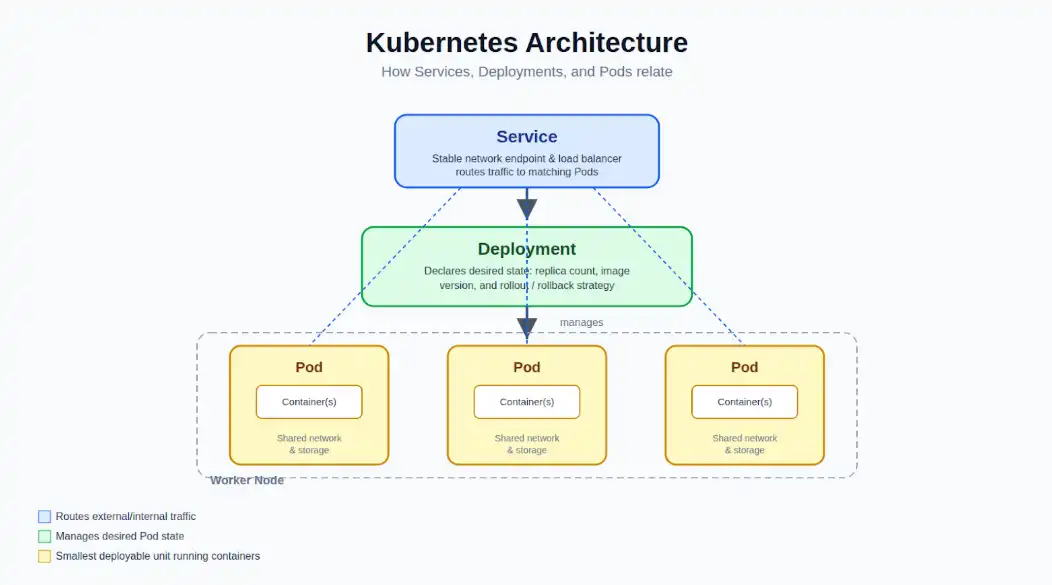
- Pod — the smallest thing you deploy. Usually one container, sometimes a couple that need to run tightly together.
- Deployment — keeps the right number of Pod replicas running and handles rolling updates without you babysitting it.
- Service — gives your Pods one stable address to be found at, even as the actual Pods behind it get replaced constantly.
For deeper hands-on preparation, you can also explore MicroDegree's Kubernetes course, which covers Kubernetes from basics to advanced concepts.
10. How does Kubernetes actually handle scaling?
Two separate mechanisms, and interviewers like to see if you know which does what:
- The Horizontal Pod Autoscaler adds or removes Pods based on CPU, memory, or a custom metric you define.
- The Cluster Autoscaler adds or removes entire nodes when there isn't enough room left to schedule new Pods.
This question tends to show up right after Pods, Deployments, and Services — not because it's harder, but because it tests whether you understand how those pieces actually cooperate under load, not just what each one means on its own.
Cloud, Infrastructure, and Monitoring Questions
11. How would you choose between AWS, Azure, and GCP for a project?
There's genuinely no universal right answer here, and interviewers know it. What they want is your reasoning: what skills the team already has, how mature each provider's relevant services are, what it'll cost, and whether compliance requirements rule anything out.
12. What's the shared responsibility model in cloud security?
The cloud provider locks down the infrastructure underneath — physical security, the hypervisor, that layer. Everything above that, your data, your access controls, how you configure things, is on you. A surprising number of cloud security incidents come down to someone assuming the provider had that second half covered.
13. How do you handle secrets in a DevOps pipeline?
Never in plaintext, never hardcoded, never sitting in a config file that gets committed to a repo. Use a dedicated secrets manager — AWS Secrets Manager, Azure Key Vault, HashiCorp Vault — and pull secrets in at runtime with access scoped as tightly as you can get away with.
14. What's the actual difference between monitoring, logging, and tracing?
People use these words loosely, but they're not interchangeable:
- Monitoring watches metrics like CPU, memory, and latency over time.
- Logging captures individual events for debugging or audits after the fact.
- Tracing follows one specific request as it hops across services, which is how you find out exactly where the delay is happening.
15. How do you set up alerting without burning out your team with noise?
Alert on things that actually affect users, not every metric that twitches. Set thresholds that mean something, group alerts that belong together, and route them automatically to whoever can actually act on them.
Scenario-Based DevOps Interview Questions
16. Your deployment succeeded, but the app isn't responding. Where do you start?
Logs first, then health checks, then load balancer and network config, then resource limits. Walk through it in that order out loud — the interviewer is watching your process, not just waiting for the right final answer.
17. Your CI pipeline suddenly takes three times as long. What's the first thing you check?
What changed recently. Look at pipeline config edits, dependency downloads that might be pulling more than usual, a test suite that's quietly grown, or shared runners that are maxed out. Most real incidents get solved by asking "what changed" before anything else — this question is testing whether that's your instinct too.
Common Mistakes, Expert Tips, and Career Impact
A few patterns show up again and again in weaker interviews:
- Reciting a definition instead of explaining how it played out in real work
- Dropping tool names without saying why that tool, specifically
- Skipping over security or cost when talking through architecture decisions
- Jumping straight into an answer on a scenario question instead of asking one clarifying question first
- Forgetting to mention monitoring or rollback when describing a deployment
On the flip side, a few things consistently help candidates stand out:
- Have two or three real incidents ready to go, and practice telling each one in under two minutes.
- Use the STAR method — Situation, Task, Action, Result — for anything behavioral or scenario-based.
- If you haven't used a tool in depth, just say that plainly. Interviewers trust clarity far more than a vague guess dressed up as confidence.
- Try explaining one of these concepts to someone outside tech. If you can't simplify it, you probably don't understand it as well as you think.
There's a bigger reason all this is worth the effort. DevOps roles are consistently among the better-paying, higher-demand positions in IT right now, largely because so few people can genuinely bridge fast-moving development with stable operations. Preparing properly for this interview isn't just about getting past one conversation — the same skills you're practicing (clear communication, structured troubleshooting, staying level-headed under pressure) are exactly what the job demands every day after you're hired.
Conclusion
Passing a DevOps interview isn't really about how many definitions you can recall. It's about whether you can talk through your own experience clearly, admit what you don't know, and walk an interviewer through your thinking instead of just your conclusion.
Treat this guide as a checklist, not a script. Work through each section, say your answers out loud, and pay attention to where you hesitate — that's usually exactly where you need more practice.
FAQs
1. What are the most commonly asked DevOps interview questions?▼
CI/CD pipelines, Docker and Kubernetes, Infrastructure as Code, cloud platforms, and troubleshooting scenarios come up in nearly every DevOps interview, regardless of company size.
2. How should a working professional prepare for a DevOps interview?▼
Lean on real projects instead of generic revision. Practice scenario-based troubleshooting out loud, and work through structured DevOps interview questions and answers rather than just re-reading documentation.
3. Are DevOps interviews more theoretical or practical?▼
At the working-professional level, mostly practical. Interviewers care far more about how you've applied a concept on the job than whether you can define it word-for-word.
4. How important are cloud platform questions in a DevOps interview?▼
Very. Since most infrastructure today runs on AWS, Azure, or GCP, interviewers generally expect solid working knowledge of at least one, alongside the core DevOps toolset.
5. What's the best way to actually practice DevOps interview questions?▼
Say your answers out loud, pull from real projects instead of hypotheticals, and run through scenario questions with a peer or mentor if you can. That combination — structured prep plus hands-on practice — beats passive reading by a wide margin.
Want to build the skills behind these answers, not just memorize the talking points? MicroDegree's hands-on DevOps and Cloud courses are built for working IT professionals who need real pipelines, real tools, and real scenarios — the kind of practice that shows up naturally in your next interview instead of sounding rehearsed.