
From DevOps to MLOps: How Much Can Your Salary Increase?

Quick Summary
Moving from DevOps to MLOps can increase your earning potential, but there is no fixed percentage or guaranteed salary jump. Current 2026 salary data shows that MLOps roles can sit above traditional DevOps roles at comparable experience levels, particularly when the engineer combines cloud, Kubernetes, CI/CD, machine learning and production model deployment skills. Public salary benchmarks currently place many Indian MLOps roles in the ₹8–35+ LPA range depending on experience and employer, while DevOps compensation varies widely across company types and seniority.
The bigger opportunity is not simply changing your job title. A DevOps engineer who learns how to deploy, monitor, version and operate machine learning systems can move toward MLOps, ML platform engineering and AI infrastructure roles.
If you already work in DevOps, you have probably wondered whether learning MLOps is worth the extra effort.
You already understand cloud infrastructure, CI/CD, Docker, Kubernetes, automation and monitoring. Now AI and machine learning teams need those same engineering practices for production models.
That creates an interesting career path:
DevOps → MLOps → ML Platform / AI Infrastructure
But how much can your salary actually increase?
The honest answer is that there is no universal percentage. Your experience, company, location, technical depth and actual responsibilities matter more than the title on your resume.
Table of Contents
▼What Changes in DevOps vs MLOps
DevOps focuses on delivering and operating software reliably. MLOps applies many of those engineering principles to machine learning systems, where you also have to manage models, training workflows, datasets and model performance.
Think of a normal application.
A DevOps engineer might automate its build, deploy it using Kubernetes and monitor CPU, memory, errors and latency.
Now consider a machine learning application.
The team has to deploy the application and manage the model behind it. They may need to track which model version is running, where it came from, what data was used, how it performs in production and when it should be replaced.
That is the additional layer MLOps introduces.
| Area | DevOps | MLOps |
|---|---|---|
| Main focus | Software delivery and operations | ML system lifecycle |
| Deployment | Applications | Models + applications |
| Versioning | Code | Code + models + experiments |
| CI/CD | Application pipelines | ML and model pipelines |
| Monitoring | Infrastructure and applications | Infrastructure + model behaviour |
| Common tools | Docker, Kubernetes, Terraform | Docker, Kubernetes, MLflow, cloud ML platforms |
This is why DevOps experience is valuable when moving into MLOps. You are not starting again. You are extending an existing engineering foundation into machine learning.

DevOps vs MLOps Salary in India
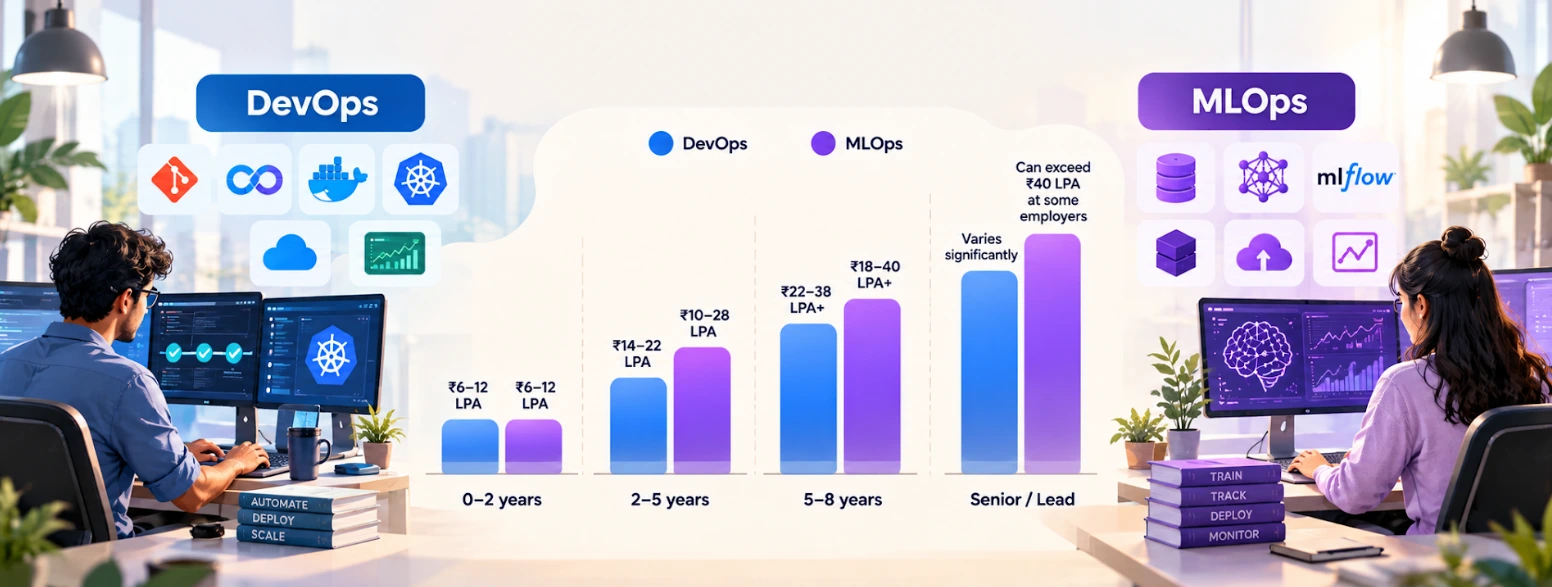
| Experience | DevOps: Indicative range | MLOps: Indicative range |
|---|---|---|
| 0–2 years | ₹6–12 LPA | ₹6–12 LPA |
| 2–5 years | ₹14–22 LPA | ₹10–28 LPA |
| 5–8 years | ₹22–38 LPA+ | ₹18–40 LPA+ |
| Senior / Lead | Varies significantly | Can exceed ₹40 LPA at some employers |
So when someone asks, “Does MLOps pay more than DevOps?”, the better answer is:
MLOps can offer higher compensation for specialized production-ML responsibilities, but simply changing from a DevOps title to an MLOps title does not guarantee a raise.
How Much Can Your Salary Increase
The potential increase depends mainly on what you add to your existing DevOps profile.
Imagine a DevOps engineer earning ₹10 LPA.
If that person moves into another DevOps position with almost identical responsibilities, there may be a normal job-switch increase. But if they develop strong skills in machine learning deployment, model serving, ML pipelines, Kubernetes and cloud-based ML infrastructure, they can start applying for a different category of roles. That changes the conversation.
The value comes from additional technical scope, not the word “MLOps” on the resume.
Why can MLOps roles command higher salaries?
Production machine learning requires more than deploying an API.
A team may need to:
- Track experiments
- Register and version models
- Automate training
- Deploy models
- Monitor production behaviour
- Roll back model versions
- Manage infrastructure
- Automate retraining
MLflow, for example, provides model tracking and registry capabilities, including versioning, lineage, aliases and deployment workflows.
This means an engineer who can connect cloud + DevOps + ML can potentially take responsibility for a broader production system.
That broader responsibility is where salary growth can happen.
What Skills Do You Need to Move Into MLOps
You do not need to abandon your DevOps skills.
Instead, build on them.
Start with Python and ML fundamentals
Python is widely used in machine learning workflows, so it becomes an important addition to a DevOps engineer's toolkit.
You should understand basic machine learning concepts such as:
- Training and validation
- Classification and regression
- Model evaluation
- Feature engineering
- Overfitting
- Model versioning
You do not necessarily need advanced data science expertise. You need enough understanding to work effectively with the ML lifecycle.
Learn production ML tools
Next, learn how a model moves from experimentation into production.
MLflow is useful here because it supports experiment tracking, model packaging, model registry and deployment workflows.
If you already know Docker and Kubernetes, you can then understand how ML models can be packaged and deployed using infrastructure you already understand.
Kubeflow is another relevant technology because it provides a Kubernetes-native stack for data and AI workloads.
Keep your cloud and DevOps foundation strong
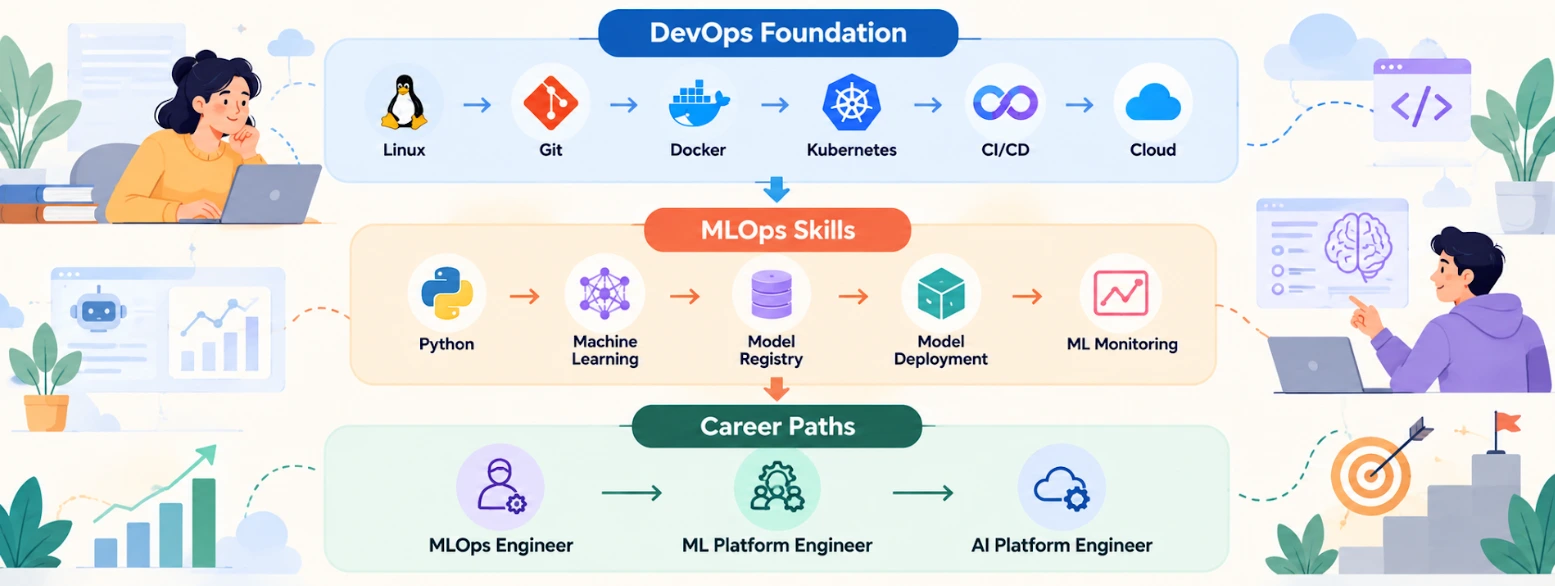
Your existing knowledge of:
Linux → Git → Docker → Kubernetes → CI/CD → Terraform → Cloud → Monitoring
still matters.
The goal is to connect it with:
Python → ML → Model Registry → Model Deployment → ML Monitoring
That combination creates a practical MLOps profile.
MicroDegree's learning platform can also be used to strengthen the underlying Cloud, DevOps, Kubernetes and AI skills before moving into more specialized MLOps work.
What MLOps Career Opportunities Can You Target
MLOps is not limited to one job title.
As companies build more production AI systems, related roles can include:
- MLOps Engineer: Builds and manages infrastructure and automation for ML deployment.
- ML Platform Engineer: Develops platforms that data scientists and ML engineers use to train and deploy models.
- AI Platform Engineer: Works on infrastructure supporting AI and generative AI applications.
- ML Infrastructure Engineer: Focuses on compute, containers, orchestration and scalable ML infrastructure.
- Cloud ML Engineer: Combines cloud engineering with machine learning deployment and operations.
The exact titles differ between companies. A job advertised as “AI Platform Engineer” at one company might have responsibilities very similar to an MLOps role at another.
That is why you should search by skills and responsibilities, not just job title.
How Can You Make the DevOps-to-MLOps Transition
The most practical approach is to build one complete production-style project instead of collecting dozens of disconnected tutorials.
For example, build a customer churn prediction system.
The workflow could look like:
Dataset → Model Training → MLflow Tracking → Model Registry → Docker → Kubernetes → API → Monitoring
This gives you something meaningful to discuss in an interview.
You can explain how you trained the model, tracked different versions, selected a model, packaged it, deployed it and monitored the service.
That is much stronger than simply saying, “I completed an MLOps course.”
A practical learning sequence
Start with your existing DevOps knowledge.
Then add Python and machine learning fundamentals.
After that, learn MLflow and model deployment. Once you are comfortable, connect the workflow to Kubernetes and cloud infrastructure.
Finally, build a complete project and document the architecture, deployment process and monitoring approach on GitHub.
For professionals looking to build practical skills across Cloud, DevOps, Kubernetes and emerging AI technologies, MicroDegree provides relevant learning resources through its FREE E-Learning Platform.
Conclusion
Moving from DevOps to MLOps can open up new career and salary opportunities, but there is no fixed salary increase you can expect. Your experience, company, location, and the kind of work you take on will all make a difference.
If you already work with cloud, Docker, Kubernetes, CI/CD, and infrastructure automation, you have a solid foundation. You don't have to start from scratch. The next step is to build on those skills by learning Python, machine learning basics, model management, MLflow, deployment, and monitoring.
The bigger opportunity is not simply changing your title from DevOps Engineer to MLOps Engineer. It is becoming someone who can take an ML system from development all the way to a reliable production environment.
If you're ready to build those skills, explore practical Cloud, DevOps, Kubernetes, and AI learning resources on the MicroDegree’s FREE E-Learning Platform.
FAQs
1. Can DevOps experience count as relevant experience for an MLOps job?▼
It can, depending on the employer and the job description. Experience with infrastructure, cloud platforms, CI/CD, containers, Kubernetes, monitoring, and automation can be relevant to MLOps positions. However, companies may also expect candidates to demonstrate knowledge of machine learning workflows and production model management.
2. Do MLOps engineers need to know mathematics?▼
You need a practical understanding of machine learning concepts, but an MLOps engineer does not necessarily need the same mathematical depth as a machine learning researcher. Understanding concepts such as model evaluation, training, validation and data drift is more important for many MLOps responsibilities.
3. Is MLOps a good career option for someone from a software background?▼
Yes. Software engineering, cloud engineering and DevOps are common foundations for moving toward MLOps because production ML systems require software development, infrastructure and automation skills in addition to machine learning knowledge.
4. Can MLOps be learned without becoming a data scientist?▼
Yes. MLOps and data science overlap, but they have different focuses. A data scientist may concentrate on developing and evaluating models, while an MLOps engineer focuses more heavily on making those models reproducible, deployable, scalable and maintainable in production.
5. Which cloud platform is better for starting an MLOps career?▼
There is no universally correct choice. AWS, Microsoft Azure and Google Cloud all provide services for machine learning and cloud infrastructure. For a DevOps engineer, it is usually more useful to become strong in one cloud platform first and understand how its compute, storage, networking, containers and ML services fit together.
6. Should I switch to MLOps or continue growing as a DevOps engineer?▼
That depends on the kind of engineering work you want to do. If you enjoy infrastructure, automation and reliability, advanced DevOps, SRE or platform engineering can remain strong career paths. If you are interested in combining those skills with machine learning and AI systems, MLOps can be a natural specialization to explore.
Ready to Take the Next Step Toward MLOps?
Moving from DevOps to MLOps is not about learning every AI tool available. It is about building on the skills you already have and adding practical knowledge of machine learning, model deployment, cloud infrastructure, and automation.
If you’re ready to strengthen these skills and explore practical learning paths across Cloud, DevOps, Kubernetes, GenAI, and AI technologies, explore the resources available on the MicroDegree Learning Platform.
Build the skills. Work on real projects. Take the next step in your career.