
DevSecOps Engineer vs Cloud Security Engineer Salary: Which Pays More in 2026?

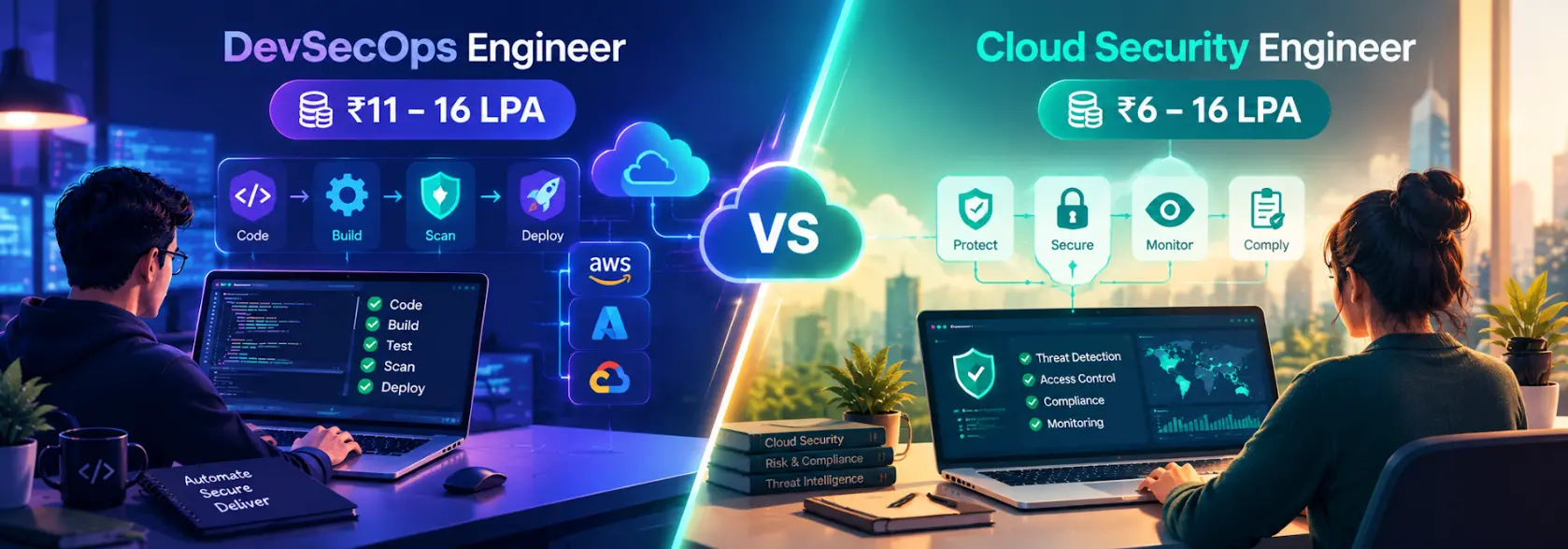
The salary for a DevSecOps Engineer is similar to the salary for a Cloud Security Engineer in India. The real amount you get depends a lot on experience, location, company, cloud skills, security abilities and what the job involves. Current Glassdoor salary data shows an average base pay of about ₹11 lakh per year for DevSecOps Engineers and about ₹10 lakh per year for Cloud Security Engineers, in India. Both DevSecOps Engineers and Cloud Security Engineers have a range of salaries. Experienced DevSecOps Engineers and Cloud Security Engineers can get pay packages.
The main difference is the kind of work. The DevSecOps Engineer works with software development, security, automation and operations. The Cloud Security Engineer works on protecting cloud infrastructure identities, networks, data and workloads.
DevSecOps Engineer vs Cloud Security Engineer Salary: Which Pays More?
If you are already in IT and thinking about moving into security two roles often come up: DevSecOps Engineer and Cloud Security Engineer. Both jobs deal with cloud platforms, automation and security measures. They also work with infrastructure. Still the tasks they handle every day are not the same.
The salary difference between these two roles isn’t clear-cut. It’s not about picking one job title over the other. Experience, the skills you have, the size of the company, where you work and the technologies you use all impact how much you earn.
So when looking at DevSecOps Engineer vs Cloud Security Engineer salary it’s important to look at more than the numbers. You also need to understand the work behind those numbers.
Table of Contents
▼DevSecOps vs Cloud Security Engineer: What's the Difference
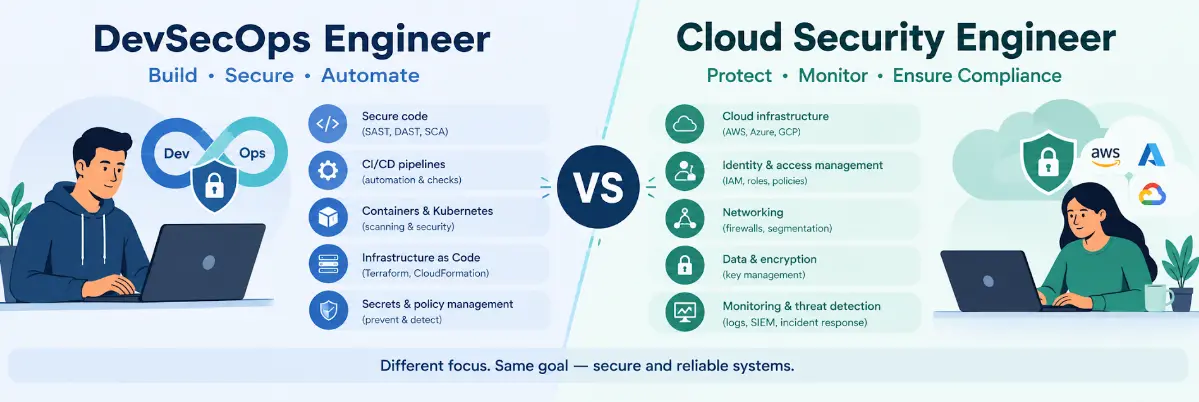
Think about a company releasing a new application.
The DevSecOps Engineer may be concerned with what happens when developers commit code. Is the code checked for vulnerabilities? Are third-party dependencies scanned? Are secrets accidentally included? Does the CI/CD pipeline stop a risky build from moving forward? Is the container image safe to deploy?
The Cloud Security Engineer may be looking at the environment where that application runs. Who has access to the cloud resources? Are permissions too broad? Is the network properly configured? Are sensitive resources encrypted? Are logs being collected? Can suspicious activity be detected?
There is obviously some overlap between these responsibilities.
| Area | DevSecOps Engineer | Cloud Security Engineer |
|---|---|---|
| Primary focus | Secure software delivery | Secure cloud environments |
| CI/CD | Core responsibility | Often involved |
| Cloud | Important | Core responsibility |
| IAM | Important | Core responsibility |
| Security automation | Strong focus | Strong focus |
| Docker | Common | Common |
| Kubernetes | Common | Common |
| Terraform | Common | Common |
| Application security | Strong focus | May be involved |
| Infrastructure security | Important | Strong focus |
The DevSecOps Engineer needs cloud security knowledge while the Cloud Security Engineer may work with DevOps technologies such as Terraform, Kubernetes, Docker and CI/CD.
The main difference is where the DevSecOps Engineer applies the technologies and what security problems the Cloud Security Engineer is responsible for solving.

DevSecOps Engineer vs Cloud Security Engineer Salary in India
Both DevSecOps and Cloud Security are growing areas in the IT industry, and salaries generally increase as professionals build stronger technical and hands-on experience. Experience level, location, company, cloud platform knowledge, and specialization can all affect the final package.
| Experience Level | DevSecOps Engineer | Cloud Security Engineer |
|---|---|---|
| Fresher (0–2 years) | ₹5–9 LPA | ₹5–9 LPA |
| Mid-Level (3–5 years) | ₹12–22 LPA | ₹12–22 LPA |
| Senior (6–10 years) | ₹22–40 LPA | ₹20–36 LPA |
| Lead / Architect (10+ years) | ₹35–60+ LPA | ₹35–50+ LPA |
For freshers, the salary is usually influenced by their understanding of cloud platforms, Linux, networking, security basics, scripting, and CI/CD. Practical projects, internships, and relevant certifications can also help when applying for entry-level roles.
At the mid-level, professionals are expected to handle more complex responsibilities such as securing CI/CD pipelines, managing cloud environments, automating security checks, container security, vulnerability management, and Infrastructure as Code.
Senior professionals often take on broader responsibilities, including cloud security architecture, Kubernetes security, identity and access management, security automation, compliance, and incident response. As the scope of responsibility increases, compensation can also increase significantly.
These figures are indicative salary ranges, not guaranteed packages. Salaries can vary between startups, IT services companies, product companies, and GCCs, as well as across cities and industries. The specific technologies and responsibilities mentioned in a job description can also have a major impact on the salary offered.
What Skills Affect Salary
We find it interesting that these careers share foundational skills.
We see Linux as useful in both careers. Networking, cloud platforms, Git, scripting, containers and infrastructure concepts are useful too.
Once the foundation is set the specialization becomes clearer.
In DevSecOps engineers often need to understand how security fits into the development pipeline. This means getting comfortable with CI/CD, source-code security, dependency scanning, SAST, DAST, software composition analysis, container scanning, secrets management and infrastructure-as-code security.
Cloud Security goes deeper into areas such as IAM, cloud networking, encryption, key management, security monitoring, logging, vulnerability management, threat detection and security architecture.
There is also a difference between knowing a tool and understanding the problem the tool solves.
For instance knowing Terraform syntax is one thing. Understanding how infrastructure created through Terraform should be secured, reviewed, scanned and deployed with permissions is much more valuable in a real engineering environment.
The same applies to Kubernetes. It is useful to know how to deploy an application. Security-focused work also requires thinking about permissions, secrets, network policies, workload identity and the security of the surrounding infrastructure.
AWS guidance for DevSecOps includes practices such as privilege, encryption, vulnerability scanning, infrastructure-as-code security and automated security checks as part of the infrastructure lifecycle.
Which Career Path Fits Your Background
The best starting point depends heavily on what you already know.
Suppose you are working as a DevOps Engineer. You may already be dealing with Git, CI/CD, Docker, Kubernetes, cloud platforms, and Terraform. Adding security controls to those workflows can take you toward DevSecOps without completely changing your technical foundation.
A Cloud Engineer has a different advantage. If you already understand AWS or Azure, networking, IAM, compute, storage, monitoring, and cloud architecture, moving deeper into Cloud Security can be a logical progression.
For a QA Engineer, DevSecOps can also be an interesting direction. Testing knowledge can transfer into automated security testing, pipeline validation, vulnerability checks, and secure release processes. The missing pieces are usually cloud, Linux, CI/CD, containers, and security fundamentals.
A system administrator or network engineer may have another useful starting point. Linux, networking, access control, infrastructure, and troubleshooting experience can provide a foundation for Cloud Security.
For professionals who want to build these foundations together, MicroDegree covers areas including Cloud, DevOps, AWS, Linux, Docker, Kubernetes, and emerging technologies. MicroDegree Learning
How to Increase Your Earning Potential
There is no one certification or tool that automatically increases a person's salary.
What usually makes a difference is how parts of the engineering environment you can understand and use with confidence.
Someone who understands Linux but cannot work with cloud infrastructure has a better profile than someone who can fix Linux systems, set up cloud resources, use Terraform to automate infrastructure work with containers, know about CI/CD and apply security measures.
That mix becomes very helpful in DevSecOps and Cloud Security.
A real-world learning path could start with Linux and networking then move to cloud basics. After that you can add Git, CI/CD, Docker, Kubernetes, Terraform, IAM, monitoring and security automation.
Projects are good here because they make all these ideas work together.
For instance you could build an application, put it in Git, create a CI/CD pipeline, add automated security checks, package the app with Docker, scan the image, set up infrastructure with Terraform and deploy it to a cloud system.
The benefit of such a project is not just having another thing on a resume. It helps you explain how development, infrastructure, automation and security fit together in life.
Career Growth and Future Opportunities
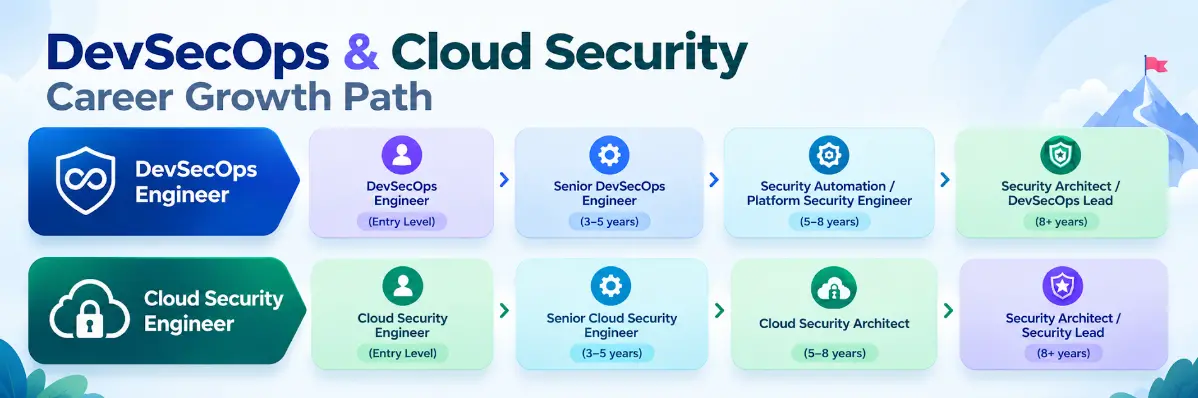
Both careers can develop into senior engineering and architecture roles.
A DevSecOps Engineer may eventually work as a Senior DevSecOps Engineer, Platform Security Engineer, Security Automation Engineer, or Security Architect.
A Cloud Security Engineer may progress toward Senior Cloud Security Engineer, Cloud Security Lead, Cloud Security Architect, or broader security architecture positions.
At higher levels, the distinction between these careers can become less obvious.
An experienced security engineer may be expected to understand cloud architecture, infrastructure-as-code, CI/CD, Kubernetes, IAM, monitoring, application security, and automation even if their official title contains only one of these areas.
That is why a broad technical foundation can be useful early in your career. You can specialize later without having to rebuild your fundamentals.
Conclusion
The salary ranges for both positions overlap and the actual pay can be very different depending on experience, location, company and the kind of work involved.
The important difference is the actual job.
DevSecOps is strongly linked to software development. Getting software out. Security is included in CI/CD, application development, containers, automation and infrastructure processes.
Cloud Security is more focused on keeping environments safe. Identity and access management, networking, workloads, data protection, monitoring, encryption and access controls are the parts of the job.
For someone who has experience in DevOps or software development DevSecOps can be a next step. For someone with a background in cloud, infrastructure, networking or system administration Cloud Security can be a path for more focused learning.
Salary is something to think about. The skills you gain and the technical challenges you can handle will have a much bigger impact on your career in the long run.
FAQs
1. Is DevSecOps higher paying than Cloud Security?▼
Current Glassdoor India data reports an average base salary of approximately ₹11 LPA for DevSecOps Engineers and ₹10 LPA for Cloud Security Engineers. Individual salaries vary based on experience, location, employer, and responsibilities.
2. What is the DevSecOps Engineer salary in India?▼
Current Glassdoor data reports an average base salary of approximately ₹11 LPA, with a reported base range of about ₹7–16 LPA for DevSecOps Engineers in India.
3. What is the Cloud Security Engineer salary in India?▼
Current Glassdoor data reports an average base salary of approximately ₹10 LPA, with a reported base range of about ₹6–16 LPA for Cloud Security Engineers in India.
4. Can a DevOps Engineer become a DevSecOps Engineer?▼
Yes. DevOps experience provides a strong foundation because DevSecOps adds security practices to development and operations workflows. CI/CD, cloud, containers, infrastructure-as-code, and automation are particularly relevant.
5. Can a Cloud Engineer become a Cloud Security Engineer?▼
Yes. Cloud Engineers can build on their existing cloud knowledge by developing deeper expertise in IAM, networking, encryption, monitoring, vulnerability management, threat detection, and security architecture.
6. Can a QA Engineer move into DevSecOps?▼
Yes. QA experience in testing and automation can transfer into security testing and CI/CD. Learning Linux, Git, cloud platforms, containers, infrastructure automation, and security tools can help bridge the technical gap.
Start Building Your GenAI, Cloud and DevOps Skills
If you are planning a move toward Cloud, DevOps, DevSecOps, or Cloud Security, developing strong technical fundamentals is a practical starting point. MicroDegree offers FREE E-learning resources covering Cloud, DevOps, AWS, Linux, Kubernetes, Docker, and emerging technologies.