
Layoffs Are Real, But These Tech Skills Can Save Your Career in 2026

If you've opened LinkedIn this year and felt a knot in your stomach, you're not imagining it. Tech layoffs have crossed six figures in 2026. Cisco, Oracle, Amazon, Meta, Intel, all cutting in the same twelve months.
What the headlines skip: these same companies are still hiring. Just for a shorter list of skills. Here's what's actually in demand, and how to get ahead of the next round of cuts instead of reacting to it.
200,000+ tech layoffs in 2026, but hiring hasn't stopped, it's narrowed. Cloud, DevOps, cybersecurity, Kubernetes, Terraform, and generative AI/AI agents are the skills still getting people hired, roles built on judgment, not repetition. Support, QA, and networking pros pivoting into these areas are landing better-paying jobs faster than generalists standing still.
Table of Contents
▼1. Why Tech Layoffs Are Accelerating in 2026
Tech layoffs crossed 100,000 by early May 2026. Q1 alone saw over 50,000 cuts, the worst since 2023, and by mid-year the count had passed 200,000. The US is taking the brunt of it, well ahead of India, Australia, or Israel.
"AI took the jobs" is the easy headline, but it's not the whole story. Three things are happening at once:
- Overhiring hangover. Teams built during the 2021–2022 boom are still getting right-sized.
- Role redesign. Microsoft has said plainly that routine, repeatable work is being automated, and that's changing what "software engineer" or "support analyst" actually means day to day.
- Investor pressure. Companies betting billions on AI infrastructure need to show returns fast, and headcount is the easiest lever to pull.
Here's the catch: plenty of layoffs tagged "AI-related" are really just overhiring or cost-cutting with AI as the convenient excuse. A layoff doesn't mean your skills are obsolete. It means the bar for "essential" just moved.
2. The In-Demand Tech Skills 2026 Employers Are Actually Hiring For
Recruiters right now are effectively working two very different pools of candidates. One is a slower, more competitive market for general-purpose developers. The other is small, hot, and well paid, made up of people with specific, current, hands-on skills that companies genuinely struggle to find.
If you look at current hiring data, a fairly consistent list of skill areas keeps showing up:
- Cloud architecture and multi-cloud management (AWS, Azure, GCP)
- Setting up and running apps/websites on cloud platforms like Amazon, Microsoft, or Google
- Sometimes using more than one cloud so the business isn't dependent on just one provider
- DevOps and platform engineering to support AI workloads at scale
- Building the behind-the-scenes systems that let AI tools run smoothly
- Making sure everything stays stable even when lots of people use it at once
- Generative AI and AI agent development
- Building AI tools like chatbots and assistants
- Creating "agents" that can complete multi-step tasks on their own, not just answer questions
- Cybersecurity and security engineering
- Protecting company systems and data from hackers
- Focused on preventing attacks, not just fixing things after a breach happens
- Kubernetes, containerization, and infrastructure automation
- Packaging apps into "boxes" (containers) so they run the same way on any computer
- Using Kubernetes to automatically manage, restart, and scale those boxes without manual work
- Data engineering and MLOps
- Collecting, cleaning, and organizing data before it's useful
- Keeping AI models running properly after they're deployed
- Terraform and infrastructure-as-code
- Writing server and network setups as code instead of manually clicking through dashboards
- Makes environments easy to repeat, track, and fix if something goes wrong
What ties these together is judgment. Each one asks for system-level thinking and decisions made under some ambiguity, which happens to be exactly what large language models still struggle with.
3. Cloud Computing and DevOps: Still the Backbone of IT Hiring
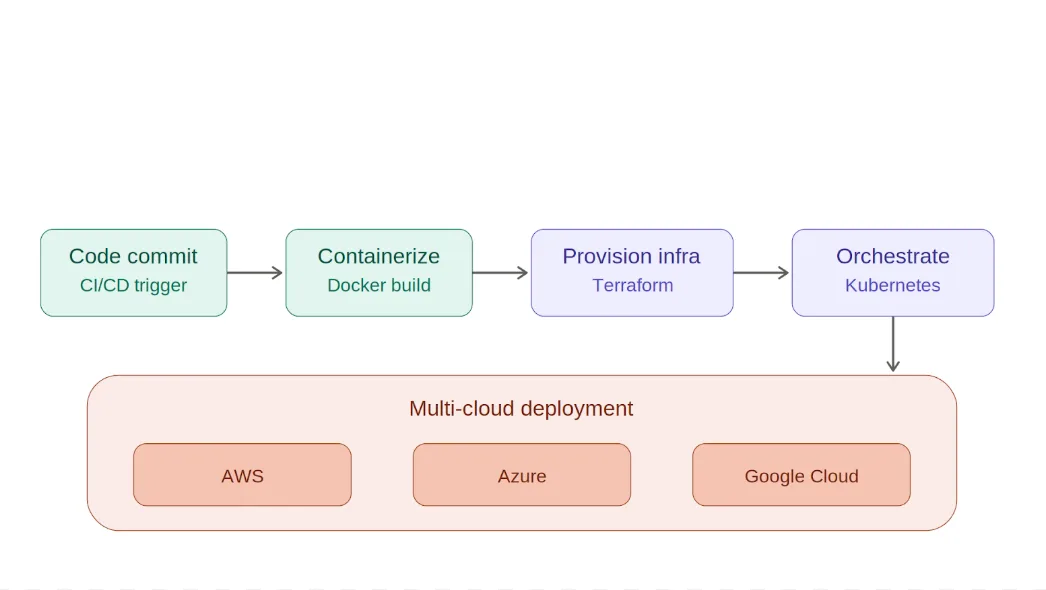
Every AI feature a company ships has to run somewhere. That's why cloud and DevOps roles have shrugged off this layoff cycle better than almost anything else in IT.
What's actually getting hired for:
- Designing cloud infrastructure that scales elastically
- Automating deployments with CI/CD
- Running containerized workloads on Docker and Kubernetes
- Provisioning infrastructure through Terraform, not manual consoles
- Watching reliability and cost across multi-cloud setups
If you're a sysadmin, network engineer, or app support engineer, this is your easiest lane in. You've already got the hard part: Linux, networking, troubleshooting under fire. What's missing is usually just hands-on reps with the tools showing up in job postings, not raw ability. MicroDegree's Cloud, DevOps & AI Certification Program and AWS & DevOps course bundle are built exactly for this kind of pivot.
4. Generative AI and AI Agent Skills Reshaping IT Careers
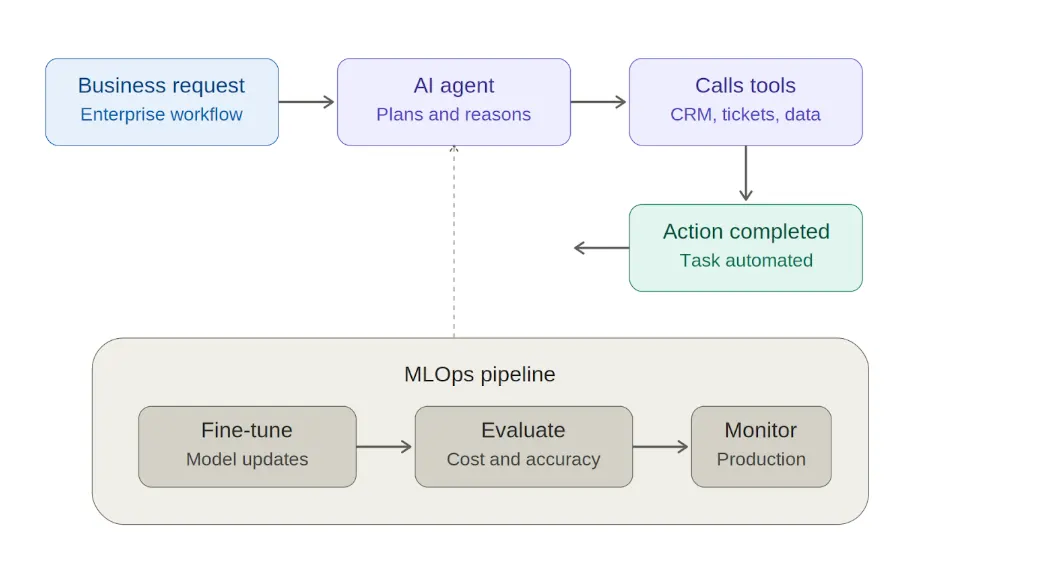
AI and ML roles are still among the fastest-growing in tech, even while everything else cools off. And it's not just data scientists anymore. Companies now want IT people who can:
- Plug generative AI into existing enterprise software
- Build AI agents that automate real workflows
- Keep MLOps pipelines running reliably in production
- Fine-tune and evaluate AI systems for cost and accuracy
No PhD required. Most working professionals get here by stacking AI skills on top of the cloud or dev background they already have, learned through project-based courses, not a full academic detour. MicroDegree's AI & Machine Learning course is designed for exactly that path.
5. At-Risk Skills vs Future Tech Skills: A Side-by-Side Comparison
| Category | Losing Ground in 2026 | Gaining Ground in 2026 |
|---|---|---|
| Development | Manual, repetitive coding tasks | AI-assisted and AI-integrated development |
| Infrastructure | Manual server management | Infrastructure-as-code (Terraform), Kubernetes |
| Support | Tier-1 scripted troubleshooting | AI-augmented support with escalation judgment |
| Data | Basic reporting and static dashboards | Data engineering, MLOps, AI-driven analytics |
| Security | Reactive, checklist-based security | Proactive security engineering, threat modeling |
| Career Positioning | Single-tool generalist | Cloud + DevOps + AI cross-functional specialist |
The pattern holds pretty consistently across the table: whatever is predictable and repeatable gets automated first, while work that needs context and cross-system judgment keeps its value, and often gets paid more precisely because so few people can do it well.
6. Real-World Examples: How IT Professionals Are Pivoting Successfully
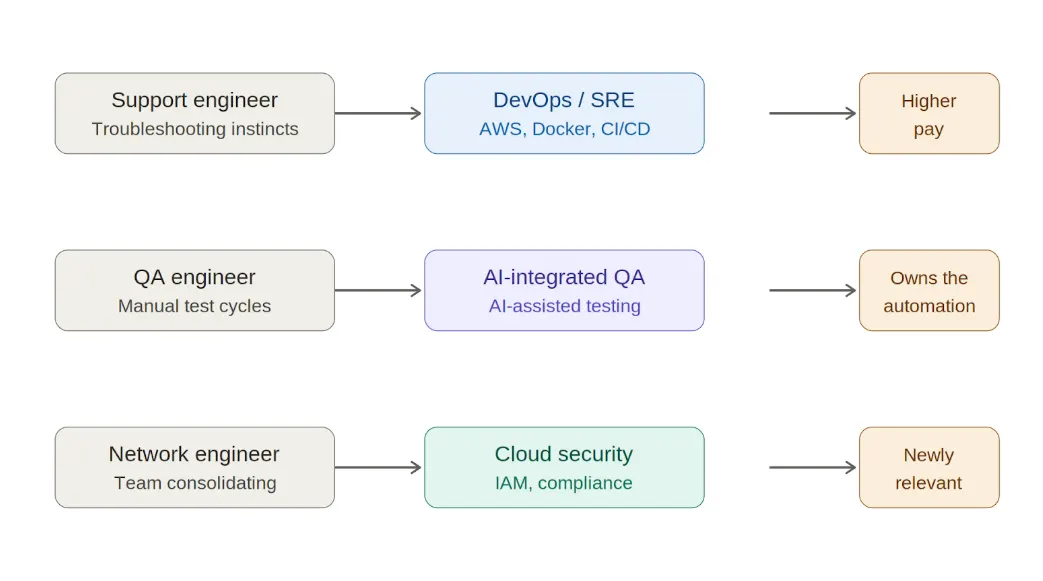
Support engineer → DevOps. Sharp troubleshooting instincts, zero cloud certs. A few months of hands-on AWS, Docker, and CI/CD later, they're a real candidate for DevOps and SRE roles paying noticeably more.
QA engineer → AI-integrated QA. Automation was quietly shrinking their job. Instead of fighting it, they learned to build AI-assisted testing frameworks and regression pipelines. Now they own the thing that was supposed to replace them.
Network engineer → cloud security. Team getting consolidated, role feeling shaky. They layered on IAM, security groups, and compliance monitoring. Same networking background, suddenly relevant again instead of at risk.
No career resets here. Just one current, in-demand skill stacked on top of what they already knew.
Conclusion
Tech layoffs in 2026 are real. But hiring hasn't stopped, it's narrowed. Companies are still pouring money into cloud, DevOps, cybersecurity, and generative AI, and struggling to find people with current, hands-on skills in those areas.
The professionals coming out on top aren't the ones with the fanciest old title. They're the ones who built these skills before they needed them, not after a layoff notice.
You don't need to start over. Just build on what you know, aimed at where the market is heading.
FAQ
Q1: What are the most in-demand tech skills for 2026?▼
Cloud computing, DevOps and platform engineering, generative AI and AI agent development, cybersecurity, Kubernetes, and infrastructure-as-code tools like Terraform are among the most in-demand tech skills 2026 employers are hiring for.
Q2: Are tech layoffs in 2026 caused entirely by AI?▼
Not entirely. AI-driven role redesign is a real factor, but plenty of 2026 layoffs also trace back to post-pandemic overhiring corrections and pressure from investors to cut costs. Some companies cite AI even when the underlying cause is something else.
Q3: Which IT roles are safest from layoffs right now?▼
Roles that lean on judgment and system-level thinking, like cloud architecture, security engineering, DevOps, and AI integration, tend to hold up better than roles built around repetitive, scripted tasks.
Q4: How long does it take to build future tech skills while working full-time?▼
Many working IT professionals get to job-ready in a focused area like cloud, DevOps, or AI agents within a few months through structured, project-based learning, without needing to quit their current job.
Q5: Do I need a computer science degree to learn these skills?▼
No. Most in-demand tech skills for IT professionals, including cloud platforms, Kubernetes, Terraform, and AI integration, are taught through hands-on courses rather than formal degrees, and they're accessible to people coming from support, QA, networking, or development backgrounds.
Layoffs are unpredictable. Your skill set doesn't have to be.
If you're an IT professional looking to move into Cloud, DevOps, or Generative AI roles, MicroDegree's practical, project-based courses are built specifically for working professionals who need to upskill without pausing their careers. Explore the course options that match your background, and start building the skills that are actually getting people hired in 2026.