
Top IT Skills to Learn for Career Growth in 2026
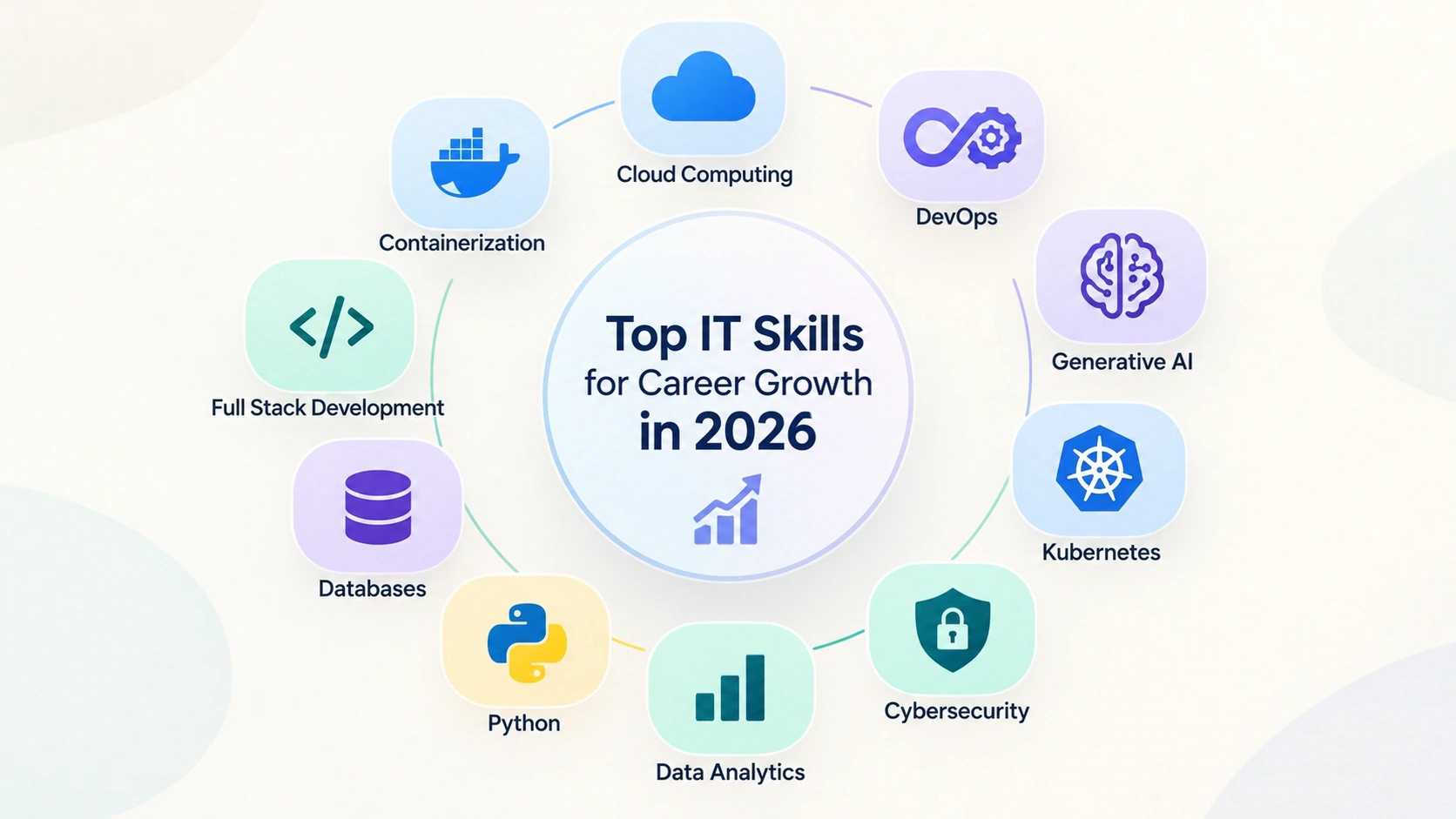
Table of Contents
▼Quick Summary
The blog explores the top IT skills to learn in 2026, including cloud computing, DevOps, Generative AI, LLM applications, data engineering and cybersecurity. It explains how IT professionals can choose a skill based on their current role, develop practical experience through projects, and improve their career prospects. The article also compares estimated salaries across experience levels and provides a 90-day learning roadmap for professionals working full-time.

The IT Skills to Learn in 2026
Are you wondering which skill is worth your evenings, and which one will be old news in two years? Six skill areas fit most working IT professionals, and each one builds on work you may already do.
| Skill area | What it means | A good first tool | Who it suits |
|---|---|---|---|
| Linux and scripting | Working on servers from the command line and automating small, repeated jobs | Linux shell, Python | Support engineers, system administrators, testers |
| Cloud computing | Running servers, storage and networks on rented infrastructure instead of your own hardware | AWS | Almost every IT role |
| DevOps and containers | Automating how code is built, tested and released, and packaging apps so they run the same everywhere | Docker, GitHub Actions, Terraform | Developers, testers, system administrators |
| AI and LLM applications | Building software on top of large language models, such as a search assistant over your own documents | Python, a vector database | Developers, data and cloud engineers |
| Data engineering | Moving data from where it is created to where people and models can use it | SQL, Python | Database, support and backend engineers |
| Cybersecurity basics | Controlling who can reach what, and keeping secrets such as passwords and keys out of code | Cloud identity and access settings | Network engineers and anyone who deploys software |
The World Economic Forum's Future of Jobs Report 2025 names AI and big data, networks and cybersecurity, and digital literacy as the fastest-growing skills. The same report says that if the world's workforce were 100 people, 59 would need some form of training by 2030.
Tool choice is easier when you see what other engineers use. In Stack Overflow's 2025 survey, Docker is used by 71.1% of respondents, Kubernetes by 28.5% and Terraform by 17.8%. The survey covers developers worldwide, not only India, so read it as a sign of what teams use and not as a hiring forecast. That gap is one reason to learn Docker before Kubernetes.
What to Learn in Each Skill Area, and Why It Matters
Linux and Scripting
Linux is an operating system that many cloud servers run. Scripting means writing short programs, in Bash or Python, to do a job you would otherwise repeat by hand.
Start with moving around the file system, reading logs, checking running processes and editing permissions. Then write one script that does something you really do, such as pulling the error lines from a log file. Our guide to Linux commands every cloud and DevOps engineer should know lists the commands to practise first.
Cloud Computing
Cloud computing means renting computing power, storage and networking from a provider and paying for what you use. AWS, Azure and Google Cloud are the three big providers.
Pick one provider and learn four things in it: compute (virtual servers), storage, networking and identity (who is allowed to do what). Then put a small web application online. If you are unsure which provider to choose, read AWS vs Azure vs GCP for career growth in 2026. A certification can wait until you have built something.
DevOps and Containers
DevOps is a way of working where the people who write software and the people who run it share the job of getting it released safely. CI/CD (continuous integration and continuous delivery) is the automated line that builds, tests and releases code every time it changes.
A container, usually built with Docker, packs an application and what it needs so it runs the same on your laptop and on a server. Kubernetes runs many containers across many servers. Terraform describes cloud infrastructure in files, so you can create it again from the same code.
A sensible order is Docker, then a CI pipeline in a tool like GitHub Actions, then Terraform, then Kubernetes when a project needs it. The DevOps roadmap for application support engineers and the Kubernetes roadmap for working professionals go deeper.
AI and LLM Applications
A large language model (LLM) is the kind of AI model behind chat assistants. Most company projects do not train a new model. They build an application around an existing one, for example a question-answering tool that searches the company's own documents first and then lets the model write the answer.
Start with Python and calling a model through an API. Then build a small search-and-answer application, and measure whether it finds the right documents. LinkedIn's Jobs on the Rise 2026 list names AI engineer as the fastest-growing job in Hyderabad, according to Deccan Chronicle's coverage from January 2026. For the skills in more detail, see Generative AI skills every software engineer should learn in 2026, and for pay, LLM engineer salary in India.
Data Engineering
A data pipeline is a set of automated steps that collects data, cleans it and stores it where analysts, dashboards and AI models can use it. Data engineers build and look after those pipelines.
SQL (the language for querying databases) comes first, then Python. After that, build a small pipeline that loads a file, cleans it and writes it to a database on a schedule. The AWS data engineer roadmap for working professionals shows how to do it in the cloud.
Cybersecurity Basics
For most IT engineers, security is a few habits and not a new job title: give every person and program only the access it needs (the principle of least privilege), keep passwords and keys out of code, and update what you run.
Practise these inside your cloud and DevOps projects. Set up a user that can only read one storage bucket, and store a database password in a secrets manager instead of a config file. The DevSecOps roadmap for working professionals shows where security fits in a delivery pipeline.
Which Skill Should You Learn First?
Learn the one closest to what you do today. A short step is easier to finish while you work full time, and finishing is what builds your confidence.
How to Choose From the IT Skills to Learn in 2026
| Your current role | Start with | Why it is a short step | Learn next |
|---|---|---|---|
| Application support engineer | Linux and scripting | You already read logs and fix tickets on servers | Cloud computing |
| QA tester | Scripting, then CI/CD | You already write test cases that can run automatically | Containers |
| System administrator | Cloud computing | You already know servers, networks and permissions | Terraform |
| Network engineer | Cloud networking and security | Routing, firewalls and DNS carry over directly | Terraform |
| Developer | Containers, or LLM applications | You can deploy your own code and add model calls to it | Cloud computing |
This table is our suggestion, not survey data. If your employer is already moving to one cloud or one AI tool, start there. Skills you can use at work this quarter are the ones you will keep practising.
To compare courses for these skills side by side, you can start from MicroDegree's learning platform.
What Do These Skills Pay in India?
Pay rises mainly with the years you have worked in a skill, and it also varies by company and city. The table shows medians from Flexiple's self-reported salary data, with the middle 50% of reported pay in brackets. All figures are all-in annual pay (CTC) in LPA, lakh rupees per year, and they are estimates.
| Role | Entry level (0 to 3 years) | Mid level (3 to 6 years) | Senior (6+ years) |
|---|---|---|---|
| DevOps engineer | 5.7 LPA (4.1 to 8.4) | 8 LPA (5.4 to 13) | 18.3 LPA (11.5 to 28.4) |
| Cloud engineer | 5.3 LPA (4 to 7.9) | 7.8 LPA (5.2 to 11.7) | 16.6 LPA (9.7 to 25.8) |
| Data engineer | 7.5 LPA (5 to 11.6) | 11.4 LPA (6.9 to 17.6) | 23.6 LPA (14.8 to 33.5) |
| LLM engineer | 7.1 LPA (4.4 to 12) | 14 LPA (7.8 to 23.9) | 30.9 LPA (17.8 to 45.2) |
| Cybersecurity engineer | Not enough data | Not enough data | Not enough data |

Three things stand out. At entry level the four medians sit close together, between 5.3 and 7.5 LPA. In every row the senior median is at least three times the entry median. And the gap between roles is widest at senior level, from 16.6 LPA for cloud engineers to 30.9 LPA for LLM engineers.
Years of hands-on work move the number more than the skill name does. Other salary sites show different figures because they use different samples, so check two or three before you negotiate. Our cloud engineer salary guide is a good place to compare.
A 90-Day Plan for Learning One Skill Alongside Your Job
You do not need a career break. A steady few hours a week, for example five or six, is enough to finish one small project in about three months.
| Weeks | Focus | What you have at the end |
|---|---|---|
| 1 to 2 | Learn the basics of the one skill you chose | Notes in your own words and a working setup |
| 3 to 6 | Build one small project on a real problem, such as a script for your team or an app online | A working project in a public repository |
| 7 to 10 | Improve it: add an automated test, a pipeline, monitoring or an evaluation check | One measurable result, such as deploy time or answer quality |
| 11 to 12 | Write a README and record a three-minute walkthrough | Something you can show in an interview |
When you reach week 3 and want a course that matches the skill you picked, MicroDegree's e-learning platform is one place to look.
Mistakes to Avoid When Choosing IT Skills to Learn
- Collecting tools instead of finishing a project. Fix: choose one skill, set a 90-day end date and stop adding new tools until the project works.
- Starting with Kubernetes. Fix: learn Linux and Docker first, because Kubernetes assumes you already know how containers behave.
- Following the highest-paid title. Fix: use the pay table to see the direction, then choose the skill that is a short step from your current job.
- Only watching tutorials. Fix: after every lesson, change something and break it on purpose, then fix it.
- Learning from old material. Fix: check the date and the version on every tutorial, because cloud and AI tools change often.
How Do You Show Employers a New Skill?
Show one small project and explain your choices. A reader who sees how you decided and what went wrong learns more than from a list of tool names.
- A public repository with code that runs.
- A README that says what the project does, how to run it and why you chose each tool.
- One problem you hit and how you fixed it.
- One number: deploy time, cost, or how often the right document was found.
- A short walkthrough you can give in an interview.
Conclusion
The IT skills to learn in 2026 are a short list, and the hard part is choosing one. Start from the work you already do, use the role table to find the nearest skill, and give it 90 days.
One finished project teaches more than a pile of half-watched courses, and it gives you something real to talk about. Once it works, add the next skill from the same table.
When you are ready to turn the choice into a plan, look for a course that matches the skill you picked and start this week.
Continue Learning with MicroDegree
Once you have picked your first skill, you can compare cloud, DevOps and AI courses and other learning opportunities in one place on MicroDegree's e-learning platform and see which one fits your next 90 days.
FAQs
1. What are the top IT skills to learn in 2026?▼
Six skill areas suit most working IT professionals: Linux and scripting, cloud computing, DevOps and containers, AI and LLM applications, data engineering and cybersecurity basics. Choose the one closest to your current job and build one small project with it.
2. Which IT skill is best for career growth in 2026?▼
There is no single best skill. The best one is the skill you can use at work soon and finish a project in. Pay data shows that years of hands-on experience raise pay in every role, so staying with one skill long enough matters more than picking the newest one.
3. Should I learn AI or cloud first?▼
If you deploy or support applications, start with cloud, because AI applications also run in the cloud. If you are a developer already, you can start with an LLM application and learn cloud deployment as part of it.
4. Can I learn new IT skills while working full time?▼
Yes. Five or six hours a week for about 90 days is enough to finish one small project. Use the plan above and keep the scope small.
5. Do I need to know coding to learn these skills?▼
Not to begin with cloud basics or security habits. Scripting in Bash or Python helps in almost every area, so it is worth learning early.
6. How long does it take to learn a new IT skill?▼
It depends on your starting point and the time you can give. About 90 days is a realistic target for a first working project. Being comfortable at work usually takes longer.
7. Are certifications worth it?▼
They can help you structure your learning, but they do not replace a project. Build something first, then choose one certification that matches your skill. Our [cloud certification roadmap for 2026](/blog/cloud-certification-roadmap-2026) explains which to take first.
8. Which IT skills pay the most in India?▼
In Flexiple's self-reported data, the senior median is 30.9 LPA for LLM engineers, 23.6 LPA for data engineers, 18.3 LPA for DevOps engineers and 16.6 LPA for cloud engineers. These are estimates that vary by company and city.