
What Is Model Context Protocol (MCP) and How Is It Different From Traditional APIs?

Introduction and Quick Summary
Model Context Protocol (MCP) is an open standard that lets AI applications connect to external tools, data, and services in one consistent way. A traditional API, by contrast, is a fixed contract that a developer wires up by hand for one specific service.
The short version: APIs are built for developers to call explicitly. With MCP, the AI application discovers what's available and the model can select a relevant tool, subject to the host's permissions and consent controls. MCP doesn't replace APIs either. Most MCP servers wrap an existing API underneath them.
This guide covers what MCP actually is, how its architecture works, where it genuinely differs from a REST API, and when each one is the right tool. By the end, you'll know exactly how to talk about MCP vs APIs without falling into the common "MCP replaces APIs" myth.
Table of Contents
▼What Is Model Context Protocol (MCP) and Why Does It Exist?
MCP is an open, open-source standard, created by Anthropic and released in November 2024, that gives AI applications one consistent way to connect to external systems. It exists because AI applications increasingly need to reach databases, files, APIs, and SaaS tools, and building a custom integration for each one doesn't scale.
The Problem MCP Solves
Engineers called this the "M×N problem." With M different AI applications and N different tools, you potentially need M times N separate integrations, and adding one new tool could mean rebuilding it for every application that wants to use it.
- Each AI application previously needed its own integration pattern per tool
- New tools meant repeated integration work across every AI client
- Maintenance cost grew with every new combination, not just every new tool
MCP flattens this into an M+N problem instead. A tool is exposed as an MCP server once, and any MCP-compatible AI application can use it without custom code on either side. In December 2025, Anthropic donated MCP to the Agentic AI Foundation, a directed fund under the Linux Foundation co-founded by Anthropic, Block, and OpenAI, so the protocol is now community-governed rather than controlled by any single company.
How Does MCP Work?
MCP runs on a client-server model: a user talks to an AI application, which uses an MCP client to reach an MCP server, which connects to whatever system actually holds the data.
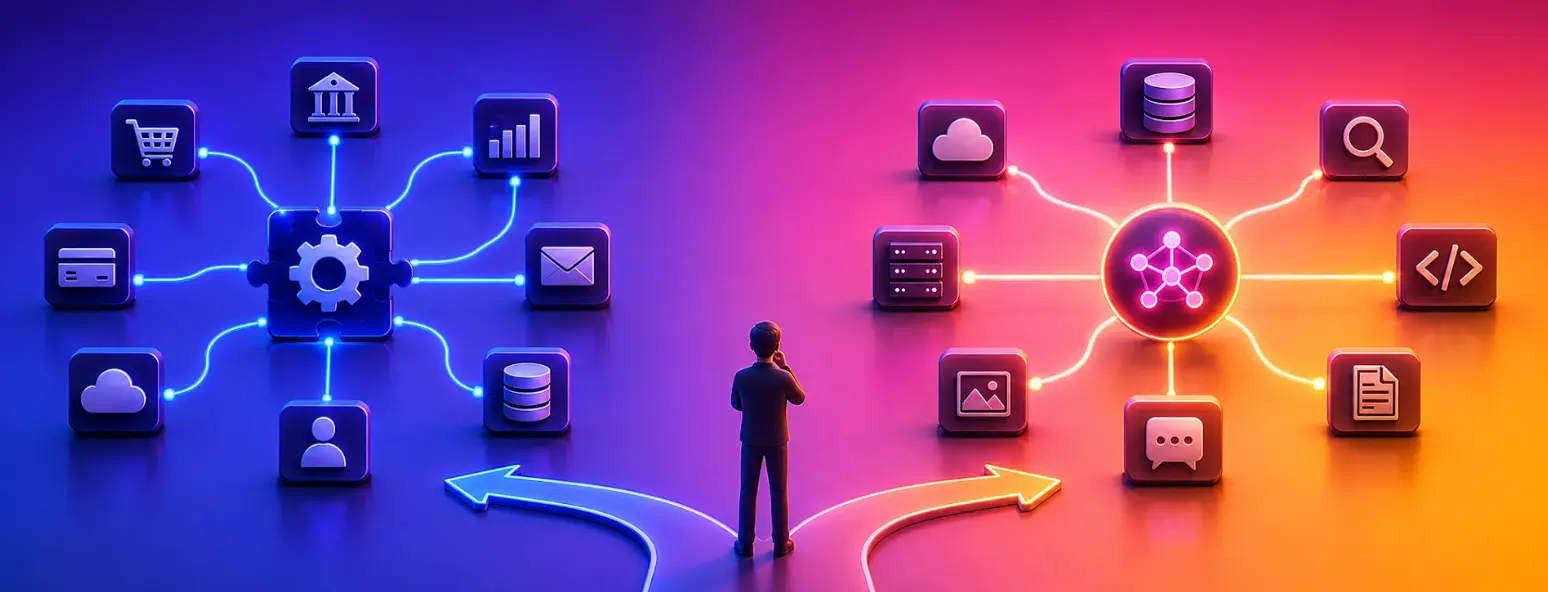
A host contains one or more MCP clients, and each client talks to one server. That server's capabilities might be backed by a REST API, a database, local files, or several of these combined, so "external system" is really shorthand for whatever the server chooses to wrap.
The Three Core Components
| Component | What It Does | Example |
|---|---|---|
| Host | The AI application the user interacts with | Claude Desktop, an IDE, a custom agent |
| Client | Lives inside the host, manages one connection to one server | Built into the host application |
| Server | Exposes tools, data, or prompts to the AI | A GitHub server, a database server, a Slack server |
Under the 2026-07-28 specification, the protocol core is stateless. Earlier versions opened with a handshake and tracked an ongoing session through an Mcp-Session-Id header. Both are gone, and every request now carries its own protocol details. This doesn't mean applications lose state entirely; a server that needs to remember something between calls now passes an explicit handle as a regular tool argument instead of relying on a session. Clients can also call a server/discover method to check a server's supported versions and capabilities before making any other request.
What Can an MCP Server Provide?
An MCP server exposes its capabilities through three primitives, and this is what separates MCP from being "just another API."
- Tools. Actions the AI can invoke, like querying a database, searching a repo, or creating a ticket.
- Resources. Data the AI can read, like files, schemas, or documentation, without taking any action.
- Prompts. Reusable templates for common interaction patterns, so workflows don't get rebuilt from scratch each time.
A server can expose any mix of the three. Well-designed servers usually keep the list of tools focused rather than exposing dozens of loosely related ones, since that makes it harder for the model to pick correctly.
How Is MCP Different From Traditional APIs?
A traditional API is a fixed contract for one service, called explicitly by a developer. MCP is a shared protocol that AI models can use to discover and call tools dynamically, across any service that exposes an MCP server.
Side-by-Side Comparison
| Feature | Traditional API | MCP |
|---|---|---|
| Primary purpose | Software-to-software integration | AI application to tools, data, and context |
| Integration | Developer wires up specific endpoints | AI clients discover capabilities directly |
| Discovery | External docs or an OpenAPI spec | Exposed through the protocol itself |
| Main abstraction | Endpoints or functions | Tools, resources, prompts |
| Decision-making | Developer-defined, fixed in advance | Model can select a tool, subject to host permissions and consent |
| Relationship | Can exist entirely on its own | Often wraps existing APIs |
A Quick Example
A REST API for order status looks like GET /orders/{order_id}, called by code a developer wrote specifically for that endpoint. With MCP, a server instead exposes a tool called get_order_status. The model can recommend calling it, but the host still applies its own permission checks and, where required, asks for user confirmation before the client actually sends the request. The underlying data source doesn't change. What changes is how the decision to call it gets made.
Does MCP Replace APIs, and When Should You Use Each?
No, MCP does not replace APIs. Most MCP servers wrap an existing API, database, or SDK underneath them. What MCP adds is a standardised, AI-discoverable front door on top of systems you already have.
Quick Decision Guide
| Your Situation | Better Fit |
|---|---|
| Standard app-to-app integration, deterministic workflow | Traditional API |
| An AI agent needs to call multiple tools dynamically | MCP |
| Your application already knows exactly which endpoint to call | Traditional API |
| Tools need to be discoverable across several AI clients | MCP |
| Exposing your product's core functionality to other developers | Traditional API |
In practice, these aren't competing choices. You keep your API. You add an MCP server on top of it when an AI model needs to reach it safely and dynamically.
How Does MCP Power Real AI Agent Workflows?
MCP sits between a model deciding it needs something and the system that actually provides it: LLM → recommends a tool → host applies permissions → MCP tool call → backing system → result → LLM.
Common Use Cases
| Use Case | What MCP Enables |
|---|---|
| Coding agents | Read files, search repos, open pull requests through a GitHub server |
| Database assistants | Query data directly instead of a developer writing SQL by hand |
| DevOps assistants | Check deployment status or pull logs from monitoring tools |
| Enterprise knowledge assistants | Search internal docs and systems on request |
Example flow: An IT professional asks an AI assistant to check the latest production incident and summarise it. Instead of a developer maintaining separate integrations with the monitoring platform and the ticketing system, both are exposed as MCP servers. The host application makes their tools available to the model, the model recommends which ones to call, and the host carries out those calls under its own permission and consent rules to build the summary.
What Security Considerations Matter for MCP?
MCP does not automatically make a server safe. Giving an AI model the ability to call tools and read data is an access-control decision that still needs deliberate design, not something the protocol handles for you.
- Authentication and authorization. Remote deployments should use an appropriate OAuth-based authorization or OpenID Connect design rather than shared credentials. The 2026-07-28 update strengthens issuer validation and binds client credentials to the authorization server that issued them, and it moves new implementations toward Client ID Metadata Documents, though Dynamic Client Registration still works for backward compatibility.
- Least privilege. A server should expose only the tools and data a use case actually needs, not broad access "just in case."
- User consent and visibility. The specification requires hosts to get user consent before exposing user data to a server or invoking a tool on the user's behalf, and users and admins should be able to see and restrict what an agent can do.
- Server trust. Tool descriptions and annotations should be treated as untrusted unless they come from a server you've deliberately chosen to trust, the same way you wouldn't grant unreviewed third-party API access.
- Prompt and tool injection. A poisoned data source or a misleading tool description can influence which tool the model picks. This is still active security research, not a solved problem.
Beyond what the specification requires, production deployments still need their own permission controls, tool allowlists, audit logging, and input validation. Treat the protocol's rules as a floor, not the whole security programme.
Conclusion
MCP is a standardised integration protocol for AI applications, not a replacement for APIs. Traditional APIs expose functionality. MCP gives AI applications a consistent way to discover and use that functionality through tools, resources, and prompts. Together, they form the integration layer behind most modern AI agent systems.
If you're working with AI agents in any capacity, knowing where MCP fits and where a plain API is still the right call is quickly becoming baseline knowledge, not a specialised one.
FAQs
1. What is MCP in AI?▼
MCP is an open standard that lets AI applications connect to external tools, data, and services through one consistent interface, instead of a custom integration for every connection.
2. Is MCP an API?▼
Not exactly. MCP is a protocol that standardises how AI applications discover and use capabilities, and it usually sits on top of existing APIs rather than replacing the concept of one.
3. Is MCP replacing REST APIs?▼
No. MCP servers typically wrap REST APIs or databases underneath them. MCP standardises the AI-facing layer, not the underlying system.
4. How is MCP different from function calling?▼
Function calling is a mechanism for giving a model predefined functions it can call, usually defined and registered by the application itself. MCP is a broader interoperability protocol that standardises how AI applications discover and use tools, resources, and prompts across different hosts and servers, rather than each application wiring up its own functions independently.
5. What is an MCP server?▼
An MCP server is a program that exposes tools, resources, and prompts to AI applications, typically by wrapping an existing API, database, or internal service.
6. Can MCP work with REST APIs?▼
Yes. Most MCP servers are built on top of existing REST APIs or SDKs, with MCP adding a standardised, AI-discoverable layer on top.
7. Is MCP only for Claude?▼
No. Anthropic created MCP, but donated it to the Agentic AI Foundation, a Linux Foundation project co-founded with Block and OpenAI, so it's intended to remain a community-governed standard rather than a Claude-only feature. Other AI platforms have adopted it too.
Want to learn MCP, RAG, AI Agents, and LLM application development through hands-on projects? Join MicroDegree's free GenAI Masterclass and start building the skills agentic AI systems actually run on.