
How to Become an SRE from a Software Testing Background (2026)

What Does a Site Reliability Engineer Actually Do?
An SRE applies software engineering to operations problems. The goal is to keep services available, fast, and dependable while still letting teams ship new features.
The term comes from Google, where the practice took shape in the early 2000s. Google has since published its approach in the free Site Reliability Engineering book.
Day to day, an SRE usually:
- Defines how reliable a service needs to be (and measures it)
- Builds monitoring, alerting, and dashboards
- Automates repetitive operational work
- Takes part in on-call rotations and incident response
- Writes postmortems and fixes the underlying causes
- Plans capacity and improves performance
- Works with developers to make releases safer
Does this sound like a long way from clicking through test cases? It is closer than you think.

Why Are Testers Well Placed to Become SREs?
Testers already think in terms of failure, risk, and verification. That mindset is the hardest part of SRE to teach.
Many people moving from QA worry they are "starting from zero." You are not.
Think about what you do every week:
- You ask, "What happens if this breaks?"
- You look for edge cases others miss
- You reproduce bugs and trace them to a cause
- You write automation that runs without you
- You work between developers, product, and operations
An SRE does the same things, but on live systems and with a wider set of tools.
The honest part: testers usually have gaps in infrastructure, cloud, and production operations. Those gaps are learnable, and the next sections show how.
Testing to Site Reliability Engineering: Skills Mapping
Which testing skills transfer to SRE? Most of your core thinking transfers. The tools change.
| What you do as a tester | Where it shows up in SRE |
|---|---|
| Designing test cases and edge cases | Failure-mode analysis, chaos and resilience testing |
| Performance and load testing | Capacity planning, load testing, latency analysis |
| Test automation frameworks | Automating operations, runbooks, and tooling |
| Bug triage and root-cause analysis | Incident diagnosis and postmortems |
| Test reporting and metrics | SLIs, SLOs, dashboards, and alerts |
| Regression testing in CI | Safe deployments, canary releases, rollbacks |
| API testing | Health checks, synthetic monitoring, dependency checks |
| Working across dev and QA teams | Partnering with developers on reliability |

What SRE Skills Do You Need to Build?
Short answer: SRE skills fall into four groups: foundations, automation, reliability practices, and communication.
Core Technical SRE Skills
You do not need all of these on day one. Build them in layers.
- Linux and networking
Most production systems run on Linux. You should be comfortable with processes, permissions, logs, systemd, and basic troubleshooting. Add networking: how a request travels from a browser to a server, and where it can fail. - Programming and scripting
SREs write code to remove manual work. Python is a good starting point for testers, especially if you already use it for automation. Bash helps for quick tasks. Go is common in cloud-native tooling. - Cloud computing
Learn one major cloud well before touching the others. Understand compute, storage, networking, IAM (access control), and managed services on AWS or Azure. - Containers and Kubernetes
Docker packages applications. Kubernetes runs and manages them at scale. Most modern SRE roles expect at least working knowledge of both. - CI/CD pipelines
You likely know pipelines from running tests. As an SRE, you also care about how code reaches production safely, using techniques like canary releases and automated rollbacks. - Infrastructure as Code (IaC)
Terraform lets you define infrastructure in files instead of clicking through consoles. This makes environments repeatable and reviewable. - Monitoring and observability
Observability means understanding a system's internal state from its outputs: metrics, logs, and traces. Common tools in this space include Prometheus, Grafana, and OpenTelemetry.
Soft Skills That Matter
- Staying calm during outages
- Explaining technical risk to non-technical people
- Pushing for reliability work without blocking delivery
Which SRE Concepts Should a Tester Learn First?
Start with SLIs, SLOs, error budgets, toil, and blameless postmortems. They define how SRE thinks.
Here is each one in plain language.
- SLI (Service Level Indicator): a measurement of how your service is behaving. Example: the percentage of requests that succeed.
- SLO (Service Level Objective): the target for that measurement. Example: 99.9% of requests succeed over 30 days.
- SLA (Service Level Agreement): a formal promise to customers, often with consequences if missed. SLAs are usually looser than internal SLOs.
- Error budget: the amount of unreliability you can accept. If your SLO is 99.9%, the remaining 0.1% is your budget. Teams can spend it on releases and experiments. If it runs out, the focus shifts to stability.
- Toil: repetitive, manual operational work that grows with the service and adds no lasting value. SREs aim to automate it away.
- Blameless postmortem: a written review of an incident that focuses on how the system and process allowed the failure, not on who made the mistake.
Callout: A useful mental shift. Testing asks, "Does it work?" SRE asks, "How reliable does it need to be, and how do we know it is?"
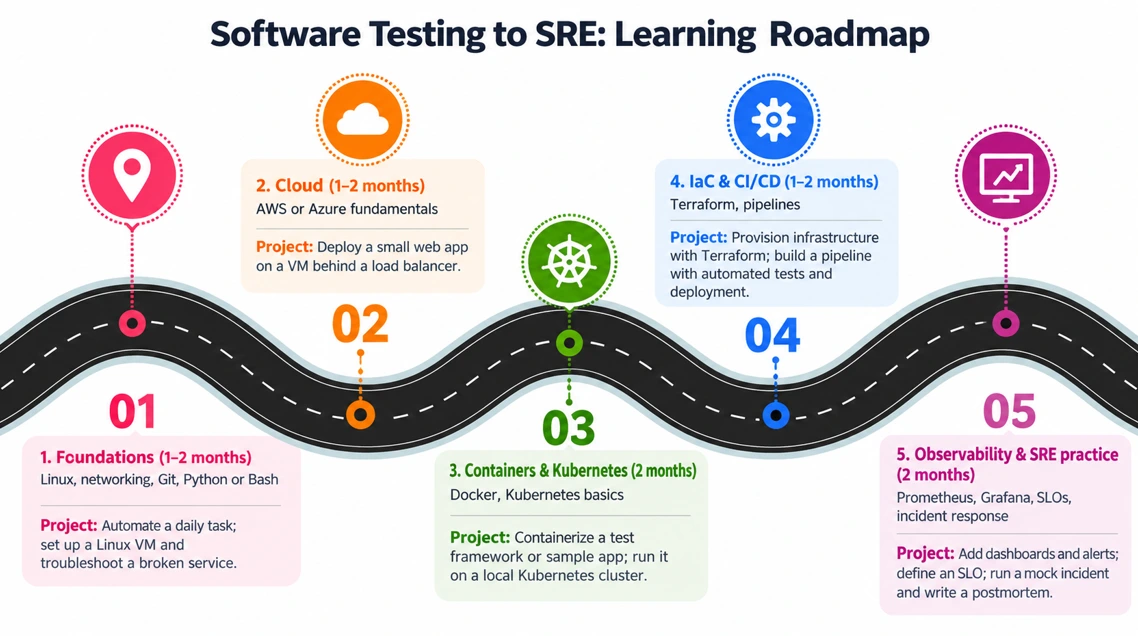
What Is a Practical Roadmap From Software Tester to SRE?
Build skills in this order: Linux and scripting, then cloud, then containers and Kubernetes, then IaC and CI/CD, then observability and incident practice. Prove each stage with a small project.
The timings below are suggestions, not guarantees. Your pace depends on your background and how many hours you can give each week.
| Stage | Focus | What to build or practice |
|---|---|---|
| 1. Foundations (about 1–2 months) | Linux, networking, Git, Python or Bash | Automate a daily task with a script; set up a Linux VM and troubleshoot a broken service |
| 2. Cloud (about 1–2 months) | AWS or Azure fundamentals | Deploy a small web app on a virtual machine behind a load balancer |
| 3. Containers & Kubernetes (about 2 months) | Docker, Kubernetes basics | Containerize your test framework or a sample app; run it on a local Kubernetes cluster |
| 4. IaC & CI/CD (about 1–2 months) | Terraform, pipelines | Provision cloud infrastructure with Terraform; build a pipeline with automated tests and deployment |
| 5. Observability & SRE practice (about 2 months) | Prometheus, Grafana, SLOs, incident response | Add dashboards and alerts to your project; define an SLO; run a mock incident and write a postmortem |
Where does hands-on practice come from? This is the stage where many learners stall, because reading about Kubernetes is very different from fixing a broken cluster. Practical, lab-based courses help here. You can explore structured, hands-on learning paths for Linux, AWS, Docker, Kubernetes, and Terraform on the MicroDegree learning platform.
A Smart First Step From Where You Are Today
If you are not sure where to start, move through an intermediate role first. Many testers go from manual testing to automation, then add pipelines and cloud work, which naturally leads into DevOps or SRE responsibilities. You do not need to jump straight into an SRE title.
What Does a Typical Day Look Like for Tester vs SRE?
Short answer: A tester's day centers on validating releases. An SRE's day centers on keeping live systems healthy and reducing future incidents.
| Area | Software Tester | SRE |
|---|---|---|
| Main goal | Find defects before release | Keep production reliable and fast |
| Typical work | Test planning, execution, automation | Monitoring, automation, incident response, capacity planning |
| Success measured by | Defect detection, coverage, release quality | SLOs, uptime, incident frequency and recovery time |
| Tools | Selenium, Playwright, Postman, JMeter, test management tools | Kubernetes, Terraform, Prometheus, Grafana, cloud consoles, pipelines |
| On-call duty | Rare | Common in many organizations |
| Coding level | Scripting to moderate | Moderate to strong |
An SRE morning might start with reviewing overnight alerts, checking an error budget, and fixing a flaky deployment step. The afternoon might go to writing automation or joining a design review to flag a reliability risk.
What Is the SRE Career Path and What Opportunities Exist?
The SRE career path usually runs from QA or automation, through DevOps or platform roles, into SRE, then toward senior, staff, or management tracks.
A Typical SRE Career Path
- QA / Test Engineer
- SDET / Automation Engineer
- DevOps or Cloud Engineer (optional but common stepping stone)
- Site Reliability Engineer
- Senior SRE
- Staff / Principal SRE or Reliability Architect
- SRE Manager / Head of Reliability (management track)
Related Roles You Can Grow Into
- Platform Engineer: builds internal tools and platforms for developers
- DevOps Engineer: focuses on delivery pipelines and automation
- Cloud Engineer / Architect: designs and runs cloud infrastructure
- Performance Engineer: a strong fit if you already do load testing
- Observability Engineer: specializes in monitoring and telemetry
Career Impact
Moving into Site Reliability Engineering can expand your role beyond testing releases. You start taking ownership of system reliability. This shift also opens doors in cloud computing, platform engineering and building systems architecture.
Pay, job openings and job titles change a lot depending on the company, where you live and how experience you have. That’s why it's best to look at job postings, in your target market. Don’t depend on one salary number or title, look at what’s being offered.
If you're looking for a way to learn these skills without having to gather resources yourself, MicroDegree's FREE cloud and DevOps learning tracks. These are made for IT professionals who want to build real-world skills that match today’s jobs.
Conclusion
The move from software tester to site reliability engineer is not as big as it seems. You already consider failure, unusual situations and the reasons behind problems. What is left is learning how to use that way of thinking with systems using Linux, cloud computing, containers, automation and monitoring.
Start small. Choose one area that needs improvement from the list, create a project around it and then go to the next one. After a month of regular effort your experience as a tester and your new skills in infrastructure will begin to support each other.
The next sensible step is a practical way to develop the SRE skills mentioned above. Practicing in real lab setups of just reading about them is what turns understanding into self-assurance, for interviews and actual work.
FAQs
1. Which cloud platform should I learn first for SRE: AWS or Azure?▼
Pick one and master it. Look at job postings in your target city or at companies you want to work for and learn the platform they ask for most. AWS and Azure both teach the same core ideas, so the skills you gain will transfer between them.
2. What is the difference between an SDET and an SRE?▼
An SDET builds test frameworks and automation to find bugs before release. An SRE keeps systems running smoothly by using monitoring, automation, and responding to incidents. SDET is often a first step because you already know how to write code and work with CI/CD pipelines.
3. Which programming language should a tester learn for SRE?▼
Python is the programming language to start with. It is clean easy to read and used widely in automation. Bash is helpful for Linux tasks. Go is used in cloud-native tools so it’s good to learn later.
4. Is SRE harder than software testing?▼
Not necessarily. SRE covers areas—more coding, more infrastructure knowledge and on-call duties. It’s not harder in every way. It just deals with kinds of problems often with higher stakes in production.
5. Is SRE a good career for QA engineers?▼
It can be a strong fit. QA engineers already understand quality, risk, and automation. You’ll need to learn cloud systems, infrastructure and how to handle, on-call responsibilities. It works well for people who like solving system-level problems and thinking in terms of systems.
Ready to move from test cases to production reliability? Build the skills step by step, from Linux and cloud to Kubernetes, Terraform, and observability, with practical, hands-on learning designed for working IT professionals.