
Is the Terraform Associate Certification Worth It? Exam Guide, Skills & Preparation Tips

Infrastructure as Code has become a baseline skill for cloud, DevOps, and platform engineering roles, and one certification keeps coming up when professionals want to prove they know Terraform properly: the Terraform Associate Certification from HashiCorp.
But is it actually worth your time and money?
This guide breaks down what the exam covers, who benefits from it, and how to prepare for it efficiently, so you can decide if it fits your career goals.
Table of Contents
▼What Is Terraform Associate Certification?
The Terraform Associate Certification is an entry-to-intermediate level credential from HashiCorp that validates your ability to use Terraform for provisioning and managing infrastructure through Infrastructure as Code (IaC). It tests your understanding of Terraform's core workflow, configuration language, and state management. In short, it confirms you can confidently use Terraform the way real teams use it on the job.
Why Terraform Skills Matter for IT Professionals?
Terraform is one of the most widely adopted Infrastructure as Code tools because it works across AWS, Azure, Google Cloud, and other providers using a single, consistent workflow.
For working IT professionals, this means:
- Managing multi-cloud infrastructure without learning separate tools for each provider
- Predictable, auditable infrastructure changes
- Smoother collaboration across DevOps, cloud, and platform teams
- Fewer manual errors during deployments through automation
Because so many organizations rely on Terraform for their infrastructure pipelines, verified Terraform knowledge gives you a practical edge. Pairing it with MicroDegree's AWS certification path for DevOps engineers can strengthen your broader cloud skill set, since the two reinforce each other.
If you're still deciding which track fits you best, our Cloud Engineer vs DevOps Engineer comparison breaks down how the two roles differ and where Terraform skills apply to each.
Is the Terraform Associate Certification Worth It?
Short answer: yes, if you're actively working with or moving into cloud infrastructure, DevOps, or platform engineering roles — and no, if you're collecting certifications without applying the skills.
Here's the honest breakdown.
It's worth it when:
- You already use Terraform at work but have gaps in your understanding of state, modules, or workflow
- You're transitioning from a sysadmin or support role into DevOps or cloud engineering
- Your employer or client requires a HashiCorp partner status, which needs certified staff
- You want structured proof of skill for a resume or LinkedIn profile when switching jobs
It's less valuable when:
- You have zero hands-on Terraform experience and are treating the cert as a shortcut around actually building infrastructure
- You're not working in a cloud-adjacent role and have no plan to use Terraform going forward
- You expect the certification alone to get you hired without a portfolio or project experience to back it up
The certification is a signal, not a substitute for experience. Recruiters and hiring managers increasingly use it as a quick filter, especially for mid-level cloud and DevOps roles, but it rarely stands alone in a hiring decision.
| Factor | Terraform Associate Certification | Real-World Terraform Experience |
|---|---|---|
| Validates | Core concept knowledge | Applied problem-solving under real constraints |
| Time to acquire | 3–6 weeks of focused study | Months to years on the job |
| Covers state file conflicts, drift, team workflows | Lightly | Deeply |
| Recognized by recruiters | Yes, as a screening signal | Yes, through project history and referrals |
| Best used | Alongside experience | As the foundation, with cert layered on top |
Think of the certification as a way to formalize and validate what you already know, or to structure your learning if you're new to Terraform. It works best as a complement to hands-on practice, not a replacement for it.
Curious where Terraform and cloud skills land you on the pay scale? Our Highest-Paying Cloud Jobs in India salary guide breaks down current compensation ranges across cloud and DevOps roles.
Terraform Associate Exam Format and Details
Understanding the exam format helps you plan your preparation timeline realistically.
| Detail | Information |
|---|---|
| Exam Name | HashiCorp Certified: Terraform Associate |
| Question Type | Multiple choice and multiple select |
| Number of Questions | around 60 questions |
| Duration | 60 minutes |
| Delivery Mode | Online proctored exam |
| Prerequisites | None officially required, but basic cloud and command-line familiarity helps |
| Validity | Certification is valid for a set period before recertification is needed |
Because HashiCorp periodically updates exam objectives and pricing, always check the official HashiCorp Certification page before registering to confirm the latest details.
Skills and Topics Covered in the Exam
HashiCorp organizes the exam around specific skill areas. Here's what you need to know cold:
- Infrastructure as Code (IaC) with Terraform — why infrastructure as code exists, and how it compares to manual provisioning
- Terraform fundamentals — providers, resources, provider architecture, and how Terraform tracks state
- Terraform's purpose — how it fits alongside tools like Ansible, CloudFormation, or Pulumi
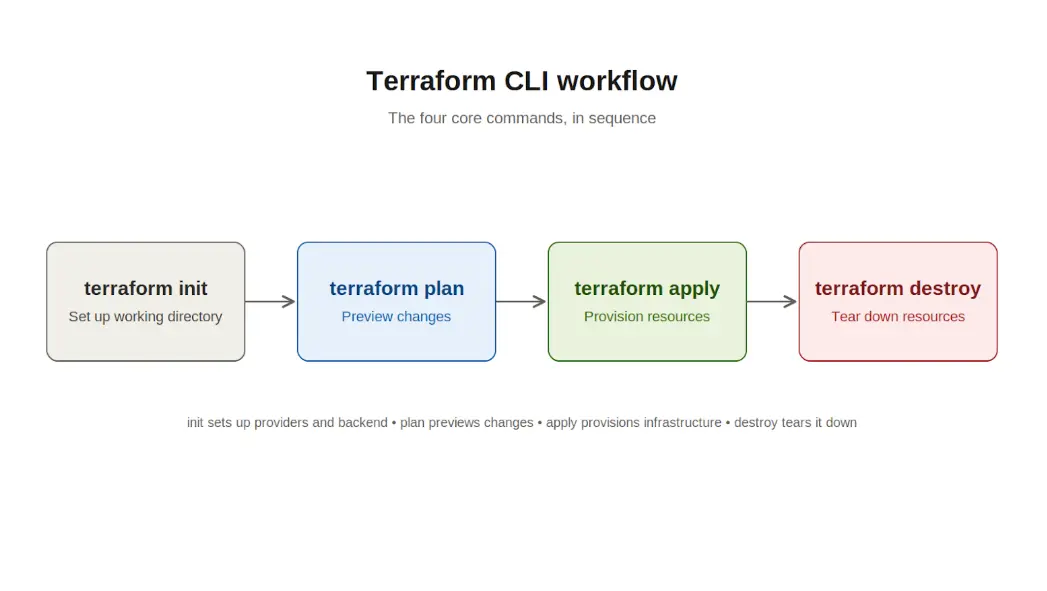
- Terraform CLI workflow — init, plan, apply, destroy, and what happens at each step
- Configuration — variables, outputs, and the .tf file structure, plus reading and troubleshooting existing configuration for errors
- State management — local vs remote state, state locking, and why state files matter
- Modules — how to structure reusable configuration
- HCP Terraform — workspaces, project organization, and how it extends the open-source workflow (this replaces the older, lighter "Terraform Cloud and Enterprise basics" framing from the 003 exam)
The exam leans heavily on practical understanding rather than memorized syntax. You're expected to reason through what a block of code will do, not just recall a definition.
Terraform Certification Guide: How to Prepare
A focused prep plan beats passive video-watching. Here's a practical sequence:
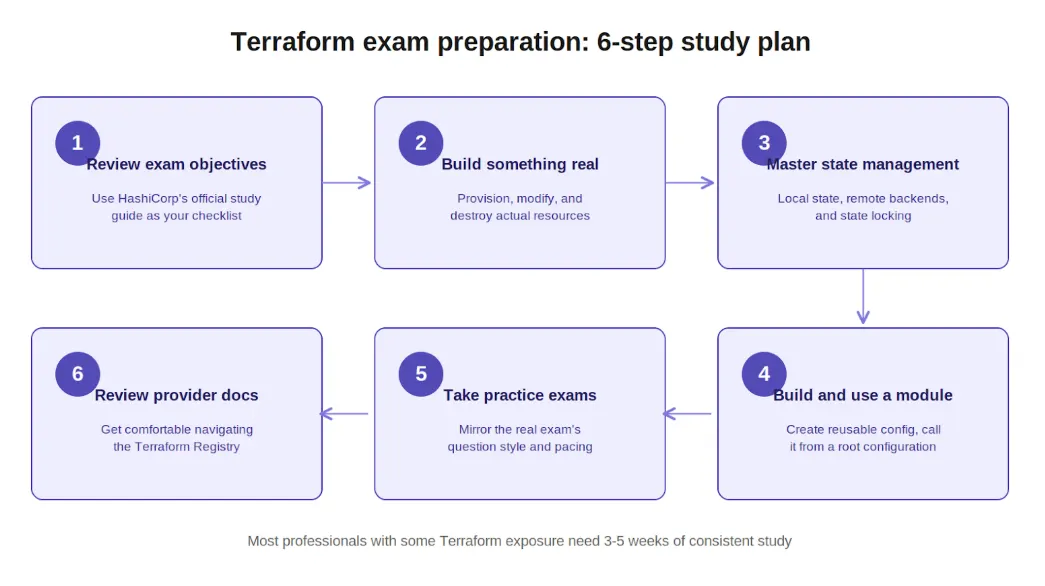
- Start with the official exam objectives. HashiCorp publishes a study guide listing every topic the exam covers. Use it as your checklist, not a suggestion.
- Install Terraform and actually build something. Provision a simple AWS or Azure resource, then modify it, destroy it, and rebuild it. Reading about terraform plan is not the same as watching it work.
- Study state management deliberately. This trips up more candidates than any other topic. Understand local state, remote backends, and state locking through practice, not just theory.
- Build and use a module. Create a reusable module, then call it from a root configuration. This is a guaranteed exam topic.
- Take practice exams. HashiCorp and several third-party platforms offer practice questions that mirror the real exam's style.
- Review provider documentation. You don't need to memorize every argument, but understanding how to navigate Terraform Registry documentation helps with real exam scenarios.
Most working professionals with some Terraform exposure need 3 to 5 weeks of consistent study, roughly 30–45 minutes a day, to prepare properly.
A few things worth keeping in mind as exam day approaches:
- Read every question fully before selecting an answer — several questions include distractors that look correct at first glance
- Flag uncertain questions and return to them rather than getting stuck
- Manage your time; with roughly 60 questions in 60 minutes, don't spend more than a minute on any single question during your first pass
- Don't just memorize CLI commands — understand what each one changes in your infrastructure and state file
- Pay close attention to variable precedence and how Terraform resolves values from .tfvars, environment variables, and defaults
- If your job doesn't give you daily Terraform exposure, build a personal lab using a free-tier cloud account to close that gap before the exam
For a broader view of where Terraform fits into your overall skill-building timeline, see our Terraform Roadmap for Cloud and DevOps Engineers.
Real-World Use Cases of Terraform Skills
Terraform shows up in day-to-day infrastructure work more often than most professionals realize before they start using it seriously. A few common scenarios:
- Provisioning multi-environment setups. Teams use Terraform to spin up identical dev, staging, and production environments from the same configuration, reducing "it worked in dev" issues.
- Managing infrastructure drift. When someone manually changes a resource outside of Terraform, terraform plan surfaces the difference, helping teams catch and correct configuration drift before it causes problems.
- Standardizing team workflows. Modules let teams package approved infrastructure patterns — a compliant VPC setup, for example — so engineers reuse tested configurations instead of writing everything from scratch.
- Supporting multi-cloud strategies. Organizations running workloads across AWS and Azure use Terraform's provider model to manage both with a consistent workflow, rather than learning two separate toolsets.
The certification matters most at two career points: moving from support or sysadmin roles into DevOps, and switching employers where Terraform is explicitly required. It's often paired with credentials like AWS, Azure, or CKA to build a rounded cloud profile. On its own, it opens conversations — combined with real Terraform projects, it strengthens your case in interviews.
Conclusion
The Terraform Associate Certification is really worth going for if you are serious about infrastructure as code and you want to show that you have the skills. It is not a replacement for doing the work, and it is not a shortcut. If you use it alongside real practice, it shows employers that you are credible.
If you are already using Terraform at your job, the exam objectives will help you see what you do not fully understand yet. If you are new to Terraform, use the certification as a guide to learn, not as the destination.
If you're preparing for the Terraform Associate exam and want a structured, hands-on learning path instead of piecing together scattered resources, explore MicroDegree's Terraform and DevOps upskilling programs built specifically for working IT professionals. You can also read our guide on building a career path from Cloud Support to DevOps Engineer for the bigger picture on where this certification fits into your journey.
JOIN THE FREE DEMO!
FAQs
1. Is the Terraform Associate Certification worth it for DevOps engineers?▼
Yes, it is. For DevOps engineers who work with cloud infrastructure, the Terraform Associate Certification shows that you have the skills for infrastructure as code, which is important for daily work. A lot of job listings ask for or prefer this certification.
2. How long does it take to get ready for the Terraform Associate exam?▼
Most people who have used Terraform before need to study for 3 to 5 weeks to cover the exam objectives and get hands-on practice.
3. Do you need to have work experience before you can take the Terraform certification exam?▼
There is no rule that says you have to. HashiCorp thinks it is better if you have around 6 months to a year of experience using Terraform. This will improve your chances of passing the exam.
4. Does the Terraform Associate Certification expire?▼
Yes, it is only valid for two years. After that, you need to retake the exam to keep the certification.
5. Is the Terraform certification enough to get a DevOps job?▼
No, it is not. It works best if you also have project experience, other cloud certifications, and a portfolio that shows you have skills. The Terraform Associate Certification is good, but it is not enough on its own to get a DevOps job. It is one part of what you need.