
What Does an MLOps Engineer Actually Do Every Day?

An MLOps Engineer manages the machine learning lifecycle, from model deployment to monitoring and maintenance in production. They automate ML pipelines, manage model versions, and ensure reliable deployments. They monitor system health, model performance, and data drift while troubleshooting production issues. They also manage cloud infrastructure, CI/CD, and scalability, collaborating with data scientists and developers. Their main goal is to make machine learning systems reliable, efficient, and maintainable in real-world environments.
This role is not about training models. An MLOps Engineer ensures that once those models are part of an application they can be deployed correctly, watched continuously updated, easily reproduced accurately and kept running over time.
Building a machine learning model is only one part of putting an AI system into production. A model may perform well during development but behave differently once it encounters real-world data. A deployment can fail, a training pipeline can break, infrastructure can become overloaded, or the model's performance can change as production data evolves.
This is where an MLOps Engineer plays an important role. An MLOps Engineer manages the operational side of machine learning and builds the processes that help teams train, test, deploy, monitor, and update machine learning models in a controlled and repeatable way.
Modern MLOps practices commonly include reproducible pipelines, model registration, deployment, monitoring, lineage, and lifecycle automation.
So, what does an MLOps Engineer actually do during a normal working day? The exact answer depends on the organization, but the role generally revolves around monitoring production systems, automating workflows, deploying models, managing infrastructure, troubleshooting problems, and collaborating with ML and engineering teams.
Table of Contents
▼What Does an MLOps Engineer Do
To understand the MLOps Engineer role, picture all the work that must happen after a machine learning model is built. A data scientist can create a model that predicts when customers will leave, detects transactions, suggests products or forecasts demand. That model still must join a live system where real users can use it and where it can be kept working for years.
The MLOps Engineer makes that transition possible. When a data scientist creates a model the MLOps Engineer can package the model, set up its runtime environment, link it to a deployment pipeline, configure the needed infrastructure and set up monitoring.
The MLOps Engineer also thinks about what happens after deployment. If a new model works poorly how can the earlier version be brought back? If the data in production changes how will the team notice? If retraining is needed how can that process be repeated without starting from scratch?
These questions are at the heart of MLOps. Microsoft's MLOps guidance talks about topics such as model lifecycle management, deployment, monitoring, automation and teamwork, between machine learning and engineering.

A Typical Day in the Life of an MLOps Engineer
There is no fixed schedule for every MLOps Engineer. Someone working at a startup may manage the entire ML platform, while an engineer at a large organization may specialize in deployment, infrastructure, monitoring, or automation.
Even so, several activities are common throughout the working day.
Starting the Day With Production Monitoring
An MLOps Engineer may begin by checking dashboards, alerts, logs, and recent deployments. The purpose is to make sure that machine learning services and their supporting infrastructure are operating normally.
They may review API response times, error rates, resource usage, failed pipeline runs, and the status of recently deployed models. They may also examine ML-specific signals, such as changes in the distribution of incoming data, which could indicate that the production environment is becoming different from the data used during training.
This is one reason monitoring is such an important part of MLOps. Deploying a model is not the end of its lifecycle; the model needs to be observed and maintained after it reaches production.
Investigating Production Problems
Suppose a model-serving application suddenly starts producing errors. The MLOps Engineer needs to determine what changed and where the problem originated.
They might examine application logs, infrastructure metrics, deployment history, configuration files, recent code changes, and model versions. The issue could come from the application, infrastructure, dependencies, configuration, or the model itself.
The engineer's job is not simply to restart the service and move on. They need to identify the underlying cause, apply an appropriate fix, and verify that the system has returned to a stable state. This troubleshooting ability becomes particularly valuable because production ML systems contain several connected components.
Improving Automation and CI/CD Pipelines
A significant portion of an MLOps Engineer's work can involve automation. Imagine that every time a data scientist produces a new model, someone has to manually test it, package it, deploy it, and verify that it works. That process may be manageable for one model, but it becomes difficult when a company has multiple models and frequent releases.
An MLOps Engineer can automate these steps through an ML pipeline. A typical workflow may connect code validation, training, evaluation, model registration, deployment, and monitoring, with additional approval or validation steps where required.
The exact stages depend on the organization, but the goal is to make the workflow repeatable and reduce unnecessary manual intervention.
Working With Data Scientists and Developers
MLOps is also a collaborative role. A data scientist may have developed a new model and need help moving it from an experimental environment into staging. The MLOps Engineer may package the model, configure its environment, connect it to the deployment pipeline, and make sure the required infrastructure is available.
They may also work with software developers who are integrating the model into an application, QA engineers who are validating the deployment, and cloud or infrastructure teams responsible for the underlying environment.
This means communication is an important part of the role. An MLOps Engineer needs to understand what different teams require and translate those requirements into reliable technical workflows.
Improving the ML Platform
Not every day involves responding to incidents. Experienced MLOps Engineers also spend time improving the platform itself.
They may simplify deployment processes, improve monitoring, reduce unnecessary infrastructure costs, strengthen security controls, or make model releases easier to reproduce. These improvements may not be visible to end users, but they make the entire ML development and deployment process more reliable as the organization grows.
What Are the Main MLOps Engineer Responsibilities

An MLOps Engineer helps deploy, automate, monitor, and maintain machine learning systems in production.
1. Model Deployment and Version Management
- Deploy ML models from development to production.
- Manage model versions and track changes.
- Maintain records of model data, code, configurations, and environments.
- Enable testing and rollback when deployments fail.
2. Building and Maintaining ML Pipelines
- Automate data preparation, model training, evaluation, and deployment.
- Add validation checks to ensure models meet quality standards.
- Build repeatable and reliable ML workflows.
3. Monitoring Models in Production
- Monitor CPU, memory, response times, availability, and error rates.
- Track model performance and prediction quality.
- Detect data drift and changes in incoming data.
- Troubleshoot production issues.
4. Managing Cloud and Infrastructure
- Manage compute, storage, networking, and security for ML systems.
- Work with tools such as AWS, Azure, Docker, Kubernetes, and Terraform.
- Automate infrastructure, support scalability, and maintain system reliability.
What Tools Does an MLOps Engineer Use
There is no single technology stack that every MLOps Engineer uses. Organizations choose different tools depending on their cloud provider, architecture, team size, and machine learning requirements.
| Area | Examples |
|---|---|
| Programming | Python |
| Version Control | Git, GitHub |
| Containers | Docker |
| Orchestration | Kubernetes |
| CI/CD | GitHub Actions, Jenkins, GitLab CI |
| Cloud | AWS, Azure, Google Cloud |
| ML Lifecycle | MLflow, cloud ML platforms |
| Infrastructure as Code | Terraform |
| Monitoring | Prometheus, Grafana |
What Skills Does an MLOps Engineer Need
An MLOps Engineer needs a combination of software engineering, infrastructure, cloud, automation, and machine learning knowledge.
Python is particularly useful because it is widely used in machine learning and automation. Linux and Git are also important foundations, while Docker and CI/CD help you understand how applications and ML workloads can be packaged, tested, and deployed.
Cloud knowledge becomes increasingly important when working with production systems. You should understand fundamental services such as compute, storage, networking, identity, and monitoring on at least one major cloud platform.
On the machine learning side, you should understand concepts such as model training, evaluation, model artifacts, experiment tracking, and retraining. You don't necessarily need advanced mathematical expertise or research-level ML knowledge to work in MLOps.
The key is understanding how a model moves through its complete lifecycle.
For IT professionals building this foundation, MicroDegree provides practical learning resources across Cloud, DevOps, Kubernetes, AWS, Azure, Linux, and AI technologies. Explore MicroDegree's FREE E-learning platform
A Real-World MLOps Workflow
Consider an e-commerce company that uses machine learning to recommend products to customers.
A data scientist develops a recommendation model using historical customer data. During development, the model performs well against the team's evaluation criteria, but the company still needs a reliable way to bring it into production.
The MLOps Engineer helps package the model and its dependencies into a reproducible environment. They connect the model to the deployment workflow and configure the infrastructure required to serve predictions.
Before production deployment, automated tests and validation checks can be run. Once the model meets the required conditions, it can be deployed to production.
But the process doesn't end there.
The engineer monitors the service and relevant model metrics after deployment. If the production data changes significantly or the model's performance declines, the team can investigate the cause and determine whether retraining or another intervention is necessary.
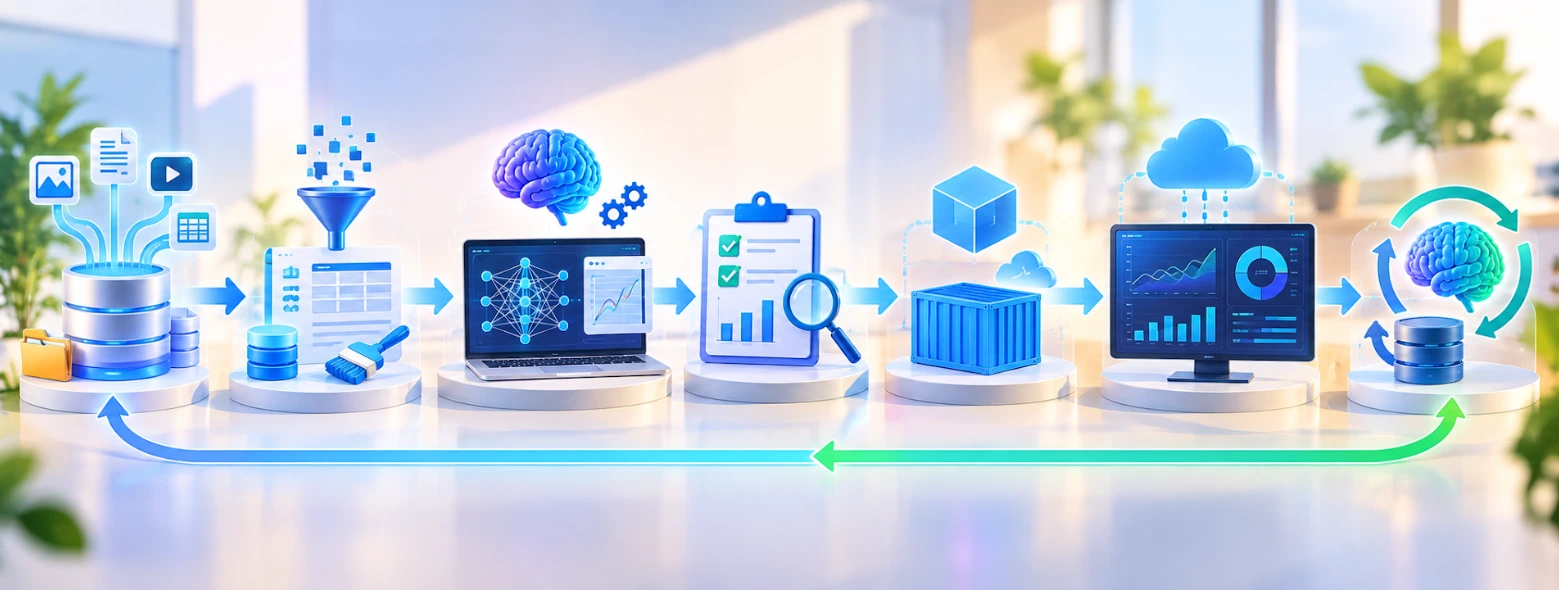
The overall lifecycle can be understood as developing the model, testing it, deploying it, monitoring its behaviour, evaluating its performance, and updating it when necessary. Modern MLOps architectures use automated workflows to support these stages and make machine learning systems easier to maintain over time.
How to Build a Career as an MLOps Engineer
If you already work in software development, DevOps, cloud, system administration, QA or application support you may already have part of the foundation required for an MLOps career.
The next step is to connect those existing skills with machine learning concepts. Start with Python and basic machine learning concepts strengthen Git, Linux, Docker, CI/CD and cloud fundamentals. Once you are comfortable with these areas move toward ML pipelines, model deployment, monitoring and lifecycle management for an MLOps workflow.
Hands-on projects are especially useful here. If building several unrelated machine learning projects try creating one complete system. For example build a prediction model expose it through an API package with Docker create a CI/CD workflow deploy it to the cloud and add monitoring. This gives you experience with the lifecycle of an MLOps solution rather than only the model‑building stage.
It also gives you a practical project to discuss during technical interviews.
If you want to strengthen the Cloud and DevOps foundation behind modern AI and MLOps workflows, MicroDegree provides practical learning resources across Cloud, DevOps, Kubernetes, AWS, Azure, Linux, and related technologies. Learn practical technology skills with MicroDegree
Conclusion
The easiest way to understand what an MLOps Engineer actually does every day is to look beyond the machine learning model itself.
Building the model is only one stage of the process. Someone needs to make sure that the model can be tested, deployed, monitored, updated, reproduced, and maintained when real users depend on it.
That is the core of the MLOps Engineer role. Their work can move between production monitoring, troubleshooting, CI/CD pipelines, cloud infrastructure, model deployment, automation, and collaboration with data scientists and engineering teams.
For professionals coming from software development, DevOps, cloud, or IT operations, MLOps brings these existing technical skills together with machine learning lifecycle knowledge.
The most effective way to understand the role is through practical work. Build a complete workflow, automate it, deploy it, monitor it, and understand how to respond when something goes wrong.
You can strengthen the Cloud, DevOps, Kubernetes, AWS, Azure, Linux, and AI skills that support modern MLOps workflows through the MicroDegree’s FREE E-learning platform.
FAQs
1. Is an MLOps Engineer involved in data engineering?▼
MLOps Engineers can work closely with data engineering teams because machine learning systems depend on reliable data pipelines. However, data engineering and MLOps are separate areas with different primary responsibilities. The amount of overlap depends on how a particular organization structures its teams.
2. Do MLOps Engineers work remotely?▼
MLOps work can often be performed remotely because many responsibilities involve cloud platforms, code repositories, monitoring systems, and collaboration tools. However, whether a specific role is remote, hybrid, or office-based depends on the employer and the nature of its infrastructure.
3. What is the difference between MLOps and ML Engineering?▼
MLOps generally focuses on operationalizing and managing machine learning workflows, while ML Engineering can involve building production machine learning systems and integrating models into applications. The distinction is not universal, and organizations may define the two roles differently.
4. Are MLOps Engineers required to work with GPUs?▼
Not necessarily. GPU requirements depend on the machine learning workload. Some models can be trained or served using CPUs, while computationally intensive workloads, including some large models, may require GPUs or other specialized hardware.
5. What does an MLOps interview usually test?▼
An MLOps interview can cover programming, Linux, Git, Docker, cloud platforms, CI/CD, infrastructure, monitoring, machine learning fundamentals, and troubleshooting. The specific topics depend on the company's technology stack and the responsibilities of the position.
6. Can an MLOps Engineer move into AI Engineering?▼
Yes. There can be considerable overlap between the two areas. Experience with model deployment, APIs, cloud infrastructure, monitoring, automation, and machine learning workflows can provide a useful foundation for AI Engineering. Moving into a specific AI Engineering role may require additional experience with AI application development, model integration, evaluation, and the technologies used by the organization.
MLOps brings together machine learning, cloud, DevOps, automation, and software engineering to make AI systems reliable in production.
If you're planning to move into this field, start by strengthening the technical foundations and then apply them through practical, end-to-end projects.