
How to Become an Agentic AI Engineer: Roadmap for IT Professionals

Your backend, cloud or automation experience is still useful, but AI-driven applications add a new problem: software can now choose a tool, read the result and decide what to do next. An Agentic AI Engineer Roadmap therefore needs more than prompt writing. It must connect models to APIs and company data, control state and permissions, test uncertain behaviour and run the system reliably.
This Agentic AI Engineer Roadmap is for working IT professionals who want that transition in a sensible order. You will see the prerequisites, seven learning stages, five portfolio projects, a 12-week practice schedule and role-specific entry points. “Agentic AI Engineer” is still an emerging title; similar work may appear under AI Engineer, LLM Engineer, AI Agent Developer or Generative AI Engineer. Treat this as a skill path, not a universal promotion ladder.
Table of Contents
▼What Does an Agentic AI Engineer Actually Do?
An Agentic AI Engineer builds applications in which a model can select approved tools, retrieve information, keep task state and complete a bounded sequence of actions. Imagine an incident agent: it reads an alert, queries logs, checks a runbook, proposes a cause, drafts a ticket and waits for an engineer before any restart. The engineering work is in the tool contracts, retrieval quality, state transitions, approval gate, tests and telemetry—not in making the model sound clever.
| Role | Usual centre of gravity |
|---|---|
| ML Engineer | Training, serving and monitoring predictive models |
| AI Engineer | Building broader AI-enabled applications and services |
| Generative AI / LLM Engineer | LLM integration, retrieval, evaluation and inference |
| Agentic AI Engineer | Tool-using, stateful workflows with bounded autonomy and approvals |
The boundaries overlap. Read AI Agents Explained for the plan-and-act loop and AI Engineer vs Generative AI Engineer for the adjacent career distinction; this article stays with the transition plan.

Prerequisites Before Learning Agentic AI
| Foundation | Working depth you need |
|---|---|
| Python | Write functions, classes, type hints, async calls, tests and error handling; you do not need to train a model. |
| REST APIs | Send authenticated requests, handle timeouts and retries, and read status codes. |
| JSON and schemas | Validate structured inputs and outputs instead of parsing free text. |
| SQL and databases | Model task records, query knowledge and persist state safely. |
| Git and GitHub | Work in branches, review diffs and document a reproducible project. |
| LLM basics | Understand tokens, context limits, sampling, embeddings and why output is non-deterministic. |
Readiness test: build a Python service that calls an API, validates JSON, stores a record and has tests. If that feels routine, begin; otherwise close those gaps.
Agentic AI Engineer Roadmap – Step by Step
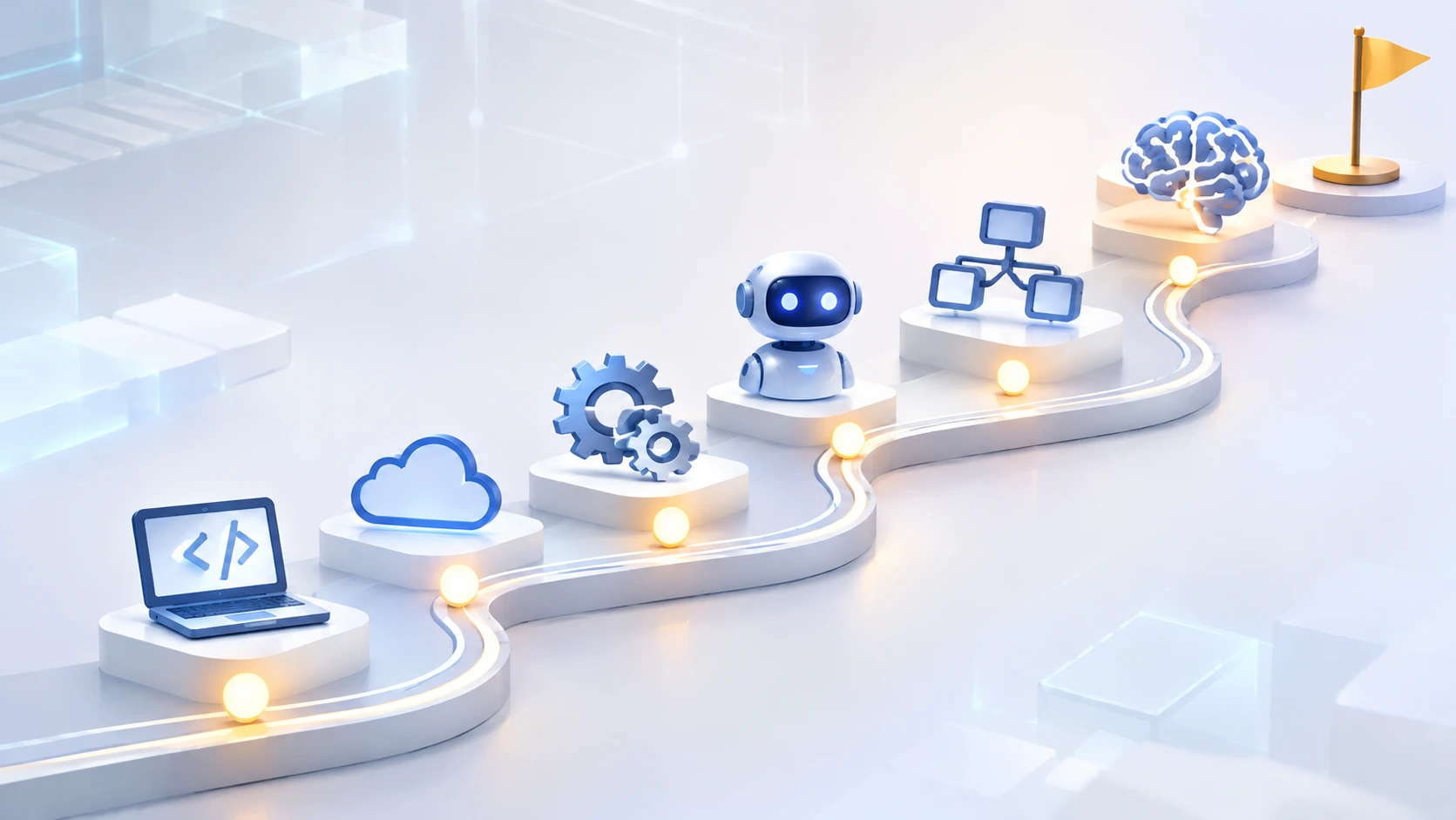
| Stage | Build before moving on | Evidence |
|---|---|---|
| 1. LLM fundamentals | Prompt-to-JSON service with two models | Schema pass rate, cost and latency notes |
| 2. Tools | One agent loop calling two safe APIs | Tool contract, errors and retry tests |
| 3. RAG | Cited answers over a small document set | Retrieval test cases and failure review |
| 4. Memory and state | A resumable task across sessions | State model and retention rules |
| 5. Workflows | Branches, limits and human approval | Trace of success and failure paths |
| 6. Framework | Rebuild the workflow in one framework | Reason for the choice, not a framework list |
| 7. Production | Evaluated, secured, deployed service | Tests, logs, cost budget and runbook |
Step 1: Master LLM Fundamentals
Learn how tokens and context windows constrain a request, then practise instructions, examples and structured output. Compare a small fast model with a stronger model on the same 30 test cases. Record accuracy, latency and cost. Model selection is an engineering trade-off, not a leaderboard decision. Your first deliverable should return validated JSON and reject malformed output.
Step 2: Learn Function Calling and Tool Integration
Function calling lets a model request a function with structured arguments; your application still decides whether and how to run it. Define narrow tools, validate arguments, set timeouts, handle rate limits and return useful error objects. Begin with read-only tools. Add idempotency and an approval step before a tool sends mail, changes a ticket or touches infrastructure.
Step 3: Understand RAG and Knowledge Retrieval
Retrieval-Augmented Generation (RAG) finds relevant source passages and supplies them to the model. Learn document chunking, embeddings, vector search, metadata filters and hybrid search. Test whether the retriever finds the right runbook before judging the final answer. Enterprise agents need citations, access controls and a rule for saying “not enough evidence”; a vector database alone does not provide those.
Step 4: Learn Agent Memory and State Management
State is what the current task needs: messages, tool results, approvals and the next step. Long-term memory is durable information reused across tasks, such as an approved user preference. Keep them separate. LangGraph, for example, documents checkpointers for thread-scoped state and stores for cross-thread information. Decide what is stored, who can read it, when it expires and how a user can correct it.
Step 5: Build Agent Workflows
Now combine task decomposition, tool selection and conditional branches. Put a maximum on steps, time and spend. Design explicit outcomes for tool failure, missing evidence and rejected approval. A deterministic workflow with one model decision is often safer than an open loop; Single-Agent vs Multi-Agent Systems can wait until one agent is observable and reliable.
Step 6: Learn One Agent Framework
Choose a framework after you understand the loop. LangChain offers agent building blocks; LangGraph suits explicit stateful graphs and resumable workflows. CrewAI organises agents and event-driven flows. AutoGen offers a high-level AgentChat API and a lower-level event-driven core. Build the same small workflow twice—plain Python, then one framework—so you can explain what the framework adds. Use the AI agent frameworks guide for a fuller comparison.
Step 7: Learn Evaluation, Security and Deployment
Create a versioned evaluation set covering correct tool choice, arguments, retrieval evidence, final answer and refusal. Run unit tests for individual nodes and end-to-end tests for traces. Treat retrieved documents and websites as untrusted: OWASP notes that indirect prompt injection can arrive through external content and that RAG does not remove the risk. Use least-privilege credentials, allowlists, output validation and human approval for consequential actions.
Containerise the service, deploy it behind authentication and log model version, tool calls, latency, token use, cost and final status without leaking secrets. Add tracing, budgets and a kill switch. Production readiness separates a portfolio chatbot from an engineering project.
5 Practical Agentic AI Projects to Build
1. AI-Powered IT Incident Management Agent
Objective: reduce the first investigation pass without giving an agent production control. Use Python, a ticket sandbox, log tools, RAG over runbooks and a stateful workflow. The agent correlates an alert, retrieves a runbook, gathers read-only evidence and drafts an update; a person approves ticket changes. Show tool permissions, redacted traces and failure tests.
2. Automated Research and Report-Generation Agent
Objective: produce a cited brief from an approved source list. The agent plans sub-questions, reads sources, extracts claims, flags conflicts and assembles a report for review. Use a search API, document store and structured outputs. Demonstrate provenance and a test that fails when a sentence has no supporting source.
3. Customer Support Resolution Agent
Objective: resolve routine cases while protecting account actions. The agent classifies intent, retrieves policy, asks for missing details and drafts a response. Refunds or identity-sensitive actions require authentication and approval. Use a helpdesk sandbox, RAG and an evaluation set with ambiguous and adversarial tickets. Show escalation rules and data-retention choices.
4. Multi-Agent Software Development Assistant
Objective: turn a small issue into a reviewed patch in an isolated repository. A planner proposes tasks, an implementer edits a branch and a reviewer runs tests; a human merges. Use Git, a container sandbox and strict termination conditions. Show why responsibilities are separated and what happens when tests fail.
5. DevOps Monitoring and Troubleshooting Agent
Objective: explain a service-health change from metrics, logs and deployment history. The agent chooses read-only queries, compares the event with a baseline and proposes next checks. Use an observability sandbox, Kubernetes sample app, Docker and tracing. Demonstrate bounded queries, secret redaction, cost limits and a no-action mode. Cloud engineers can also read AWS Agentic Engineering for the cloud-specific role angle.
How Long Does It Take to Become an Agentic AI Engineer?
| Weeks | Focus | Output |
|---|---|---|
| 1–2 | Python gaps, APIs and LLM fundamentals | Validated prompt-to-JSON service |
| 3–4 | Function calling and RAG | Read-only tool agent with cited retrieval |
| 5–6 | Memory and workflows | Resumable workflow with an approval gate |
| 7–8 | Framework and multi-step agents | One traced portfolio prototype |
| 9–10 | Evaluation, security and deployment | Test suite, threat model and container |
| 11–12 | Capstone and portfolio | Deployed demo, architecture note and runbook |
This is an illustrative schedule for someone who already codes and can protect six to eight focused hours a week. A Python beginner or a person learning only on weekends will need longer. Twelve weeks can produce one credible capstone; it cannot guarantee job readiness. Your evidence matters more than the calendar.
How IT Professionals Can Transition into Agentic AI
| Current role | Skills that transfer | Best first project |
|---|---|---|
| Software / Python developer | Application design, tests, debugging | Research or support agent with typed tools |
| Backend developer | APIs, databases, auth, queues | Stateful tool service with approval endpoints |
| DevOps / cloud engineer | Containers, IAM, telemetry, incident response | Read-only troubleshooting agent |
| QA / automation tester | Test design, fixtures, edge cases, CI | Agent evaluation harness with adversarial cases |
| IT support engineer | Ticket context, runbooks, escalation judgement | Support triage agent over a synthetic knowledge base |
Use your current domain as the test environment for your first agent. A QA engineer who exposes tool-selection failures or a support engineer who designs a safe escalation path has evidence a generic chatbot cannot provide.
Career Opportunities, Employer Signals and Adjacent-Role Pay
Search beyond one title: AI Engineer, LLM Engineer, Generative AI Engineer, AI Agent Developer, Applied AI Engineer and AI Platform Engineer may include the same work. Read the responsibilities, not just the heading. Useful signals include Python and backend depth, LLM and API integration, RAG, orchestration, evaluation, authentication, deployment and the ability to debug production failures.
There is not enough dependable public data for an Agentic AI Engineer salary table. The closest transparent sources I could read are below. They are adjacent-role indicators, not a salary promise. Figures were read in November 2026 and vary by company, skill, experience and city.
| Public source and role | India figure | Bengaluru figure | Caution |
|---|---|---|---|
| Flexiple, LLM Engineer (updated Aug 2026) | ₹10.4 LPA median; middle 50% ₹5.5–₹21.6 LPA | ₹16.2 LPA median; 4,127 records | Related technical role, not the exact Agentic AI Engineer title |
| Indeed, AI Developer (updated 10 Oct 2026) | ₹10.10 LPA average; ₹5.44–₹18.74 LPA range; 56 salaries | ₹11.48 LPA average | Average rather than median; small reported-salary set |
For experience bands and city detail, use the dedicated LLM Engineer salary guide. Do not average these two sources: they measure different roles and use different statistics.
Common Mistakes to Avoid When Learning Agentic AI
- Jumping into frameworks before you can write and test one tool loop in plain Python.
- Learning prompting without APIs, schemas, authentication and error handling.
- Building only chatbots instead of agents that complete a bounded task with real evidence.
- Testing a few happy-path prompts and calling the system reliable.
- Ignoring prompt injection, excessive permissions, private data and human approval.
- Adding multiple agents when one deterministic workflow is easier to observe.
- Stopping at a notebook instead of deploying, tracing and documenting the service.
Conclusion
The path is cumulative: Python and APIs, model fundamentals, safe tools, retrieval, state, controlled workflows, one framework and production discipline. Build one system deeply enough that another engineer can run it, inspect its traces and reproduce its tests. That is stronger evidence than collecting framework certificates.
If you want structured practice across Generative AI, Agentic AI, cloud and DevOps, MicroDegree offers instructor-led live online classes, morning and evening batches for working professionals, Kannada-first explanations designed to help you learn 10x faster, and 20+ practical capstone projects. Treat those as a learning environment; your own project quality and interview performance still determine the outcome.
Build Practical AI Engineering Skills with MicroDegree
Explore MicroDegree E-Learning to compare practical programs in Generative AI, Agentic AI, cloud and DevOps, and choose a project path that fits your current IT experience.
FAQs
1. Can I become an Agentic AI Engineer without a machine learning degree?▼
Yes, for application-focused roles, a strong software or platform background can be a practical starting point. You still need LLM fundamentals, retrieval, evaluation and security, but you do not need to begin by training foundation models.
2. Which programming language should I learn for Agentic AI development?▼
Start with Python because major AI libraries, examples and evaluation tools support it well. Keep TypeScript if your product stack uses it; the important skill is building typed, tested APIs and tool contracts.
3. Should I learn LangChain or LangGraph first?▼
Learn the basic model-tool loop first, then use LangChain for a small agent and LangGraph when you need explicit state, branches, persistence or human approval. The right order depends on the workflow you are building.
4. How many Agentic AI projects should be in my portfolio?▼
Two deep projects are usually more informative than five demos. For each, show the architecture, tool permissions, evaluation cases, failure handling, deployment and a short runbook; use the other ideas as smaller experiments.
5. Is a 12-week roadmap enough to get an Agentic AI job?▼
Not by itself. Twelve weeks can be enough for an experienced developer to build a credible capstone, but job readiness depends on prior coding depth, weekly practice, system-design ability and the quality of the evidence you can explain.