
Is CKA Worth It in 2026? Salary, Jobs & Career Opportunities

For IT professionals who're interested in DevOps, cloud engineering, site reliability engineering, Kubernetes administration or platform engineering the CKA Certification can be a helpful credential when you have real experience working with Kubernetes.
The Certified Kubernetes Administrator (CKA) is a certification that does not favor any one vendor. It is a performance-based certification offered by the Linux Foundation and the Cloud Native Computing Foundation. The exam today asks candidates to complete real Kubernetes administration tasks in a command-line environment. The exam takes two hours. It is based on Kubernetes version 1.35.
Just having a certification does not mean you will get a job or earn a certain salary. The value of the certification depends on how strong your technical background is, how much hands-on experience you have the role you are aiming for and how well you can work with related tools like Linux, Docker, cloud platforms, networking, CI/CD and infrastructure automation.
If you want to build a career, around Kubernetes the CKA can be a step. If the job you are going for does not use Kubernetes or cloud-native infrastructure then other technical skills might be more important to focus on.
Table of Contents
▼What Is CKA Certification
The Certified Kubernetes Administrator (CKA) is a professional certification created by the Linux Foundation and CNCF. It focuses on the practical skills required to administer Kubernetes environments.
One of the main differences between CKA and traditional theory-based certifications is the exam format. The CKA is performance-based, meaning you are given a Kubernetes environment and asked to complete real administrative tasks instead of simply selecting answers from a list.
The current exam duration is two hours. The Linux Foundation currently lists the exam-only price at US$445, although pricing can change. A registration includes 12 months to schedule the exam, two exam attempts, and two simulator attempts.
This practical approach matters because Kubernetes administration involves solving problems rather than simply knowing definitions. For example, knowing what a Kubernetes Service does is useful, but when an application becomes inaccessible, an administrator needs to investigate Pods, Services, endpoints, networking and logs to identify the actual problem.
That practical focus is what makes CKA Certification relevant for professionals who want to demonstrate Kubernetes administration skills. It can also provide a structured learning target for people moving toward DevOps, cloud infrastructure, SRE or platform engineering.
Why Kubernetes Matters in 2026
Kubernetes has become a part of modern cloud setups. Companies use it to run apps, microservices, internal platforms and distributed tasks.
The CNCF Annual Cloud Native Survey came out in January 2026. It said that 82% of people using containers were running Kubernetes in production. The same survey found that 66% of organizations hosting AI models were using Kubernetes for at least some of their inference workloads.
That kind of adoption opens up chances in different job roles. A DevOps engineer might use Kubernetes to automate app deployments. A cloud engineer could manage Kubernetes clusters on AWS, Azure or Google Cloud. An SRE might work with Kubernetes to make systems more reliable and fix issues in production. A platform engineer might build tools that help developers deploy applications faster and easier.
So when you look for CKA jobs don’t just hunt for titles like "Kubernetes Administrator." Kubernetes skills often appear as requirements in roles, like DevOps, cloud engineering, SRE and platform engineering.
This point is important when planning your career path. Only searching for jobs that mention CKA focus on positions where Kubernetes is actually part of the technical duties. That way you’ll find roles where your skills fit naturally.

What Does the CKA Exam Cover
The CKA focuses on practical Kubernetes administration, including troubleshooting, cluster architecture, networking, workloads, scheduling, and storage. Since the exam is hands-on, practicing real Kubernetes tasks is essential.
For practical preparation, check out our CKA Practice Guide: 20 Kubernetes Tasks to Master
CKA Salary and Job Opportunities in India
One of the questions professionals ask is: What CKA salary can I expect?
I have seen many people wonder about this. There is no fixed CKA salary for someone who holds this certification. Employers usually set pay based on the job role, experience, technical duties, company, location and overall skill set. A certification can make a profile stronger. It does not automatically decide to pay.
For example a professional with Kubernetes certification, years of DevOps experience and skills in AWS, Terraform and CI/CD will apply for very different jobs than someone who has just passed the exam but has no real infrastructure experience. I have seen this happen.
Higher-Paying Career Roles Where CKA Skills Are Relevant
CKA itself is not a job role. Instead, it can support a career path toward roles that involve Kubernetes, cloud infrastructure, automation and production systems.
| Career Role | Early Career | Mid-Level | Senior Level | Lead / Principal |
|---|---|---|---|---|
| Platform Engineer | ₹8–14 LPA | ₹16–26 LPA | ₹26–42 LPA | ₹38–60 LPA |
| Cloud Architect | ₹8–14 LPA | ₹18–28 LPA | ₹28–48 LPA | ₹42–70 LPA |
| DevOps Engineer | ₹6–11 LPA | ₹14–22 LPA | ₹22–38 LPA | ₹35–55 LPA |
| SRE | ₹7–12 LPA | ₹15–24 LPA | ₹24–40 LPA | ₹36–58 LPA |
The CKA Certification can strengthen your profile, but the larger career value comes from being able to use those skills in real production environments.
CKA Career Opportunities and Who Should Take It
| Role | How CKA/Kubernetes Skills Can Help |
|---|---|
| DevOps Engineer | Supports application deployment and infrastructure management using Kubernetes. |
| Cloud Engineer | Adds container orchestration skills to existing cloud infrastructure knowledge. |
| SRE | Relevant to reliability, scaling, monitoring, and production troubleshooting. |
| System Administrator / Infrastructure Professional | Helps when moving toward cloud-native environments. |
| Developer | Depends on career direction. For application-focused roles, a developer-focused Kubernetes path may be more relevant. For a move toward infrastructure, DevOps, or platform engineering, Kubernetes administration skills become more useful. |
A practical learning progression could look like:
Linux → Docker → Kubernetes → Cloud → CI/CD → Terraform → CKA
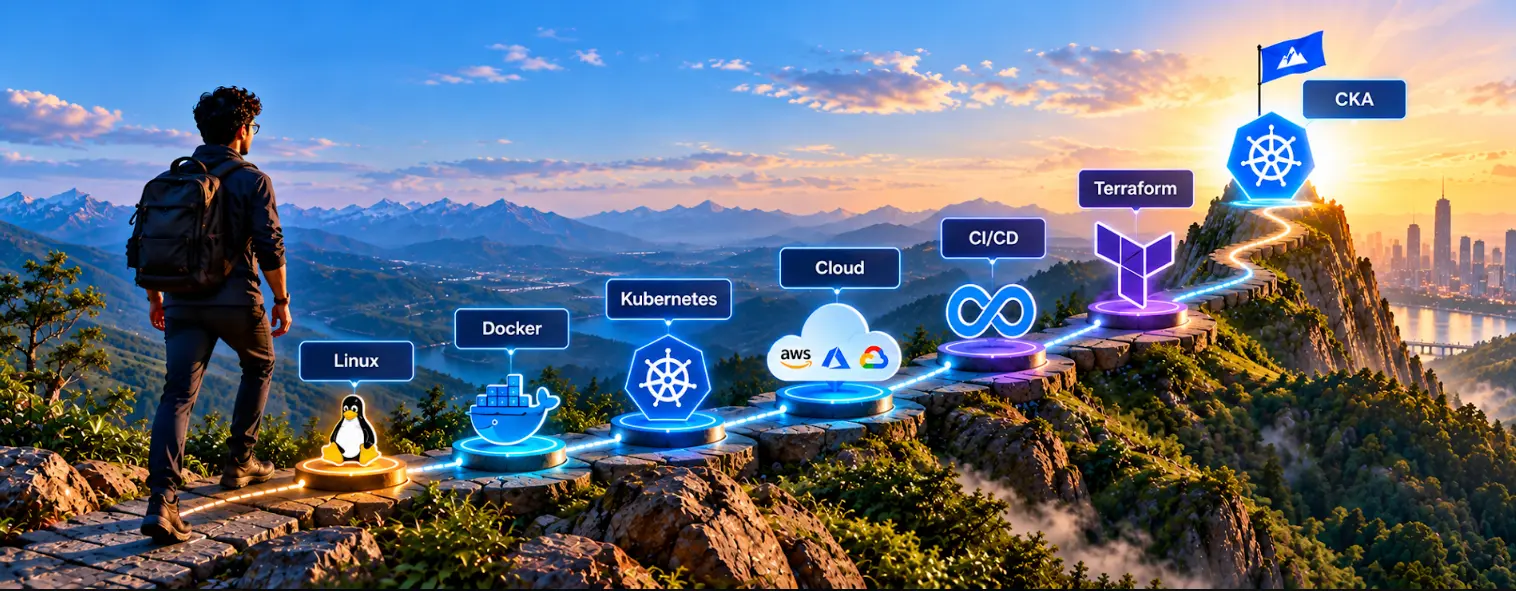
You don't have to master every technology before learning Kubernetes. The important thing is understanding how these technologies work together in a real development and deployment environment.
For professionals building this broader foundation, MicroDegree provides learning resources covering Kubernetes, DevOps, AWS, Azure, Linux and other cloud technologies. This allows you to build the surrounding skills instead of treating Kubernetes as an isolated certification topic.
Explore MicroDegree's practical technology learning resources
How to Prepare for CKA
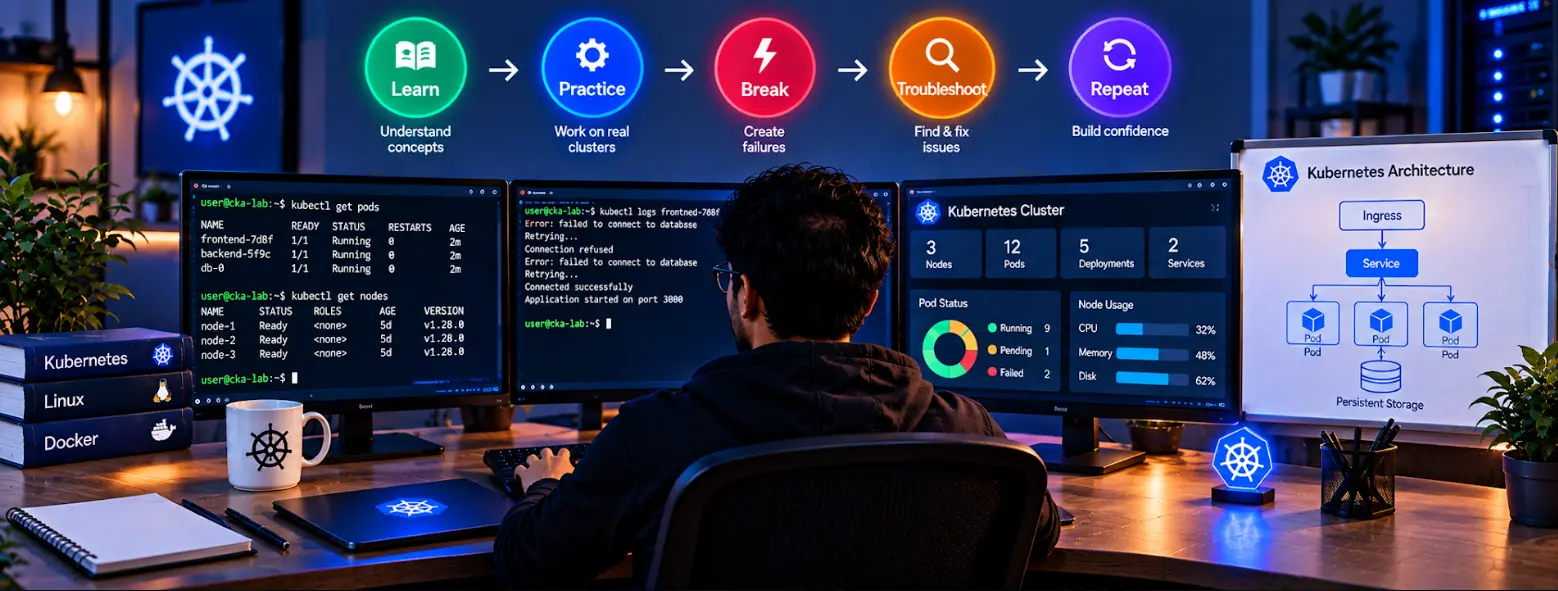
Preparing for the CKA requires hands-on practice with real Kubernetes administration tasks rather than simply memorizing commands. Focus on building practical skills through repeated practice in a Kubernetes environment.
For a structured set of hands-on exercises, check out our CKA Practice Guide: 20 Kubernetes Tasks to Master, which provides practical tasks to help you strengthen your Kubernetes skills and prepare for the exam.
Mistakes to Avoid When Preparing for CKA
- Certification alone does not make you job-ready. The CKA exam checks Kubernetes administration skills, but real jobs can also involve cloud infrastructure, monitoring, security, automation, incident response, and CI/CD.
- Real projects matter. When an interviewer asks, “What have you done with Kubernetes?”, explaining a project you deployed and troubleshooting is more useful than simply saying you studied for the certification.
- Do not ignore Linux and networking. Kubernetes runs on top of infrastructure, so troubleshooting may require knowledge of processes, ports, DNS, IP addresses, routes, containers, and resource usage.
- Choose certifications based on your target role. Before paying for an exam, review job descriptions for the positions you want and identify the skills employers require.
- Plan certifications around your career goals. Decide whether Kubernetes and the CKA Certification fit into your overall learning plan rather than collecting certifications without a specific goal.
Is CKA Worth It in 2026
For professionals targeting Kubernetes administration, DevOps, cloud engineering, SRE or platform engineering, the certification can be a useful way to validate practical Kubernetes knowledge.
The broader technology landscape supports its relevance. CNCF's 2026 Annual Cloud Native Survey reported that 82% of container users were running Kubernetes in production, while Kubernetes was also being used for some or all AI inference workloads by 66% of organizations hosting generative AI models.
But the value of CKA Certification depends on what you do with the knowledge.
If you simply add the certification to your resume, its impact may be limited. If you use the preparation to develop strong Kubernetes troubleshooting skills, combine those skills with cloud and DevOps technologies, and build projects that demonstrate your ability, the certification becomes much more meaningful.
The strongest approach is to treat CKA as one milestone within a broader cloud-native learning plan rather than as a standalone job guarantee.
If you are strengthening your broader cloud and DevOps foundation at the same time, explore MicroDegree's FREE E-learning to connect Kubernetes with related technologies.
Start Learning FREE: Build Your Cloud and DevOps Skills with MicroDegree
Conclusion
The CKA Certification is most valuable when you can connect the certificate to skills you can actually demonstrate. Learning how to deploy a workload is useful, but understanding why it failed, finding the root cause and fixing it is much more valuable in a real engineering environment.
If Kubernetes is part of the career you want to build, focus on practical learning first. Work with clusters, troubleshoot failures, build projects and understand how Kubernetes fits into cloud and DevOps environments.
Your next step could be to strengthen the skills around Kubernetes rather than studying the certification in isolation. MicroDegree offers practical learning resources across Cloud, DevOps, Kubernetes, Linux, AWS and Azure to support that broader learning path.
FAQs
1. What Career Opportunities Will Kubernetes Offer in 2026?▼
Kubernetes remains relevant to several infrastructure and engineering career paths, including DevOps, cloud engineering, SRE and platform engineering. Its production adoption remains significant, with CNCF reporting that 82% of container users were running Kubernetes in production in its 2025 survey published in January 2026.
2. What is the difference between Kubernetes and Docker?▼
Docker is commonly used to build and run containers, while Kubernetes is used to orchestrate and manage containerized workloads across clusters. In many development and production environments, they are complementary technologies rather than direct alternatives.
3. Can Kubernetes be used for AI and machine learning?▼
Yes. Kubernetes can be used to operate AI workloads, including model-serving and inference infrastructure. CNCF reported that 66% of organizations hosting generative AI models were using Kubernetes for some or all of their inference workloads in its 2025 survey.
4. Is Kubernetes only useful for DevOps engineers?▼
No. Kubernetes can also be relevant to cloud engineers, SREs, platform engineers, infrastructure engineers and developers working with cloud-native applications. The depth of Kubernetes knowledge required depends on the specific role.
5. Do you need coding skills to learn Kubernetes?▼
You don't need advanced programming skills to start learning Kubernetes. However, basic scripting and programming can become useful for automation, CI/CD, infrastructure management and troubleshooting. Bash and Python are particularly useful complementary skills.
6. How long does it take to become comfortable with Kubernetes?▼
There is no fixed timeline because it depends on your existing Linux, networking and container knowledge and the amount of hands-on practice you get. Someone with infrastructure experience may progress faster, while a beginner may need additional time to understand the underlying concepts.
Build Your GenAI, Cloud & DevOps Skills with MicroDegree
If you're planning to pursue CKA Certification, don't stop at exam preparation. Build practical skills across Kubernetes, Linux, Docker, cloud platforms, DevOps, CI/CD, and infrastructure automation so you can apply what you learn to real projects and job roles.
Explore MicroDegree's FREE E-learning platform and start building your GenAI, Cloud & DevOps skills.