
Cloud Administrator vs. Cloud Engineer: Which Role Requires Less Coding?

Want a cloud career without writing code all day? The **cloud administrator vs cloud engineer** choice matters because the two roles use automation differently. An administrator keeps cloud systems available, secure and controlled. An engineer designs and builds repeatable infrastructure.
In a **cloud administrator vs cloud engineer** comparison, the administrator usually needs less coding. That does not mean zero scripting. The employer, cloud platform and seniority decide where console work ends and automation begins.
Table of Contents
▼What does a cloud administrator do?
A cloud administrator looks after the day-to-day health of a company's cloud environment. If you are the person called when access fails, a backup misses its window or a virtual machine stops responding, the mindset will feel familiar.
- Manage accounts, subscriptions, permissions and billing alerts
- Create and maintain virtual machines, storage and networks
- Monitor availability, performance, logs and cost
- Run backups and test recovery
- Apply updates and respond to incidents
- Automate repeated checks or changes with Bash, PowerShell or Python
Microsoft's current Azure Administrator profile includes identity, governance, storage, compute, networking and monitoring. It also expects experience with PowerShell, Azure CLI and ARM templates or Bicep. Administration is the lower-code path, but current administration still rewards automation.

What does a cloud engineer do?
A cloud engineer designs, builds and improves the environment that applications run on. The work is less about processing one ticket and more about making the same safe change repeatable across accounts and environments.
- Design cloud architecture for applications
- Describe infrastructure with Terraform, CloudFormation or Bicep
- Build and maintain CI/CD workflows
- Work with containers and Kubernetes where the product needs them
- Automate provisioning, policy checks and operational work
- Review reliability, security and cost with developers and platform teams
Cloud engineer coding requirements are practical rather than application-heavy: scripting, infrastructure-as-code files, YAML or JSON configuration, Git and pipeline logic. You may not build a customer-facing application, but teammates must be able to review and safely reuse what you write.
Cloud administrator vs. cloud engineer: key differences
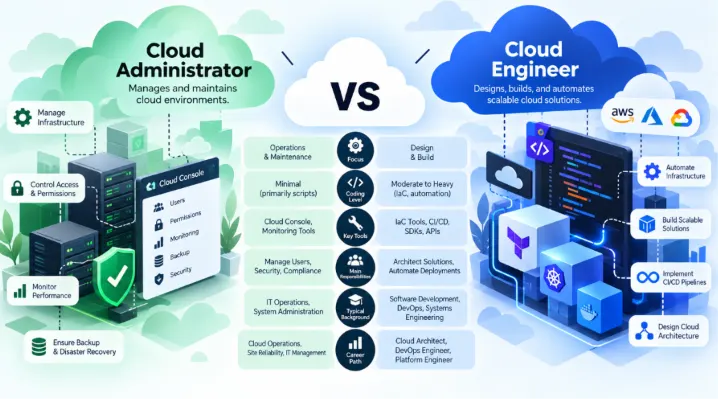
| Area | Cloud administrator | Cloud engineer |
|---|---|---|
| Main focus | Operate and maintain | Design, build and automate |
| Typical work | Access, backups, monitoring, support | Architecture, IaC, pipelines, containers |
| Coding level | Light to moderate scripting | Moderate scripting plus IaC |
| Common tools | Console, CLI, monitoring, ticketing | Terraform, Git, CI/CD, Docker, Kubernetes |
| Closest teams | Support, security, business operations | Development, DevOps, platform engineering |
| Work rhythm | Tickets, maintenance and incidents | Projects, releases and platform changes |
These are patterns, not fixed borders. A small company may give both sets of work to one person. Job titles also drift: cloud operations engineer, cloud support engineer and cloud systems administrator can describe administrator-style work. Read the duties and tools before trusting the title.
How much coding does each role need?
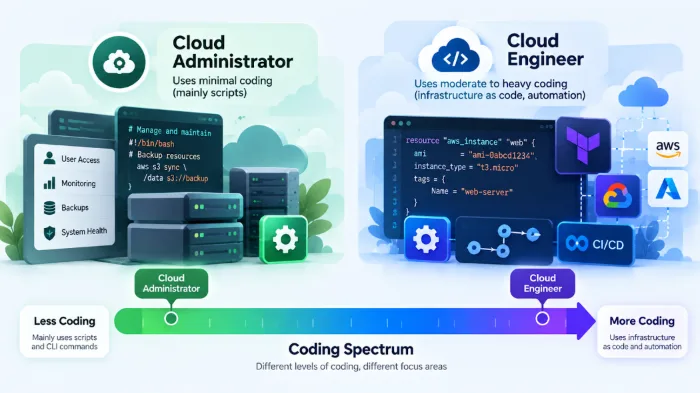
Administrators usually script repeated operational work: bulk account changes, scheduled shutdowns, usage reports, backup checks and clean-ups. Engineers use code to define the environment itself and to decide how changes move through testing and deployment.
A practical example
Imagine a company needs separate storage for 20 teams. An administrator might create the storage, apply permissions, check access and document it. A short script can make the repeated steps faster. An engineer is more likely to write one reviewed Terraform module that accepts the team names, creates all 20 resources and can reproduce them in another environment.
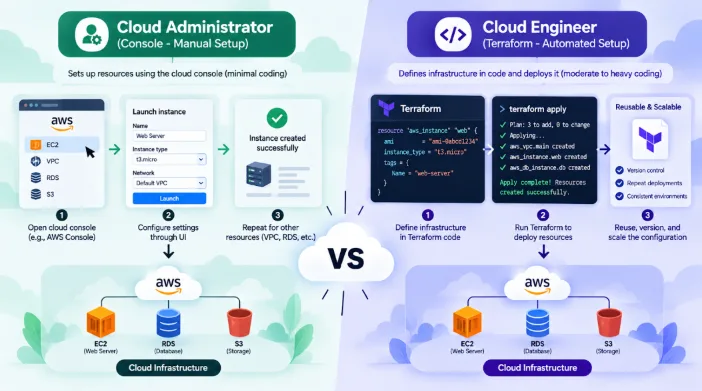
variable "team_names" {
  type = set(string)
}

resource "aws_s3_bucket" "team" {
  for_each = var.team_names
  bucket   = "company-${each.key}"
}
This fragment only shows the repetition pattern. It omits access policy, encryption, naming validation, state design and tests, so do not use it as a production bucket definition.
Which role requires less coding?
Cloud administration generally requires less coding. Administrators lean more on consoles, command-line tools and occasional scripts. Engineers maintain scripts, infrastructure code and pipeline configuration as a central part of the job.
- Search the tools in the advert. Python, Terraform, CI/CD and Kubernetes usually point toward the engineering end.
- Look for the outcome. Operating, monitoring, access and incident duties lean administrator; platform design and reusable provisioning lean engineer.
- Ask how changes reach production. Manual approval and console changes suggest lighter code; pull requests and automated plans suggest more.
The gap is narrowing. AWS's 2025 CloudOps certification update added more emphasis on automation and infrastructure as code. Even the lower-code route is moving toward scripts and repeatable configuration.
Cloud roles for non-programmers: where to start
You can enter cloud work without being an application programmer. Cloud administration, support, monitoring, identity and access management, governance and FinOps all value troubleshooting, networking and communication. If you come from support or system administration, those are transferable foundations.
Pick one scripting language and learn it through real tasks. Bash fits Linux-heavy work; PowerShell fits Windows and Azure environments; Python travels well across platforms. Start with a script you can run twice without breaking anything, put it in Git and explain its error handling.
Skills and a learning path for each role
| Build first | Administrator path | Engineer path |
|---|---|---|
| Cloud base | Identity, compute, storage, networking | The same base, then architecture trade-offs |
| Operations | Monitoring, backup, patching, incident response | Reliability patterns and automated policy checks |
| Automation | CLI plus one scripting language | Scripting plus Terraform, CloudFormation or Bicep |
| Delivery | Git basics and change records | Git branches, reviews and CI/CD workflows |
| Containers | Troubleshoot existing workloads | Build and operate container platforms when required |
Build four small projects in order: host a private static site through a controlled delivery path, add cost and CPU alerts, write a safe script that stops tagged idle resources, then recreate the setup with Terraform. If you prefer a structured route after that, MicroDegree's programs are one option to compare.
Cloud administrator vs cloud engineer salary in India
The table uses India-wide AmbitionBox ranges read on 24 October 2026. The pages were last updated in 2025. Their experience spans and sample sizes differ, so this is a market snapshot, not a like-for-like proof that one role pays more.
| Role | Experience shown | Annual range | Salary records |
|---|---|---|---|
| Cloud Administrator | 2-8 years | ₹3-12.6 LPA | 3,200 |
| Cloud Engineer | 1-7 years | ₹3-14.9 LPA | 19,000 |
AmbitionBox reported ₹3-12.6 LPA for Cloud Administrators with 2-8 years of experience, based on 3,200 salaries, and ₹3-14.9 LPA for Cloud Engineers with 1-7 years, based on 19,000 salaries. Company, city, skills and scope can move an offer outside these ranges. No reliable Bangalore-only administrator figure was available, so none is guessed.
How to choose the right role
- Choose administrator work if you enjoy access, incidents, monitoring and keeping systems stable.
- Choose engineering if you enjoy designing systems, reviewing changes and removing repeated work.
- Choose the lower-code starting point if it gets you practising sooner, then add scripting one useful task at a time.
- Open 10-15 current job listings in your city and count how often Python, PowerShell, Terraform, CI/CD and Kubernetes appear.
For a broader view of engineering responsibilities, read Which Cloud Skills Should You Learn After Your First IT Job?. If you already manage servers, compare this choice with What Should a System Administrator Learn First: AWS, Linux or DevOps?. The Cloud Engineer Salary in India guide adds more context around location and experience.
Frequently asked questions
Conclusion
Cloud administration usually requires less coding than cloud engineering. It still calls for CLI confidence and useful scripts, while engineering makes infrastructure code and delivery automation part of the core job. Start with the work you can practise now, then let real job descriptions show you how far toward automation your target market has moved.
FAQs
1. Cloud administrator vs cloud engineer: which is better for non-coders?▼
Cloud administration is usually the easier entry point because it centres on operations, access, monitoring and support. Basic scripting still matters, and current administrator profiles increasingly include command-line and infrastructure-template skills.
2. Do cloud administrators need to know programming?▼
They rarely need deep application-development skills, but Bash, PowerShell or Python helps with repeated operational tasks. The goal is safe automation, not building a large software product.
3. How much coding does a cloud engineer do?▼
A cloud engineer regularly works with scripts, infrastructure as code, configuration files and pipeline logic. The amount varies, but code is normally part of how the infrastructure is created and changed.
4. Can a cloud administrator become a cloud engineer?▼
Yes. Administration builds useful experience in networking, identity, security and incidents. Add Git, infrastructure as code, CI/CD and one portfolio project that can be rebuilt from a repository.
5. Do cloud engineers earn more than cloud administrators?▼
They can, but the ranges overlap and the available datasets are not matched by experience. AmbitionBox's India pages showed ₹3-12.6 LPA for administrators and ₹3-14.9 LPA for engineers; company, city, skills and scope matter.
Want to test the fit before committing to a path?Click here to take a free Cloud & DevOps demo