
Most In-Demand Cloud Skills in Bangalore (2026)

Open any cloud job listing in Bangalore and you will see the same pattern: a long list of tools, and no clue which ones matter most. If you are planning to learn cloud skills this year, that list makes it hard to decide where to start, and easy to waste months on the wrong thing.
The in-demand cloud skills in Bangalore 2026 job listings ask for most often come down to a short list. Which ones you need depends on the role, and job markets change faster than any article, so you can also check current demand yourself in about an hour.
Table of Contents
▼Which Cloud Skills Are in Demand in Bangalore in 2026?
The skills that keep appearing in cloud job descriptions are one major cloud platform (usually AWS, then Azure), Linux and networking, infrastructure as code with Terraform, containers and Kubernetes, CI/CD pipelines, cloud security and monitoring. Newer on the list are cost control and building AI features on the cloud.
This list is based on the skills that commonly appear in cloud job descriptions, not on a count of live job postings, so treat the order as a guide. A later section shows how to confirm it yourself.

Why Bangalore's Cloud Job Market Looks the Way It Does
Bangalore has product companies, startups, IT services firms and global capability centres, and many of them run on the cloud. That mix shapes which skills are asked for.
- Product companies and startups often want people who can build and run their own platform, so they ask for infrastructure as code, containers and CI/CD.
- Services and consulting firms often work on migrations and managed cloud for clients, so platform knowledge, certifications and security carry more weight.
- Global capability centres run large internal platforms, so monitoring, reliability and cost control are common requirements.
Because the market is broad, the best choice depends on the kind of company you want to join. If you are still deciding between platforms, our comparison of AWS, Azure and GCP for career growth in 2026 will help.
The 10 Most In-Demand Cloud Skills
| Skill | Why employers ask for it | Where to start |
|---|---|---|
| AWS or Azure core services | Almost every cloud role assumes you can work with compute, storage, networking and access control on one platform | Pick one platform and learn its core services with a free-tier account |
| Linux and networking | Most cloud servers run Linux, and most problems are networking problems | Command line, permissions, services, DNS, ports and load balancers |
| Infrastructure as code (Terraform) | Teams create servers from code so environments are repeatable | Write Terraform for a small network and server, and keep it in Git |
| Docker and Kubernetes | Applications are packaged in containers and run on clusters | Containerise one application, then deploy it to Kubernetes |
| CI/CD pipelines | Code must be built, tested and deployed automatically | Build a pipeline that deploys on every code change |
| Cloud security and access control | Misconfigured access is a common cause of cloud incidents | Identity and access management, secrets, encryption and network rules |
| Monitoring and observability | Teams need to see problems before users do | Metrics, logs, dashboards and alerts for your own project |
| Python and Bash scripting | Automation and glue code are part of nearly every cloud job | Automate a repetitive task from your own work |
| Cost control (FinOps) | Cloud bills grow quickly and companies want people who can control them | Budgets, tags, right-sizing and turning off unused resources |
| Building AI features on the cloud | More teams are adding AI assistants and search to their products | Use a managed AI service and learn the basics of retrieval |
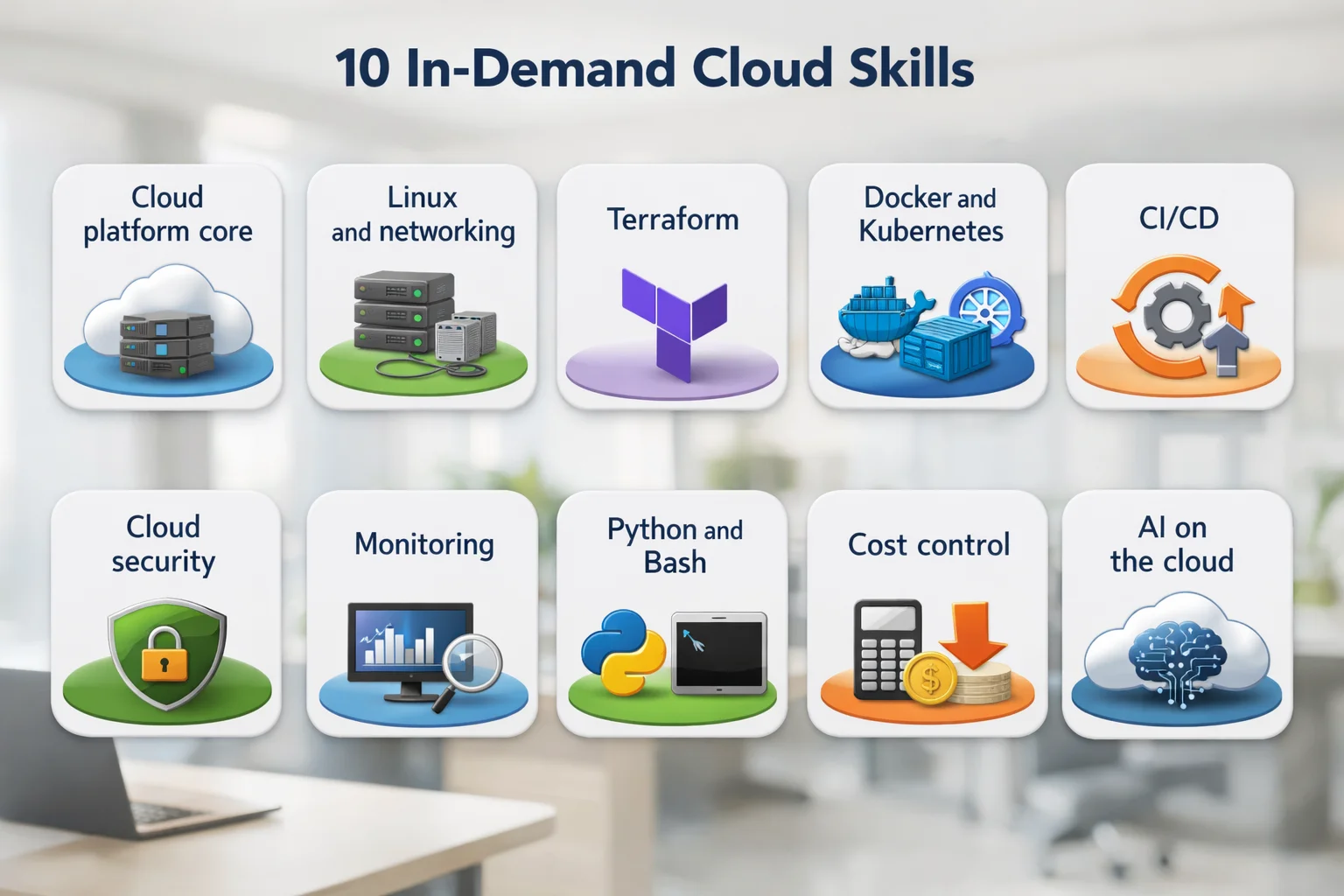
If you want help with the first skill, our guides to AWS services every cloud engineer should know and Linux for cloud cover the foundations.
Which Skills Matter for Which Cloud Role
You do not need all ten at once. Different roles stress different skills, so choose the role first.
| Role | Skills that matter most | Also useful |
|---|---|---|
| Cloud engineer | Platform core services, Linux, networking, security | Terraform, scripting, cost control |
| DevOps engineer | CI/CD, Docker, Kubernetes, Terraform, monitoring | Cloud platform, security, scripting |
| Cloud security engineer | Access control, network security, secrets, compliance basics | Scripting, monitoring |
| Cloud data engineer | Platform data services, Python, SQL, pipelines | Terraform, cost control |
| Cloud AI engineer | Platform AI services, Python, retrieval basics | Containers, monitoring, cost control |
To compare what these roles can pay, see our guides to cloud engineer salary in India in 2026 and the highest paying cloud computing jobs in India.
Certifications That Match These Skills
A certification is not a replacement for hands-on skill, but it helps a CV get shortlisted, especially at services firms. Match the certification to the platform you chose.
- Start with an entry-level certification on your platform, such as AWS Cloud Practitioner or Azure Fundamentals.
- Move to an associate-level certification once you have built a few projects.
- Add a Terraform or Kubernetes certification only after you have used the tool in practice.
Our cloud certification roadmap for 2026 explains which one to take first.
How to Check What Bangalore Employers Want Right Now
Demand shifts, so do a short check of your own before you commit months to a skill. It takes about an hour.
- Search a job site for the role you want, with Bangalore as the location, and open 20 recent listings.
- Write down every skill and tool named, and count how often each appears.
- Compare the counts with the table above, and keep the skills that appear in at least half the listings.
- Look at the experience level asked for, and focus on the listings that match your own.
- Repeat the check every few months, because tools and titles change.
The Order to Learn Them
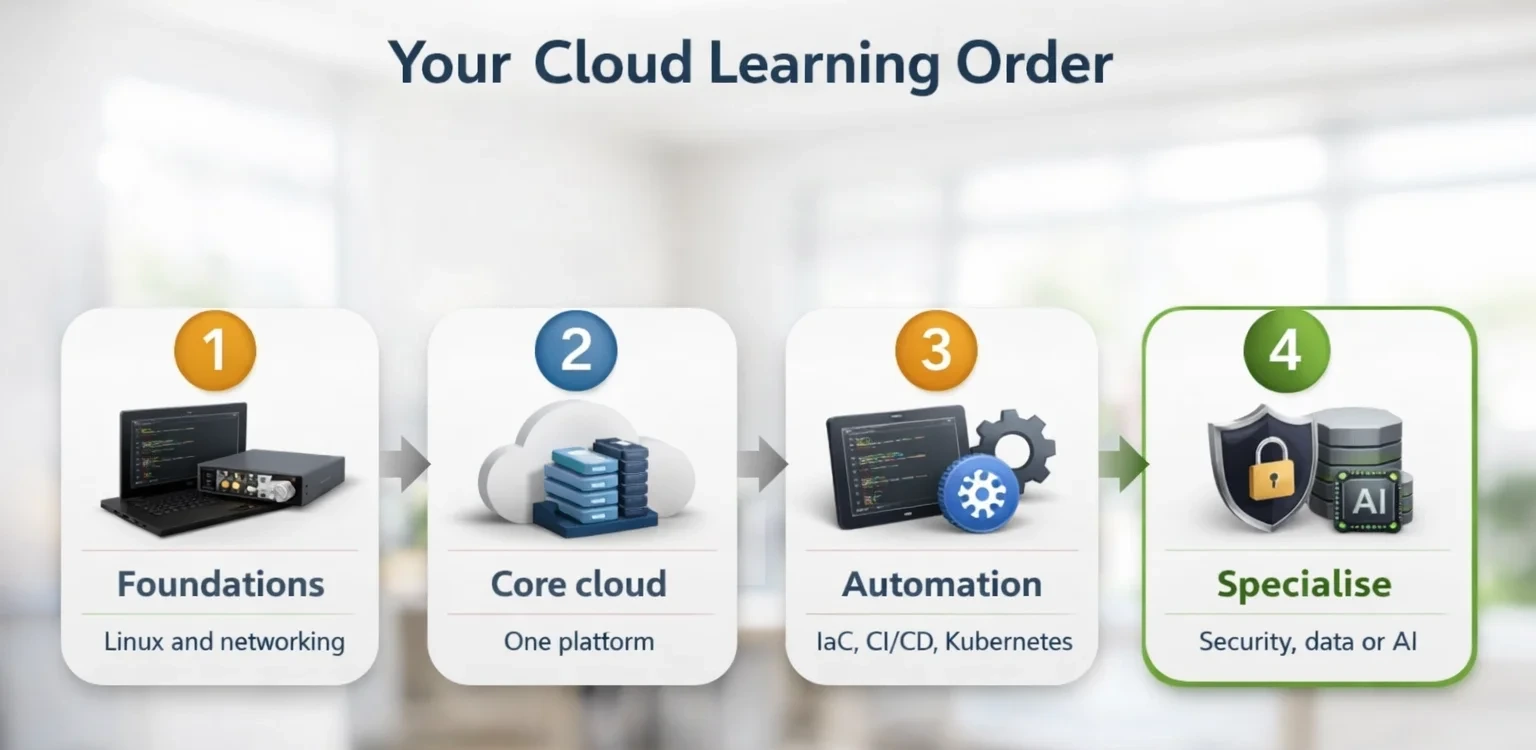
- Foundations: Linux, networking basics, Git and a little scripting.
- Core cloud: one platform, with compute, storage, networking and access control, plus an entry-level certification.
- Automation and operations: Terraform, CI/CD, Docker and Kubernetes, with monitoring and cost control, built into one project you can show.
- Speciality: cloud security, data or AI, depending on the role you want.
If you are working full time, our 90-day cloud and DevOps learning plan shows how to fit this around a job. A guided option is MicroDegree's learning programs.
Common Mistakes to Avoid
- Learning three cloud platforms at once. Go deep on one first.
- Starting with Kubernetes before Linux, networking and one cloud platform are comfortable.
- Collecting certificates without building projects.
- Copying a skills list without checking current job descriptions for your own role.
- Ignoring security and cost, which employers increasingly ask about.
- Waiting to feel ready. Start a small project this week.
Conclusion
To build the in-demand cloud skills in Bangalore for 2026, learn the foundations, go deep on one platform, add automation and containers, then pick a speciality. Confirm the details against current job listings for your own role, and build projects as you go. The wider picture is in our guide to future-proof IT skills beyond 2026.
FAQs
1. What are the most in-demand cloud skills in Bangalore in 2026?▼
The skills that appear most often are one major cloud platform such as AWS or Azure, Linux and networking, Terraform, Docker and Kubernetes, CI/CD, cloud security and monitoring. Cost control and building AI features on the cloud are also being asked for more often.
2. Should I learn AWS or Azure first for jobs in Bangalore?▼
Either is a sound choice. AWS has a broad market, while Azure is common in companies that already use Microsoft products. Check the job listings for the roles you want, choose one, and go deep before adding a second.
3. Do I need Kubernetes to get a cloud job?▼
Not for every role. Cloud engineer roles often focus on platform services, Linux and security. DevOps and platform roles ask for Kubernetes more often. Learn it after you are comfortable with the basics.
4. Is a cloud certification necessary in Bangalore?▼
It is not strictly required, but an entry-level certification can help you get shortlisted, especially at services firms. Projects you can explain in an interview usually carry more weight.
5. How long does it take to learn these cloud skills?▼
For a working professional, building a solid base usually takes several months of steady practice. The time depends on your starting point, the role you target and how many hours you can study each week.
6. Can I learn cloud skills while working full time?▼
Yes. A common pattern is an hour or two on weekdays and a longer block at weekends, practising on small projects. Short regular sessions work better than occasional long ones.
Still deciding which skills to start with?Click here to take a free demo