
RAG Evaluation: How to Measure AI Search and Retrieval Quality
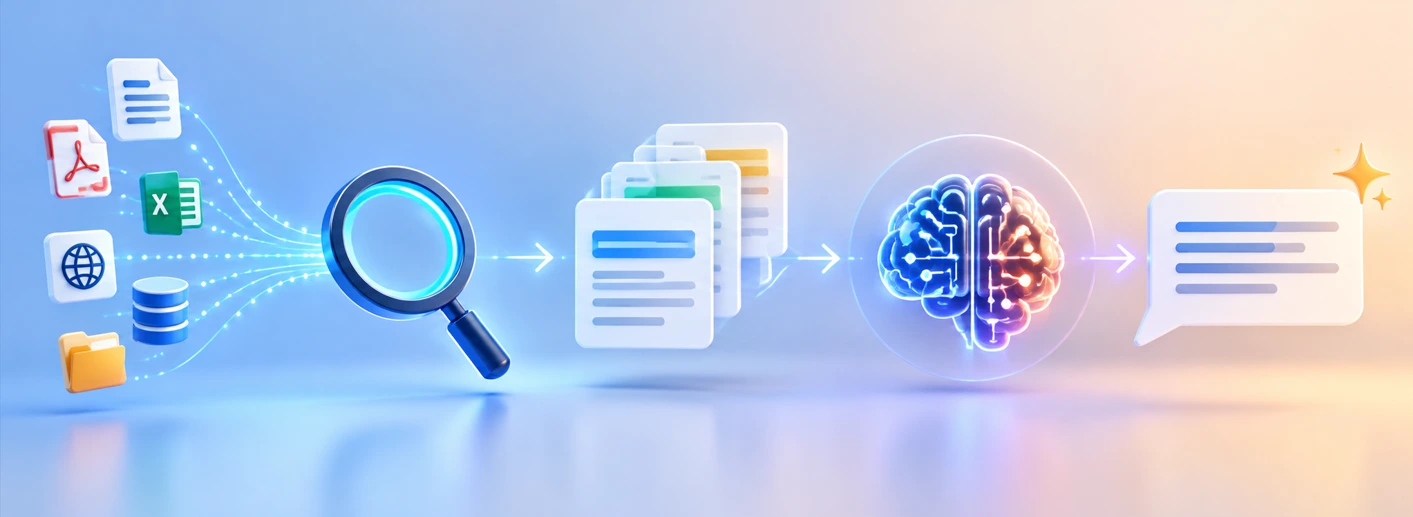
RAG evaluation helps ensure AI systems provide accurate, relevant, and trustworthy answers. It evaluates both retrieval quality and generation quality using metrics such as Precision, Recall, Faithfulness, and Answer Relevance. The blog also covers popular tools like RAGAS, TruLens, DeepEval, and LangSmith. Finally, it explains how to build a repeatable evaluation workflow and automate testing through CI/CD.
ALSO READ: Top 8 Generative AI Projects for Resume
Table of Contents
▼Introduction
If you've built a Retrieval-Augmented Generation (RAG) system, you already know that it can look impressive in a demo and still fall apart in production. The chatbot answers three questions perfectly, then confidently makes up a policy that doesn't exist. This is exactly why RAG evaluation has become one of the most important skills for anyone building AI search or question-answering systems today.
RAG evaluation isn't about running one test and getting a pass/fail grade. It's a structured way of checking two very different things — whether your system found the right information, and whether it used that information correctly to generate an answer. Get this wrong, and you'll spend weeks tuning the wrong part of your pipeline while the real problem sits somewhere else entirely.
In this guide, we'll break down what RAG evaluation actually means, walk through the retrieval evaluation metrics and generation metrics that matter, look at the tools engineering teams use to automate this process, and show you how to build a repeatable evaluation workflow.
What Is RAG Evaluation and Why It Actually Matters
RAG evaluation is the process of systematically measuring how well a Retrieval-Augmented Generation system retrieves relevant information and how accurately it uses that information to produce an answer. It's the quality-control layer that sits between "we built a RAG pipeline" and "we can trust this in production."
Here's why this matters more than it might seem at first glance. A RAG system has two moving parts: a retriever that searches a knowledge base (usually a vector database) for relevant chunks of text, and a generator (an LLM) that reads those chunks and writes a response. If the retriever pulls the wrong documents, the LLM has no chance of giving a correct answer — no matter how good the model is. On the flip side, even if the retriever does its job perfectly, a poorly prompted or poorly tuned generator can still ignore the retrieved context and hallucinate an answer anyway.
This is the core reason plain accuracy checks aren't enough. If you only look at the final answer, you can't tell which half of the system failed. Was it a retrieval evaluation problem — wrong or missing context? Or was it a generation problem — the model ignoring good context? Without separating these two, teams end up "fixing" the wrong component, tweaking prompts for weeks when the real issue was chunking strategy or embedding quality.
For working engineers, RAG evaluation also has a very practical business angle. AI search and internal knowledge assistants are increasingly used for things like customer support, compliance lookups, internal documentation search, and developer tooling. When these systems give wrong answers, the cost isn't just embarrassment — it can mean incorrect guidance to a customer, a support ticket that never gets resolved, or an engineer following outdated documentation. Structured evaluation is what turns a fragile prototype into something your organization can actually rely on.
Why Traditional Search Metrics Fall Short for RAG
Traditional information retrieval metrics were built for search engines — systems where a human reads a ranked list of results and picks the ones that look useful. RAG is different because there's no human in the loop at that stage. The LLM automatically consumes whatever the retriever hands it, which means low-quality or irrelevant context doesn't just lower search satisfaction — it directly corrupts the final answer.
This is why RAG evaluation borrows metrics from classic search evaluation (like precision and recall) but adds a whole new layer on top: metrics that check whether the generated text is actually faithful to the retrieved context. A search engine doesn't need to worry about "hallucination." A RAG system does, constantly.
Two Halves of One Pipeline: Retrieval vs. Generation
Every RAG evaluation strategy starts with accepting that you're evaluating two distinct stages, not one black box.
Stage 1: Retrieval. This is the search step. Given a user query, the system converts it into an embedding and searches a vector index (or a hybrid of vector and keyword search) for the most relevant chunks of text. Retrieval evaluation asks: out of everything in the knowledge base, did the system pull back the chunks that actually contain the answer?
Stage 2: Generation. This is where the LLM takes the retrieved chunks plus the user's question and writes a response. Generation evaluation asks: did the model use the retrieved context correctly, stay faithful to it, and produce an answer that actually addresses the question?
| Aspect | Retrieval Stage | Generation Stage |
|---|---|---|
| What it checks | Did the system find the right documents/chunks? | Did the model use those chunks correctly? |
| Failure mode | Missing or irrelevant context | Hallucination, ignoring context, incomplete answers |
| Typical fix | Better chunking, embeddings, re-ranking, hybrid search | Better prompting, context formatting, model choice |
| Common metrics | Precision@k, Recall@k, MRR, NDCG, Context Precision, Context Recall | Faithfulness, Answer Relevance, Groundedness |
Treating these as separate diagnostic layers is the single biggest shift in how engineering teams approach RAG evaluation today. If your generation metrics look bad, the first question shouldn't be "let's fix the prompt" — it should be "let's check if retrieval even gave the model a fighting chance."
RAG Evaluation Metrics You Need to Know
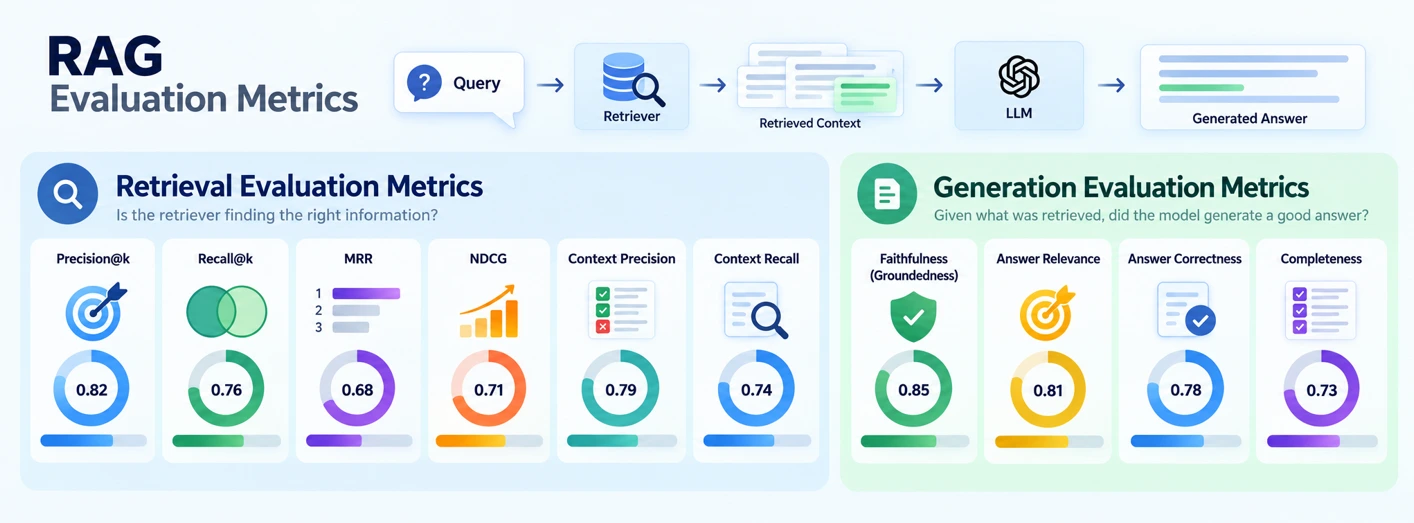
Once you accept the two-stage model, the next step is knowing which specific metrics to track at each stage. Below is a practical breakdown of the RAG evaluation metrics that show up most often in real-world evaluation pipelines.
Retrieval Evaluation Metrics
These metrics answer the question: "Is my retriever actually finding the right information?"
- Precision@k – Out of the top k chunks returned, what percentage are actually relevant to the query? High precision means low noise reaching the LLM.
- Recall@k – Out of all the relevant chunks that exist in the knowledge base, what percentage did the retriever manage to find within the top k results? This matters a lot when an answer depends on multiple scattered pieces of information.
- Mean Reciprocal Rank (MRR) – Measures how high up the first relevant result appears. If the correct chunk is ranked first, MRR is high; if it's buried at position ten, MRR drops sharply.
- Normalized Discounted Cumulative Gain (NDCG) – A more nuanced ranking metric that rewards placing highly relevant chunks near the top, not just any relevant chunk.
- Context Precision – A RAG-specific metric (popularized by evaluation frameworks like RAGAS) that checks whether the relevant chunks are ranked ahead of irrelevant ones in what's actually passed to the LLM.
- Context Recall – Checks whether the retrieved context contains all the information needed to fully answer the question, often compared against a reference/ground-truth answer.
Generation Evaluation Metrics
These metrics answer the question: "Given what was retrieved, did the model generate a good answer?"
- Faithfulness (Groundedness) – Measures whether every claim in the generated answer can actually be traced back to the retrieved context. This is the primary metric for catching hallucination in RAG accuracy testing.
- Answer Relevance – Checks whether the generated answer actually addresses the user's question, regardless of whether it's factually grounded. A faithful but off-topic answer still fails this check.
- Answer Correctness – When ground-truth reference answers are available, this compares the generated answer against them for factual overlap.
- Completeness – Whether the answer covers all parts of a multi-part question, not just the easiest sub-question to answer.
Retrieval Evaluation in Practice
Let's walk through a practical example. Say you're building an internal RAG assistant for a DevOps team that answers questions like "What's our rollback procedure for a failed Kubernetes deployment?"
For this to work, retrieval evaluation needs a small test set — a collection of realistic questions paired with the document chunks that should be retrieved to answer them correctly. This is often called a "golden dataset" or evaluation set. You don't need thousands of examples to start; even 30–50 well-chosen question-context pairs covering your most common query patterns can reveal serious retrieval gaps.
Once you have that test set, you run your retriever against each question and compare the chunks it returns against the expected ones. This is where Precision@k and Recall@k come in directly — you're literally checking the overlap between "what came back" and "what should have come back."
A few practical patterns worth knowing:
- If precision is high but recall is low, your retriever is accurate but too narrow — it's missing relevant chunks scattered elsewhere in the knowledge base. This often points to chunking that's too small or an embedding model that isn't capturing semantic nuance well.
- If recall is high but precision is low, you're retrieving too much noise along with the good stuff — often solved by adding a re-ranking step after initial retrieval.
- If both are low, the problem is usually more fundamental: poor chunk quality, a mismatched embedding model for your domain (technical documentation vs. general text), or missing metadata filters.
This kind of diagnostic clarity is exactly why separating retrieval evaluation from generation evaluation saves so much engineering time. You're no longer guessing — you're pointing at a specific, measurable weak spot in the pipeline.
Popular Tools and Frameworks for RAG Evaluation
You don't need to build RAG evaluation metrics from scratch. Several open-source and commercial tools have emerged specifically to automate this process, and most engineering teams pick one (or combine a few) rather than reinventing the wheel.
- RAGAS – An open-source Python library purpose-built for RAG evaluation. It implements LLM-as-a-judge versions of core metrics like faithfulness, answer relevance, context precision, and context recall, and integrates with common observability platforms, making it a common starting point for teams that want reference-free evaluation without hand-labeling huge datasets.
- TruLens – Focuses on instrumentation and tracing across the RAG pipeline, and is known for the "RAG Triad" approach — evaluating context relevance, groundedness, and answer relevance as three connected checks.
- DeepEval – An LLM evaluation framework with explicit support for testing retriever and generator components separately, often used inside CI/CD pipelines for regression testing.
- LangSmith – A tracing and evaluation platform from the LangChain ecosystem, useful for teams already building their RAG pipeline with LangChain, offering dataset management and automated scoring.
- ARES – A research-driven framework for automated RAG evaluation, often referenced in academic benchmarking of RAG accuracy.
The right choice depends on your stack and how much manual labeling effort you're willing to invest. Reference-free tools like RAGAS are attractive because they don't require a large hand-curated ground-truth dataset for every metric, which makes them practical for teams iterating quickly on a live knowledge base.
Building a Repeatable RAG Evaluation Workflow
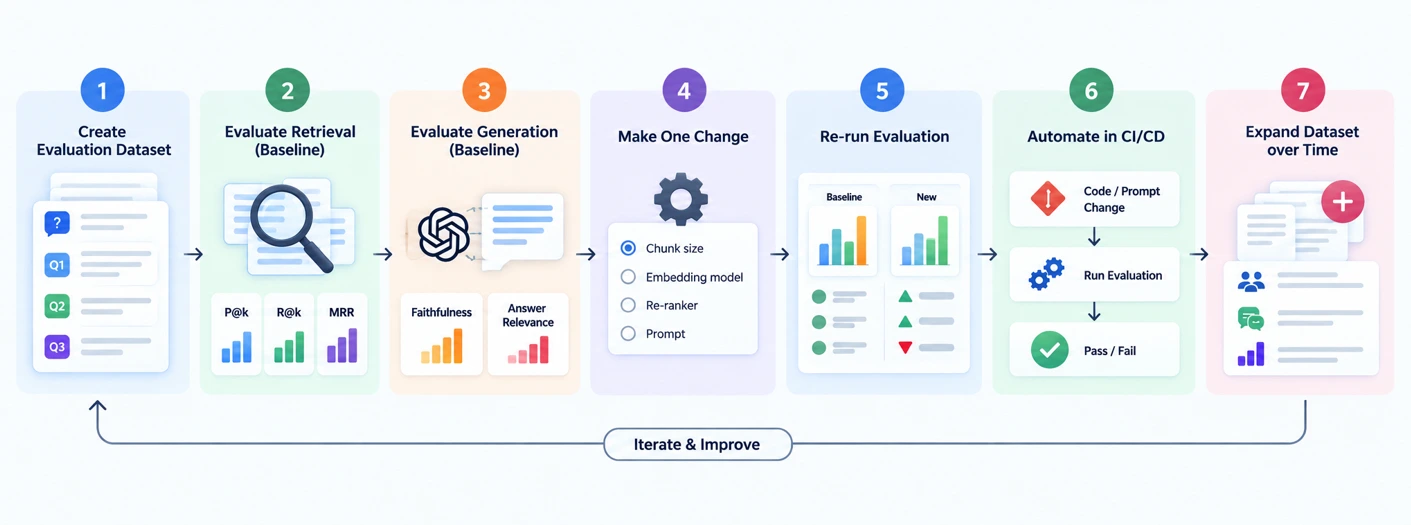
A one-time evaluation is better than nothing, but it won't protect you from regressions. Here's a practical workflow that engineering teams use to make RAG evaluation an ongoing part of development rather than a one-off audit:
- Build a small, realistic evaluation dataset. Pull real or representative user questions, and where possible, identify the correct source chunks and/or a reference answer for each.
- Run baseline retrieval evaluation. Calculate Precision@k, Recall@k, and MRR against your current retriever setup to establish a starting point.
- Run baseline generation evaluation. Use an evaluation framework (like RAGAS or DeepEval) to score faithfulness and answer relevance on the same question set.
- Make one change at a time. Adjust chunk size, switch embedding models, add a re-ranker, or tweak the prompt — but change one variable so you know what caused any shift in scores.
- Re-run the same evaluation set. Compare new scores against the baseline to see whether the change actually helped.
- Automate it in CI/CD. Wire the evaluation script into your deployment pipeline so any code or prompt change automatically re-runs the test set before it ships.
- Expand the dataset over time. As you spot new failure patterns in production (via user feedback or logs), add those cases to your evaluation set so you never regress on a bug you already fixed.
Conclusion
RAG evaluation isn't an optional extra step you bolt on before a demo — it's the discipline that determines whether your AI search or question-answering system can actually be trusted. By separating retrieval evaluation from generation evaluation, and by tracking RAG evaluation metrics like precision, recall, faithfulness, and answer relevance, you get a clear, diagnostic view of exactly where a system is succeeding and where it's failing.
The teams that consistently improve RAG accuracy aren't the ones with the fanciest models — they're the ones with a disciplined, repeatable evaluation loop that catches problems before users do. If you're building or maintaining a RAG system, start small: build a modest evaluation dataset, measure both stages of the pipeline, and make evaluation a permanent part of how you ship changes, not a one-time exercise.
If you want to go deeper into building and evaluating production-grade AI search systems, MicroDegree's applied AI and RAG courses walk through hands-on evaluation pipelines using real tools and datasets.
FAQs
Q1: What is RAG evaluation in simple terms?▼
RAG evaluation is the process of checking how well a Retrieval-Augmented Generation system finds relevant information and uses it to generate accurate answers. It typically involves two separate checks: retrieval evaluation, which measures whether the right documents were found, and generation evaluation, which measures whether the AI's answer is faithful to that retrieved information.
Q2: Can RAG evaluation be automated?▼
Yes. Frameworks like RAGAS, TruLens, and DeepEval automate much of RAG evaluation using an LLM-as-a-judge approach, scoring things like faithfulness and context precision without requiring a large hand-labeled dataset for every test.
Q3: How often should a RAG system be evaluated?▼
RAG evaluation shouldn't be a one-time task before launch. Because knowledge bases, prompts, and models change over time, evaluation works best as an ongoing practice — ideally automated into your CI/CD pipeline so every meaningful change (a new embedding model, a chunking strategy update, a prompt tweak) gets re-tested against your evaluation dataset before it ships.
Q4: What causes low RAG accuracy, and how do you fix it?▼
Low RAG accuracy usually comes from one of two places: the retriever isn't finding the right context, or the generator isn't using good context correctly. Retrieval problems are often fixed with better chunking, a more suitable embedding model, or adding a re-ranking step. Generation problems are often fixed by improving how context is formatted in the prompt, tightening instructions to the model, or in some cases switching to a stronger model. Running retrieval and generation evaluation separately is the fastest way to identify which one needs attention.
Q5: Do I need a large dataset to start evaluating my RAG system?▼
No. You can get meaningful signals from a modest evaluation set of 30–50 realistic question-context pairs that cover your most common and most important query types. What matters more than volume is relevance — the questions should reflect what real users actually ask, including edge cases and multi-part questions, not just easy examples.
RAG evaluation can feel overwhelming when you're staring at a dozen metrics for the first time — but you don't have to figure it out alone. If you're building or maintaining an AI search or RAG system at work, start with just two metrics: context precision and faithfulness. They'll tell you more about where your pipeline is breaking than almost anything else.
Want a structured, hands-on way to learn RAG evaluation, retrieval architecture, and production AI system design? Explore MicroDegree's applied AI courses, or drop a comment below with the RAG evaluation challenge you're currently stuck on — we read every one.