
How to Move from a Service Desk Job to a Cloud Engineer Role

A service desk to cloud career move is a bigger step than a promotion, but you do not start from zero. You already work a queue, follow incident and request processes, handle user access and read what systems tell you. What you add is the work behind those tickets: building and running the systems.
The short answer is that a service desk to cloud career move is realistic, usually takes more than one step, and goes faster for people who start using cloud tools on real tasks early. This guide redoes one ticket in the cloud with real commands and compares pay using named sources.
Table of Contents
▼What Your Queue Already Teaches You
Most daily service desk work has a cloud counterpart. The table pairs them, so you can see which parts you have already practised.
| Service desk task | Cloud engineering version |
|---|---|
| Password resets and account unlocks | Managing identities, roles and permissions in a cloud account |
| Software and hardware requests | Creating resources from templates and code instead of by hand |
| Incident tickets and priorities | Alerts, on-call incidents and severity levels |
| Knowledge-base articles | Runbooks and documentation the whole team uses |
| Escalating to second line | Working with developers and platform teams on a shared problem |
| Reporting on service levels and ticket volume | Dashboards for availability, performance and cost |

One Ticket, Two Ways: A Cloud Access Request
Take a request you handle often: a new colleague needs access. At the service desk you create the account, add it to the right group and tell the person to change the temporary password. In a cloud account the same job has the same shape: a user, a group and a permission policy. Here is that request in the AWS command line, using a practice account.
# 1. Create the user
aws iam create-user --user-name asha.dev

# 2. Give a first sign-in password that must be changed.
#    create-login-profile.json holds: UserName, Password (a temporary one) and "PasswordResetRequired": true
aws iam create-login-profile --cli-input-json file://create-login-profile.json

# 3. Add the user to an existing group and give that group a read-only AWS managed policy
aws iam add-user-to-group --user-name asha.dev --group-name read-only
aws iam attach-group-policy --group-name read-only --policy-arn arn:aws:iam::aws:policy/ReadOnlyAccess
Treat this as an exercise in a personal practice account, not a template for work. AWS's own guidance says people should sign in through an identity provider and use temporary credentials, and recommends IAM Identity Center for central access management. Where an IAM user is needed, it recommends multi-factor authentication and least-privilege permissions, and it notes that managed policies such as ReadOnlyAccess may not be least privilege for your case. The skill that transfers is deciding who should have access to what. For the full picture, read our guide to AWS IAM users, roles and policies.
The Roles Between the Desk and the Cloud
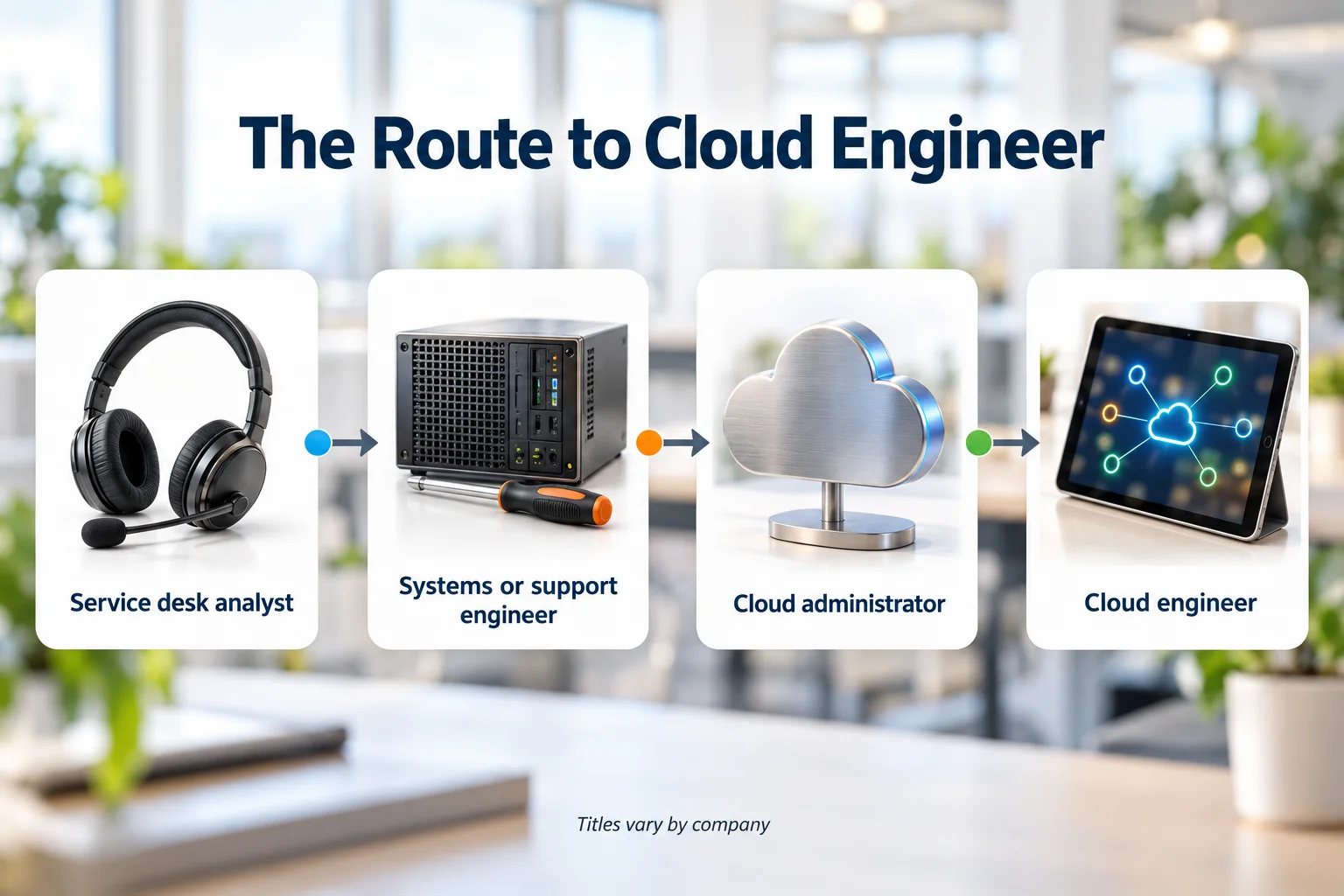
Few people go from the queue straight to a cloud engineer title. Career guides describe a route through systems or infrastructure work and cloud administration first, and the titles differ from company to company. Treat the route below as a common pattern, not a fixed ladder. If your company has a cloud team, ask whether it takes people from support on rotation.
What to Learn, and Why in This Order
The order below starts with what you can already see from the desk and moves towards what you build.
| Step | What to learn | Why it comes here |
|---|---|---|
| 1 | Networking basics: DNS, DHCP, subnets, firewalls | You see the symptoms in tickets every day, and cloud networks use the same ideas |
| 2 | The Linux command line and one scripting language | Many cloud servers run Linux, and a script replaces a task you would repeat by hand |
| 3 | Identity and access on one cloud platform | It is the closest cloud topic to the access requests you already handle |
| 4 | Compute, storage and networking on the same platform | This is where you start building what users reach |
| 5 | Infrastructure as code | It records what you built in files that a team can review and repeat |
| 6 | Monitoring and a basic delivery pipeline | It connects the building to the incident work you already know |
Which Certifications Help, and When
Certifications show that you have covered the foundations. They do not replace hands-on practice. AWS describes its Certified Cloud Practitioner as validating a foundational, high-level understanding of AWS Cloud, services and terminology, and says candidates may have up to six months of exposure to AWS but do not need it. Microsoft calls Azure Fundamentals a common starting point for a career in Azure, aimed at people with experience in an area of IT such as infrastructure management. Career guides for help desk staff also list CompTIA A+ and Network+ at the entry stage and an AWS or Azure certification later. Pick the one that matches the platform you will practise on. Our AWS Cloud Practitioner guide covers the first AWS option.
Say It in Cloud Terms
The wording on a service desk resume often hides how much of the experience applies. These before and after lines show the idea. Only claim what you did, and add numbers only if you have them.
| Service desk wording | Wording that shows the overlap |
|---|---|
| Resolved user tickets within SLA | Worked an incident queue to service-level targets and recorded the cause of recurring issues |
| Reset passwords and managed accounts | Managed user accounts and access rights, and rebuilt the same task with roles and policies in a personal cloud account |
| Wrote knowledge-base articles | Wrote runbooks that other engineers used to fix common faults |
| Escalated to second line | Handed incidents over with the steps taken, the evidence and the timeline |
Service Desk vs Cloud Engineer Pay in Bangalore and India
Flexiple's salary pages publish self-reported annual pay, counted as the total package a year (cost to company). Flexiple has no page for a service desk analyst, so the technical support engineer page is used as the closest match. The figures are medians from pages updated in August 2026, read in October 2026. The first three columns are India-wide medians by experience that Flexiple does not re-cut to Bengaluru, and only the last column is specific to the city. All figures are in lakh rupees a year (LPA).
| Role | 0 to 3 years | 3 to 6 years | 6+ years | Bengaluru, all levels (middle 50%) |
|---|---|---|---|---|
| Technical support engineer (closest to service desk) | 4.2 | 6 | 10.7 | 6.9 (4.5 to 13) |
| Cloud engineer | 5.3 | 7.8 | 16.6 | 9.8 (6.4 to 17.5) |
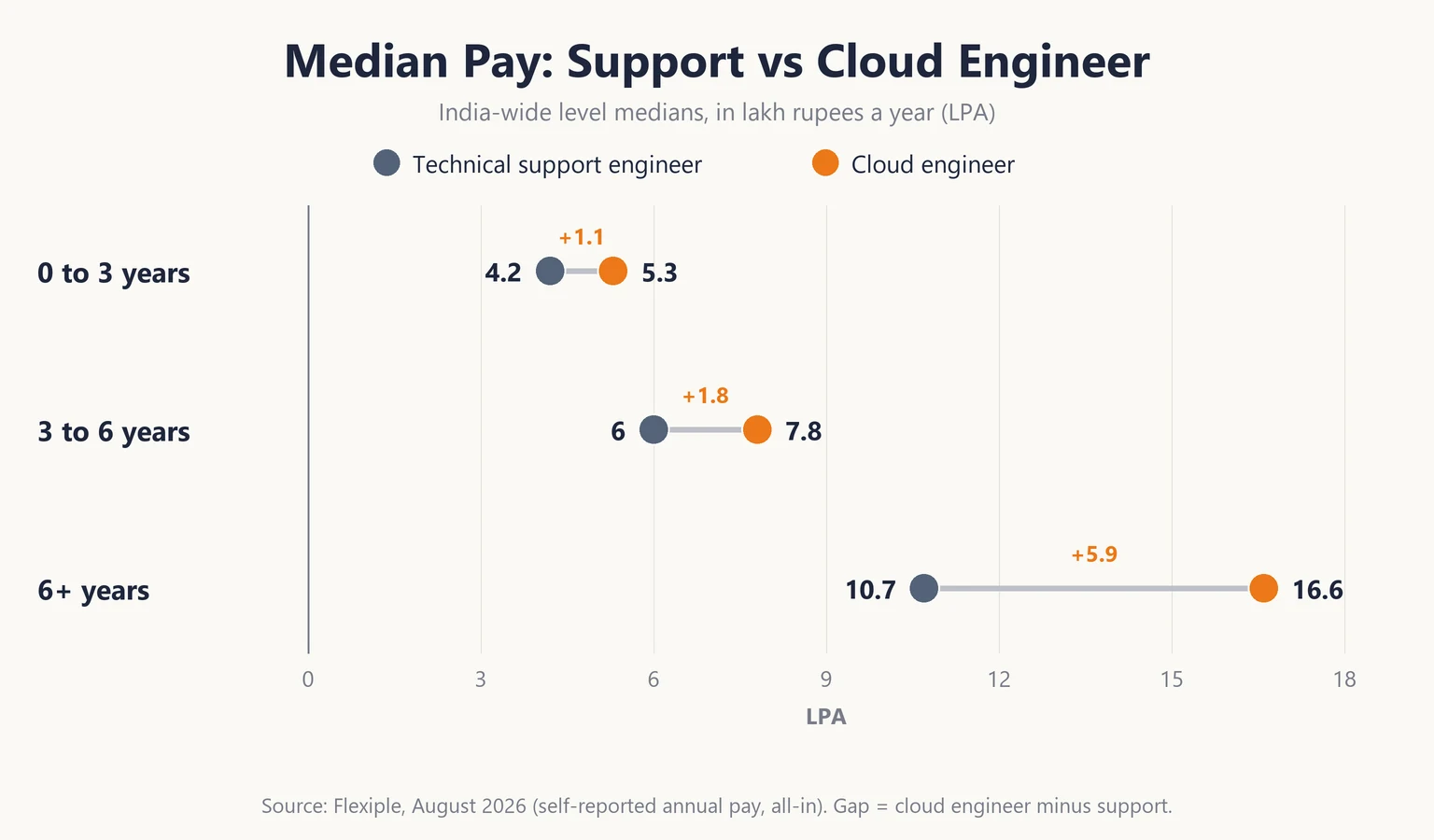
Treat these as estimates that vary with company, skills and city. Each Flexiple page's own FAQ gives different level medians from the main figures used here. As a cross-check, PayScale's Service Desk Analyst page for India shows an average base salary of ₹448,125 from 117 profiles, updated on 11 March 2026, which is a different basis from Flexiple's: base pay for India as a whole, not total package. PayScale has no cloud engineer page to pair with it. In the Flexiple data, the cloud engineer median is higher at every level, by 1.1 LPA at 0 to 3 years, 1.8 LPA at 3 to 6 years and 5.9 LPA at 6+ years. That gap widens with experience, and it does not promise a raise for any one person. For more detail, see Cloud Engineer Salary in India 2026.
Where to Start This Week
- Open a cloud account for practice and set a spending alert before you create anything.
- Redo one real service desk task there, such as the access request above, using the command line.
- Write down what you did as a short runbook, the way you would for the knowledge base.
- Ask your team lead whether any cloud-related tickets or projects need an extra pair of hands.
- Choose one foundational certification for the platform you practised on, and book the exam only when you are ready.
If you want a guided route alongside your current job, MicroDegree's learning programs are one option to compare. Our guide on the move from desktop support to Azure administrator covers a neighbouring route.
Conclusion
A service desk gives you the user's view of IT: how access, incidents and outages look when they land on a person. A cloud engineer role adds the builder's view of the same system. Start with the cloud version of a task you already do, write it up, and let each small piece of proof lead to the next role on the route.
FAQs
1. Can a service desk analyst become a cloud engineer?▼
Yes, though it usually takes an intermediate step, such as a systems, infrastructure or cloud support role. Your ticket, access and incident experience carries over, and the building skills are the part you add.
2. How long does the move take?▼
It depends on how much time you can practise and how much of the networking and Linux basics you already know. Measure progress by what you have built and written up, not by a calendar.
3. Do I need to learn to code?▼
Scripting helps a great deal, because it replaces repeated manual work. Infrastructure as code uses configuration files, which you can pick up after the command line and one scripting language.
4. Which cloud platform should I start with?▼
Start with the one your company or your target employers use, and go deep before adding another. AWS and Azure are both common choices.
5. Is a certification required?▼
Not as a rule. A foundational certification shows you have covered the basics, but employers also look for proof that you have built something, so pair it with a practice project.
6. Does a cloud engineer earn more than a service desk analyst?▼
In the Flexiple data above, the cloud engineer median is higher at each level and the gap widens with experience. Ranges are wide, the comparison uses technical support as the closest match, and the sources differ, so treat it as an estimate.
Would a closer look help?Click here to take a free Cloud & DevOps demo