
Best Cloud Computing and DevOps Training Institutes in Mangalore
You've spent six or eight years keeping networks, servers or applications running, and now every job description mentions AWS, Kubernetes or CI/CD. So you search for cloud and DevOps courses in Mangalore and find hardware institutes, certification centres, company internships and online platforms, with little to tell them apart.
This guide covers what an experienced professional should look for in a course.
Table of Contents
▼Why do cloud and DevOps skills matter for experienced IT professionals?
The work you already do is moving onto platforms built from code. Network engineers now design cloud networks, sysadmins automate setups instead of logging in to servers, and developers own their deployments. These are the pieces that show up in real job descriptions:
- Cloud infrastructure: servers, storage and networks rented on demand, so capacity planning becomes architecture and cost decisions.
- Infrastructure automation: Terraform or Ansible make environments repeatable instead of hand-built.
- Containers: Docker packages an app with its dependencies so it runs the same everywhere.
- CI/CD pipelines: Jenkins or GitHub Actions build, test and deploy every change.
- Kubernetes: schedules and restarts containers across machines, and running clusters is a job in itself.
- Cloud-native development: applications built as small services on managed databases and queues.
- Platform engineering: internal platforms that let developers deploy without raising tickets.
- Site Reliability Engineering: running services against reliability targets with monitoring and incident response.
A tool list on a brochure says little about whether a course prepares you for any of this.
Most institutes publish a tool list but not depth, duration, batch timings or fees. Ask for those in writing, plus a sample session.

Which institutes offer cloud and DevOps training in Mangalore?
MicroDegree – Cloud, DevOps & AI Certification Program
MicroDegree offers a Cloud, DevOps & AI Certification Program designed for IT professionals who want to develop practical technical skills while continuing their careers.
The program combines instructor-led live online classes with hands-on project work. Its Kannada-first teaching approach can be particularly useful for professionals who prefer learning technical concepts in their native language.
With morning and evening batches, the program is designed to accommodate working professionals with different schedules.
Key highlights:
- Build 20+ real capstone projects.
- Learn Cloud Computing, DevOps, and AI in one program.
- Get trained by industry experts with experience at companies such as Google, Flipkart, and Walmart.
- Attend live online classes with morning and evening batch options.
- Get community support for doubt clarification.
- Receive career training for resume building and mock interviews.
The program duration ranges from 3 to 8 months, depending on the selected plan. MicroDegree also provides a course completion or internship certificate.
For professionals who want to combine cloud infrastructure, DevOps tools, and AI learning, MicroDegree offers an integrated training option.
Explore the program: MicroDegree Cloud, DevOps & AI Certification Program.
ITTC – IT Training Centre, Mangalore
The institute focuses on technical training in areas such as networking, Linux administration, cloud computing and IT infrastructure.
Its training areas include networking technologies such as CCNA, Linux administration, Red Hat certification tracks, AWS Cloud and Microsoft Azure. These subjects are relevant for learners interested in developing a foundation in network administration, server management and cloud infrastructure.
ITTC also offers training options in online and offline formats, with an emphasis on instructor-led sessions and practical learning. Its website features courses and student testimonials relating to AWS Solutions Architect Associate, Azure Administration and Red Hat training.
Who should consider ITTC?
- Beginners looking to build a foundation in networking and IT infrastructure.
- IT support professionals interested in Linux and server administration.
- Learners planning to explore AWS or Microsoft Azure.
- Candidates preparing for networking and Linux-related certifications.
- Professionals interested in developing skills relevant to cloud infrastructure and administration.
CTTI Computer Education – Cloud Computing and Networking Training, Mangalore
CTTI Computer Education is an IT training institute located in Hampankatta, Mangaluru. Established in 2007, the institute offers courses in networking, cloud computing, Microsoft technologies, programming and software development.
Its cloud-related training includes AWS Solutions Architect Associate and Microsoft Azure Administrator Associate. It also offers training in Windows Server administration and VMware virtualization, which are relevant to learners interested in cloud infrastructure and system administration.
CodeLab Systems – Cloud Computing and DevOps Training, Mangalore
CodeLab Systems is a technology training and internship provider located at Light House Hill Road, Bavutagudda, Mangaluru. It offers a Cloud Computing programme that introduces learners to AWS infrastructure, cloud architecture and DevOps fundamentals.
The programme includes practical exposure to AWS services and tools used in cloud deployment. Learners get introduced to managing cloud resources, configuring access permissions, understanding cloud networking and working with containerisation and CI/CD workflows.
CloudZee
CloudZee is a technology training provider with courses in Cloud Computing, DevOps and Artificial Intelligence. Its training areas include AWS, Microsoft Azure, Google Cloud, cloud security and automation.
For learners interested in cloud technologies, the institute offers training focused on cloud platforms and related technical skills. It also lists DevOps and automation among its areas of training.
SAN IT Solutions
SAN IT Solutions is an IT training and services organisation associated with technical education and skill development. Its activities include IT training, employability programmes and staffing-related services.
For students and graduates exploring IT careers, it may be worth contacting the organisation to understand its current training offerings. However, dedicated AWS, Azure and DevOps course details for its Mangaluru centre could not be confirmed from the available information.
Which technologies should experienced professionals learn, and what is each best for?
| Technology | Best for |
|---|---|
| AWS EC2, S3, IAM, VPC | The base of any AWS role; IAM and VPC reward network and sysadmin experience |
| AWS RDS and Lambda | Developers and admins who want less server upkeep |
| AWS EKS | Teams running containers on AWS |
| Azure VMs, Virtual Networks, Storage | Admins from Microsoft-heavy enterprises and hybrid setups |
| Azure Entra ID and AKS | Identity-focused and container roles on Azure |
| DNS, routing, load balancing | Network engineers designing cloud traffic paths |
| VPNs, firewalls, hybrid connectivity | Anyone linking an on-premises network to the cloud |
| Git, Jenkins, GitHub Actions, CI/CD | Developers and ops people who ship often |
| Docker | Anyone deploying applications repeatably |
| Kubernetes administration | Infrastructure engineers and future SREs |
| Terraform and Ansible | Sysadmins automating provisioning and configuration |
| GitOps | Teams that deploy to Kubernetes from Git |
| Prometheus, Grafana, observability | Ops and SRE roles that chase incidents |
| SRE and DevSecOps | Senior engineers owning reliability and pipeline security |
| Platform Engineering | Experienced DevOps engineers building internal platforms |
Torn between Terraform and Ansible? Start with this comparison, then follow the Kubernetes roadmap.
Which cloud and DevOps career path suits your background?
| Move | Skills to add |
|---|---|
| Network Engineer to Cloud Engineer | VPC and hybrid design on AWS or Azure, IAM, Linux, Terraform basics |
| System Administrator to DevOps Engineer | Git, a CI/CD tool, Docker, Ansible and Terraform |
| Developer to DevOps or Platform Engineer | Docker, Kubernetes, pipelines, infrastructure as code, observability |
| Cloud Support Engineer to Cloud Engineer or Architect | Architecture patterns, Terraform, cost and security, one associate-level certification |
| DevOps Engineer to SRE or Platform Engineer | Service level objectives, incident response, Prometheus and Grafana, platform design |
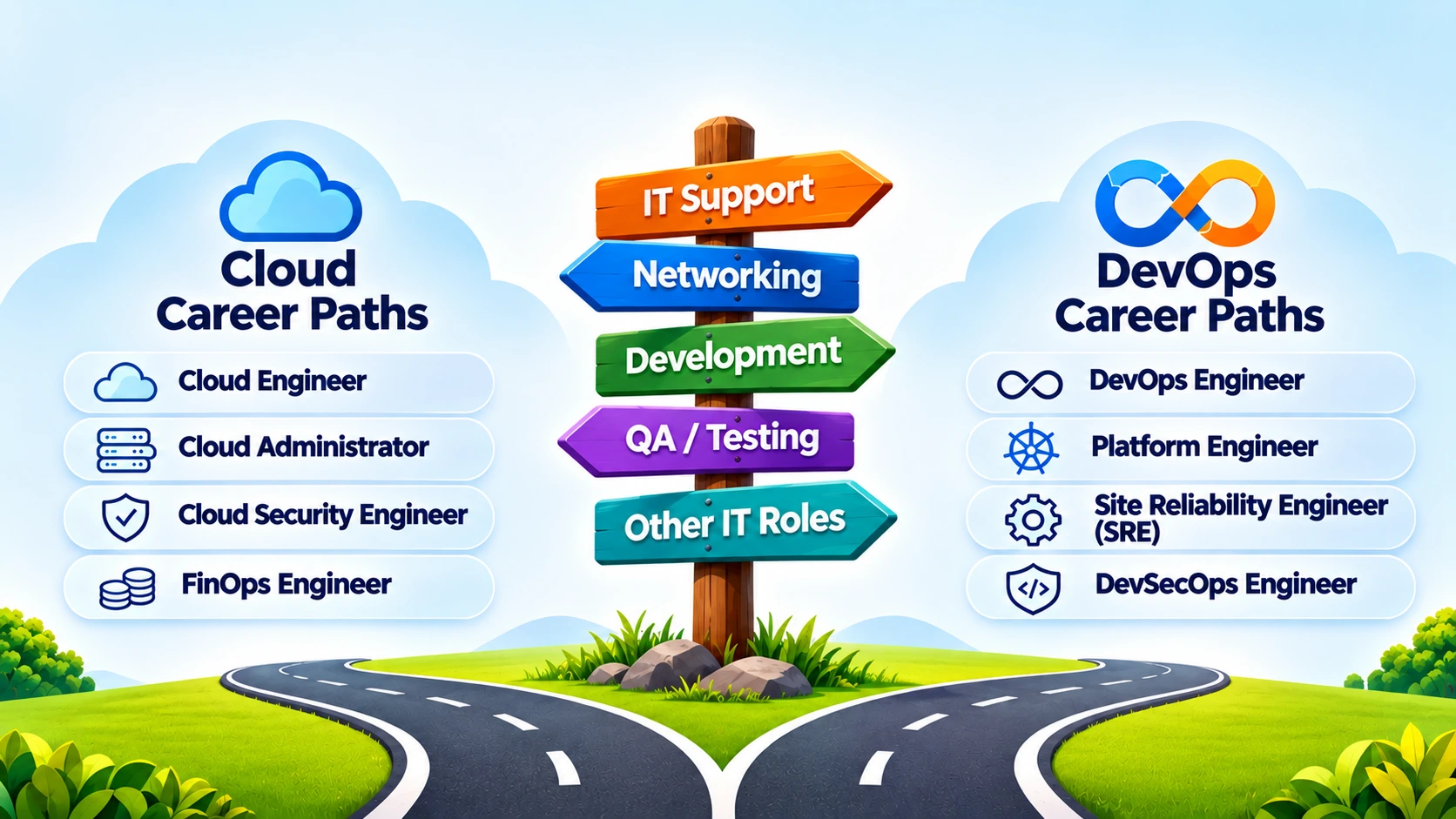
For the first two, read what a system administrator should learn first and our guide to backend developer to DevOps engineer. The last move is covered in the SRE roadmap and Platform Engineering vs DevOps.
How can you upskill in cloud and DevOps while working full-time?
- Pick a morning or evening slot you can keep every week, and protect it.
- Choose instructor-led live classes if you stall when you study alone, because a fixed session creates a deadline.
- Practise a little between classes, such as rebuilding that day's lab from memory.
- Finish with a capstone project, not just a certificate, so you have something concrete to discuss.
- Apply each topic at work: tag resources, script a manual task or write a pipeline for one service.
A 90-day plan for working professionals shows one way to pace it, and our guide to switching to cloud without quitting your job covers the conversation with your manager. MicroDegree's E-Learning platform suits the practice side, since you can revisit a topic at your own pace.
Conclusion
MicroDegree has two routes. The Cloud, DevOps + AI Certification Program is taught in live online classes, while E-Learning is a self-paced library. Both teach in Kannada first, with English tool names kept as they are in the industry.
- Kannada-first teaching. Hard ideas such as IAM policies, subnets or Kubernetes scheduling are easier to absorb in your first language, and you still learn the English terms interviewers use.
- Built for people with jobs. The live programme offers morning and evening batches, so you can fit it around office hours instead of taking a career break.
- Instructor-led live online classes. You can ask about your own network or pipeline and get an answer in the session, which a recorded video can't do.
- 20+ real capstone projects. Implementing end-to-end work matters when you already know the theory and need something to show.
- Wider technology range. Cloud, DevOps, AWS, Azure, Docker, Kubernetes, Generative AI and Agentic AI sit under one roof, so you can add AI skills later without switching providers.
- A practical path. It is meant for professionals who want to build on the IT knowledge they have, not restart as beginners.
Build Cloud and DevOps Skills at Your Own Pace
Ready to strengthen your Cloud and DevOps skills? MicroDegree E-Learning has learning opportunities across Cloud Computing, DevOps, Kubernetes, Generative AI and Agentic AI.
FAQs
1. Which institute offers Cloud and DevOps courses in Mangalore for working professionals?▼
Few Mangalore institutes publish batch timings for working professionals. CTTI lists AWS and Azure courses and CodeLab Systems runs a cloud and DevOps internship, but neither states evening or weekend schedules. MicroDegree offers morning and evening batches for its live online programme.
2. What is the difference between Cloud Computing and DevOps?▼
Cloud computing is where applications run: rented servers, storage and networks. DevOps is how you build, test, deploy and operate them reliably through automation. DevOps practices run on cloud infrastructure, so most roles need both.
3. Can an experienced network or system administrator move into Cloud Engineering?▼
Yes. Networking, DNS, firewalls and Linux map directly to VPCs, security groups and EC2. The gaps are usually IAM, infrastructure as code and depth in one platform. Build a small VPC with a private subnet before choosing a certification.
4. Which technologies should I learn for a DevOps Engineer role in 2026?▼
Linux, Git, one cloud (AWS or Azure), Docker, Kubernetes, a CI/CD tool, Terraform and monitoring with Prometheus and Grafana. Add Ansible and security scanning as you progress, and check postings for the role you want.
5. Can I learn Cloud and DevOps while working full-time?▼
Yes, if you keep a fixed morning or evening slot and practise between sessions. Live classes add structure, and applying each topic in a small project or at work keeps it from fading.