
Best Non-Coding Cloud Jobs in India: Roles, Salaries & How to Get Hired

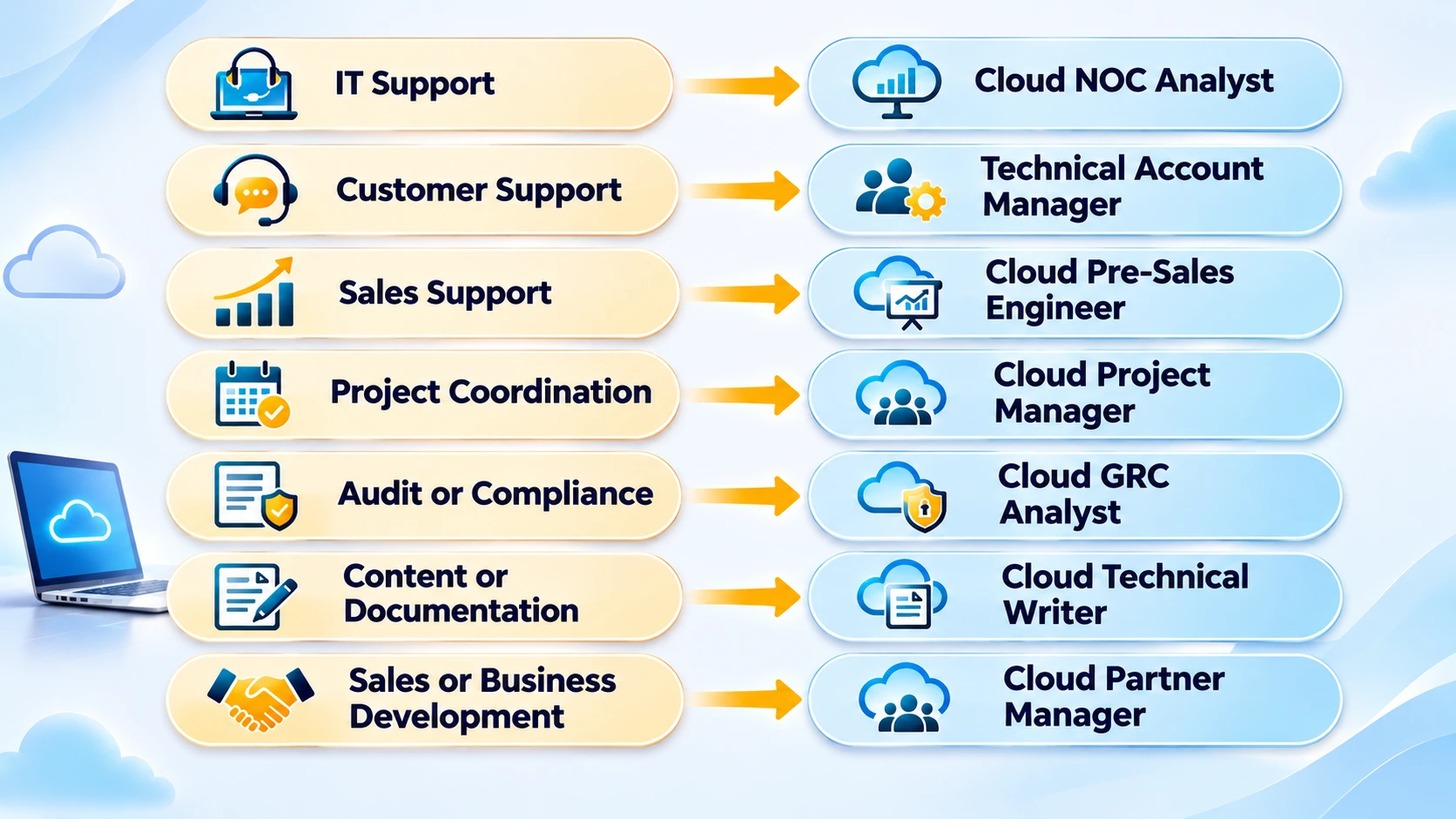
The best non-coding cloud jobs in India are the ones where you help customers choose, plan, run, document or sell cloud services instead of building applications. Seven roles fit that description: Cloud Pre-Sales Engineer, Technical Account Manager, Cloud Project or Program Manager, Cloud Compliance or GRC Analyst, Cloud Operations or NOC Analyst, Cloud Technical Writer and Cloud Sales or Partner Manager.
Cloud jobs without coding still expect you to understand how cloud services work, read architecture diagrams and talk to engineers. Some of these roles also use light scripting or command-line work now and then. This guide shows what each role involves, what it pays according to a named source, who can realistically apply as a fresher, which three entry-level certifications help and how to get hired.
Table of Contents
▼Seven non-coding cloud jobs in India
Each role below follows the same layout so you can compare them. Pay figures are rounded Payscale India base salaries for the closest job title, because Payscale has no pages for most of these titles with "cloud" in them. Treat them as a guide, not as cloud-specific averages. The salary section after the roles explains the data and its limits.
1. Cloud Pre-Sales Engineer
- What it involves: you work with the sales team before a deal is signed. You learn what the customer is trying to solve, then show how a cloud service could solve it through demos, simple architecture diagrams and written proposals.
- A day in the role: prepare for a customer call from the account notes, run a short demo of a managed service, help fill in a security questionnaire with a specialist and update a proposal. The day ends with a debrief with the sales manager.
- Main responsibilities: discovery calls, demos, proof-of-concept support, architecture sketches, answers to tender or RFP questions and handing the customer to the delivery team.
- Skills: cloud basics (compute, storage, networking, identity, the shared responsibility model), reading architecture diagrams and using a cloud console for demos; light scripting helps but isn't always required. On the people side: listening, presenting and writing clearly.
- Suitable for and freshers: people who enjoy explaining. Mixed for freshers: some companies hire trainee or associate pre-sales staff, but many expect prior technical or sales-support experience.
- Entry routes: technical support, solution or implementation support, sales support with technical grounding, or a technical role where you already present to customers.
- Career progression: Senior Pre-Sales, then Solutions Architect on the pre-sales side or Pre-Sales Manager.
2. Technical Account Manager (TAM)
- What it involves: you're the named technical contact for a customer's cloud environment. You review how they use the platform, guide them on reliability, security and cost, and bring in specialists when something is beyond you.
- A day in the role: join a stand-up on open support cases, talk to a customer's operations lead after an incident, prepare a monthly usage and risk report, and coordinate with the provider's specialists.
- Main responsibilities: regular service reviews, escalation handling, best-practice guidance, tracking open issues and keeping the customer informed during incidents.
- Skills: solid cloud fundamentals and troubleshooting, enough knowledge to read logs, metrics and bills with an engineer, and strong communication and ownership. Some TAMs write scripts or queries, so don't assume zero technical work.
- Suitable for and freshers: usually people with prior technical or customer-facing experience. A fresher is unlikely to start here, though associate TAM roles exist at some companies.
- Entry routes: cloud or technical support engineer, customer success, service delivery or operations roles.
- Career progression: Senior TAM, then Customer Success or Service Delivery Manager.
3. Cloud Project / Program Manager
- What it involves: you plan and track cloud work such as a migration of applications to the cloud, a new platform rollout or a landing-zone build, and keep engineers, vendors and business teams moving together.
- A day in the role: update the plan and risk log, run a status meeting, chase an access approval, discuss a delayed milestone with an engineer and brief a sponsor.
- Main responsibilities: scope and schedule, budget tracking, risk and dependency management, stakeholder updates and change control.
- Skills: project management methods, stakeholder management and clear status reporting, plus enough cloud vocabulary (regions, migration phases, environments, cost models) to understand a delay. Certifications such as PMP are optional unless the employer asks.
- Suitable for and freshers: a fresher can start as a project coordinator or project analyst, but a Project or Program Manager title usually needs prior delivery experience.
- Entry routes: project coordination, PMO support, business analysis, IT operations or service delivery.
- Career progression: Senior Project Manager, Program Manager, then Delivery Head or Director.
4. Cloud Compliance / GRC Analyst
- What it involves: GRC stands for governance, risk and compliance. You check that a company's cloud setup meets internal policies and external standards, gather the evidence and track the gaps.
- A day in the role: review a list of failed configuration checks with an engineer, collect screenshots and reports for an audit, update the risk register and draft a short policy exception request.
- Main responsibilities: mapping controls to a standard, evidence collection, risk assessments, policy upkeep and supporting internal and external audits.
- Skills: understanding of cloud security basics and the shared responsibility model, ability to read configuration reports from tools such as AWS Config or Azure Policy, careful documentation and clear writing. It isn't coding, but it is technical reading.
- Suitable for and freshers: yes, for junior analyst roles, especially for people with a commerce, audit, risk or IT-compliance background who learn cloud basics. Senior GRC roles need experience.
- Entry routes: internal audit, IT compliance, information security operations or risk analysis.
- Career progression: Senior GRC Analyst, Compliance or Risk Manager, then Head of Governance. Some move toward cloud security engineering.
5. Cloud Operations / NOC Analyst
- What it involves: NOC stands for network operations centre. You watch dashboards and alerts for cloud systems, follow runbooks when something fails and escalate to engineers when it's beyond the runbook.
- A day in the role: take over from the previous shift, review open incidents, respond to alerts, update tickets, escalate a failing service and write a handover note.
- Main responsibilities: monitoring, first-line incident handling, ticket updates, escalation, and communicating status to customers or internal teams.
- Skills: cloud and networking basics, calm troubleshooting, a clear and fast writing style and willingness to work shifts. You'll follow scripts and runbooks, and sometimes run simple commands, but you aren't building software.
- Suitable for and freshers: one of the most accessible roles for freshers and IT support professionals, though shift work and night shifts are common.
- Entry routes: IT support, help desk, data-centre or network support, and technical support roles.
- Career progression: Senior NOC Analyst, Cloud Support Engineer, Cloud Operations or Site Reliability roles, with more scripting and automation as you move up. For AWS support, administration and cost-analysis roles, see Can You Learn AWS Without Programming?.
6. Cloud Technical Writer
- What it involves: you write the documents engineers and customers rely on: how-to guides, setup tutorials, runbooks, command and API references and release notes for cloud products or internal platforms.
- A day in the role: interview an engineer about a new feature, follow its setup steps yourself in a test account, draft a tutorial, review a teammate's page and update a diagram after a release.
- Main responsibilities: planning and writing documentation, keeping it current, working with engineers to get facts right and improving pages based on user feedback.
- Skills: strong English writing, learning new technology quickly, comfort with command-line steps and screenshots, and using a documentation format such as Markdown with version control. You may read code samples and run commands, though you may not write production code.
- Suitable for and freshers: yes. A portfolio of two or three clear tutorials counts for a lot, and freshers with strong writing can apply.
- Entry routes: content writing, support documentation, QA or training roles, or engineers who like writing.
- Career progression: Senior Technical Writer, Documentation Lead, or Content Strategy and developer-experience roles.
7. Cloud Sales / Partner Manager
- What it involves: either you sell cloud services to customers, or you manage relationships with the partners (resellers, consultancies and integrators) who sell and deliver them.
- A day in the role: review the pipeline, call a customer or partner about an opportunity, prepare a joint plan with a partner, bring in a pre-sales engineer for a technical discussion and update the sales forecast.
- Main responsibilities: finding and qualifying opportunities, meeting targets, managing relationships, planning joint campaigns and tracking deals.
- Skills: understanding of cloud products and pricing models at a business level, negotiation, relationship building and pipeline management. You need to be able to explain what a cloud service does without bluffing, and to ask a technical colleague when you can't.
- Suitable for and freshers: freshers can enter through sales or business development associate roles, while partner manager titles generally need sales experience.
- Entry routes: inside sales, business development, channel or alliances support, or account management.
- Career progression: Senior Account or Partner Manager, Regional Sales Lead, then Alliances or Sales Head.

Quick comparison of the seven roles
| Role | Freshers can apply? | Technical depth | Typical entry route | Average base pay, proxy title (Payscale) |
|---|---|---|---|---|
| Cloud Pre-Sales Engineer | Mixed: some associate roles | Medium: demos, architecture, light scripting | Technical or sales support | About ₹11.6 LPA (Pre Sales Consultant) |
| Technical Account Manager | Rarely | Medium to high: troubleshooting, reading logs and bills | Cloud or technical support, customer success | About ₹15.1 LPA (Technical Account Manager) |
| Cloud Project / Program Manager | As coordinator; manager titles need experience | Low to medium: cloud vocabulary and delivery | Project coordination, PMO, business analysis | About ₹18.2 LPA (IT Project Manager/Salary)) |
| Cloud Compliance / GRC Analyst | Yes, junior roles | Medium: reading cloud configuration and controls | Audit, IT compliance, security operations | About ₹4.9 LPA (Compliance Analyst) |
| Cloud Operations / NOC Analyst | Yes | Low to medium: monitoring, runbooks, simple commands | IT support, help desk, network support | About ₹4.1 LPA (NOC Engineer_Engineer/Salary)) |
| Cloud Technical Writer | Yes, with a portfolio | Medium: following and documenting technical steps | Content writing, support documentation, QA | About ₹6.8 LPA (Technical Writer) |
| Cloud Sales / Partner Manager | Via sales associate roles; partner titles need experience | Low to medium: product and pricing knowledge | Inside sales, business development, channel support | About ₹12.3 LPA (Strategic Partnership Manager) |
Indicative annual pay in India by experience level. These are estimates and vary by employer, city, experience and specialisation.
| Role | Freshers (0 to 2 years) | Mid-level (2 to 5 years) | Senior (5+ years) |
|---|---|---|---|
| Cloud Pre-Sales Engineer | ₹4 to ₹8 LPA | ₹8 to ₹14 LPA | ₹14 to ₹25 LPA |
| Technical Account Manager | ₹6 to ₹10 LPA | ₹10 to ₹18 LPA | ₹18 to ₹30 LPA |
| Cloud Project / Program Manager | ₹6 to ₹10 LPA | ₹12 to ₹20 LPA | ₹20 to ₹35 LPA |
| Cloud Compliance / GRC Analyst | ₹3.5 to ₹6 LPA | ₹6 to ₹12 LPA | ₹12 to ₹20 LPA |
| Cloud Operations / NOC Analyst | ₹3 to ₹5.5 LPA | ₹5.5 to ₹10 LPA | ₹10 to ₹18 LPA |
| Cloud Technical Writer | ₹4 to ₹7 LPA | ₹7 to ₹12 LPA | ₹12 to ₹20 LPA |
| Cloud Sales / Partner Manager | ₹6 to ₹10 LPA | ₹10 to ₹18 LPA | ₹18 to ₹30 LPA |
Multi-cloud certifications for non-coding roles
Each of the three major clouds offers a foundational certification that doesn't require coding. They show an employer that you understand the basics, and they don't guarantee a job. You don't need all three: pick the one that matches the platform your target employers use, and add another only if a job requires it. For help choosing between them, see our cloud certification roadmap, and for the Google Cloud options in more detail, which Google Cloud certification to choose.
AWS Certified Cloud Practitioner
AWS describes this as a foundational exam for candidates new to cloud who may not have an IT background, and it names roles such as sales, marketing and project management among the people it's meant for. Up to six months of exposure to AWS is possible but not required. It supports roles like pre-sales, TAM, project management and sales that need to speak AWS vocabulary. Official page: AWS Certified Cloud Practitioner.
Microsoft Azure Fundamentals (AZ-900)
AZ-900 is a beginner certification and, in Microsoft's words, a common starting point for an Azure career. It assesses cloud concepts, Azure architecture and services, and Azure management and governance, and the exam takes 45 minutes. It's useful for operations, GRC, project and sales roles in companies that run on Microsoft's cloud. Official page: Microsoft Certified: Azure Fundamentals.
Google Cloud Digital Leader
Google says this certification is for anyone who wants to show cloud basics and how Google Cloud products and services help an organisation meet its goals. The exam covers six areas: digital transformation, data transformation, artificial intelligence, modernising infrastructure and applications, trust and security, and operations. It has no prerequisites, runs 90 minutes with 50 to 60 multiple choice questions, costs USD 99 and is valid for three years. It suits sales, partner, project and pre-sales roles that deal with business conversations. Official page: Google Cloud Digital Leader.
How to get hired for non-coding cloud jobs in India
Resume keywords by role
Applicant tracking systems match your resume to the job description. Use these terms only where they honestly describe your work:
- Cloud Pre-Sales Engineer: pre-sales, solution demo, proof of concept, RFP response, discovery call, cloud architecture, customer presentations, technical proposal.
- Technical Account Manager: technical account management, customer success, escalation management, service review, incident communication, cloud support, SLA, stakeholder management.
- Cloud Project / Program Manager: cloud migration, project plan, risk management, stakeholder management, Agile, PMO, status reporting, change control, vendor management.
- Cloud Compliance / GRC Analyst: GRC, compliance, risk assessment, audit evidence, ISO 27001, cloud security controls, policy, shared responsibility model.
- Cloud Operations / NOC Analyst: NOC, incident management, monitoring, ticketing, runbook, escalation, AWS or Azure, cloud monitoring, ITIL.
- Cloud Technical Writer: technical writing, documentation, API documentation, tutorials, release notes, Markdown, Git, cloud platforms.
- Cloud Sales / Partner Manager: cloud sales, partner management, channel sales, pipeline management, account planning, negotiation, quota achievement, cloud services.
Job search queries to use
Try these searches on job portals such as Naukri, LinkedIn, Indeed and company career pages. Change the city to match where you want to work:
- Cloud Pre-Sales Engineer Fresher India
- Associate Technical Account Manager India
- Cloud Project Coordinator India
- Junior Cloud GRC Analyst
- NOC Analyst AWS Azure
- Cloud Technical Writer India
- Cloud Partner Sales Associate India
Interview preparation
Interviewers ask about situations from the job. Practise your answers aloud and tie them to real experience from support, sales, operations or projects. Five questions for each role:
Cloud Pre-Sales Engineer
- A customer says their website is slow during sales events. What questions do you ask first, and how would you explain a cloud option in plain language?
- How would you prepare a 20-minute demo for a non-technical decision-maker?
- The customer asks for a feature you aren't sure exists. What do you do?
- How do you explain the shared responsibility model to a customer who thinks the provider handles all security?
- Walk us through how you'd help the sales team respond to a security questionnaire in two days.
Technical Account Manager
- A customer's service has been down for 40 minutes. How do you communicate during the incident and afterwards?
- How would you run a monthly service review, and what would you put in it?
- A customer's cloud bill has doubled. How do you approach the conversation?
- When do you escalate to a specialist, and how do you hand over the context?
- How do you handle a customer who is unhappy with a support response?
Cloud Project / Program Manager
- Your migration is two weeks behind because access approvals are delayed. What do you do?
- How do you build a plan for moving 30 applications to the cloud in phases?
- An engineer says a task will take a week, but you think it's two days. How do you handle it?
- How do you report a risk to a sponsor without causing panic?
- What does a change request look like on a cloud project, and who approves it?
Cloud Compliance / GRC Analyst
- An auditor asks for proof that data in cloud storage is encrypted. How do you collect it?
- A configuration check fails on 40 resources. How do you prioritise?
- How do you decide whether a policy exception is acceptable?
- Explain in simple terms what the cloud provider is responsible for and what the company is responsible for.
- How do you keep audit evidence organised across several teams?
Cloud Operations / NOC Analyst
- An alert shows high CPU on a production server at 3 a.m. What are your first three steps?
- How do you decide whether to escalate or follow the runbook?
- Write a handover note for the next shift after a partly resolved incident.
- Two alerts arrive together, one for a customer-facing site and one for a test system. How do you prioritise?
- A runbook is wrong or out of date. What do you do?
Cloud Technical Writer
- An engineer gives you a rough note about a new feature. How do you turn it into a tutorial?
- How do you check that your instructions actually work?
- How would you explain a cloud storage service to a first-time user?
- What would you do if the engineer who owns a feature is too busy to answer questions?
- Show us one piece of documentation you've written or improved, and explain your choices.
Cloud Sales / Partner Manager
- A partner has a customer interested in cloud migration but no technical lead. How do you help?
- How do you plan your pipeline and targets for a quarter?
- A customer compares your offer with a cheaper one from a competitor. What do you say?
- How do you keep a partner engaged when deals are slow?
- When do you bring in a pre-sales engineer, and what do you share first?
Conclusion
The best non-coding cloud jobs in India are in pre-sales, account management, project delivery, compliance, operations, documentation and partner sales. They need cloud understanding, and they reward communication, ownership and organisation. Start with the role that matches the work you already do, learn the vocabulary of one cloud and consider one foundational certification, then show your work through a project, a document or a story from your current job. Freshers will find NOC, technical writing and junior GRC roles easier to enter, while TAM, program management and partner management usually come after experience.
Learn Cloud Skills at Your Own Pace
If you're exploring a cloud career, MicroDegree's e-learning platform teaches in Kannada and has self-paced recorded sessions, with AWS, Azure, Kubernetes, DevOps, Generative AI and Agentic AI among the skills it covers. You can explore them in one place and choose where to begin.
FAQs
1. Can you get a cloud job in India without coding?▼
Yes, in several roles, such as NOC analyst, technical writer, GRC analyst, project coordinator and sales or partner roles. You'll still need to understand how cloud services work, and some roles involve simple commands or scripts.
2. Which non-coding cloud job is best for freshers?▼
Cloud operations or NOC analyst, cloud technical writer and junior GRC analyst are the most accessible. Sales associate roles are another route. Technical Account Manager and program manager roles usually need experience first.
3. Do non-coding cloud roles still need technical knowledge?▼
Yes. Non-coding means you don't build software, not that you can skip cloud basics. Expect to learn terms like regions, compute, storage, networking and identity, and to read dashboards, logs or documentation.
4. Which cloud certification should a non-coding professional start with?▼
Pick the one for the cloud your target employers use: AWS Certified Cloud Practitioner, Azure Fundamentals (AZ-900) or Google Cloud Digital Leader. All three are foundational and need no coding.
5. Does a cloud certification guarantee a job?▼
No. A certification shows you've learned the basics, but employers also look for relevant experience, communication and examples of your work. Use it alongside a project or a documented example.
6. Which of these cloud roles pays the most?▼
On Payscale's figures for the nearest job titles, project manager and technical account manager roles report the highest average base pay, and NOC and compliance roles the lowest. Sales and partner roles can pay a lot more through variable pay. These are estimates that vary by employer, city and experience.
7. Can I move into these roles from IT support or sales?▼
Yes. IT support leads naturally into NOC and TAM roles, sales support into pre-sales, and sales or business development into cloud sales and partner roles. Learn the vocabulary of one cloud and show how your current work relates.