
Cloud Skills Every Scrum Master Should Learn in 2026

At the Daily Scrum a developer says a story is blocked because the environment is down. Nobody asks which environment, who owns it, or whether the same thing will happen next sprint. You were not hired to fix it, but the sprint goal depends on the answer.
Cloud skills for Scrum Masters do not mean learning to build infrastructure. They mean knowing the vocabulary, a few delivery metrics, and the cost and security questions well enough to run a better conversation. The Scrum Guide says the Scrum Master causes the removal of impediments to the team's progress and enables the team to improve its practices. For a team that ships to the cloud, that work includes these topics.
Table of Contents
▼Cloud Terms You Will Hear in Planning and Stand-ups
AWS defines cloud computing as the on-demand delivery of IT resources over the internet with pay-as-you-go pricing. Most of the words below follow from those two ideas: things can be created quickly, and most of them cost money for as long as they exist.
| Term | In plain words | Where it comes up in a sprint |
|---|---|---|
| Environment | A separate copy of the system for one purpose, such as development, testing (often called staging) or production | "Blocked: the test environment is down" |
| Deployment | Putting a new version of the software into an environment | Release plans and the Definition of Done |
| Pipeline (CI/CD) | The automated steps that build, test and deploy a change | A story is finished but the pipeline is red |
| Infrastructure as code | Describing servers and networks in files, so they can be reviewed and recreated | An environment change that needs a pull request |
| Container | An application packaged so that it runs the same way wherever containers are supported | "It works locally but not in the cluster" |
| Monitoring and alerts | Dashboards and notifications that show whether the system is healthy | Who gets called at night, and what counts as an incident |
| Rollback | Returning to the previous version after a bad deployment | Risk discussions in Sprint Planning |
| Cloud cost | What running the system costs, usually per resource per hour or per use | A spike that surfaces at the Sprint Review |
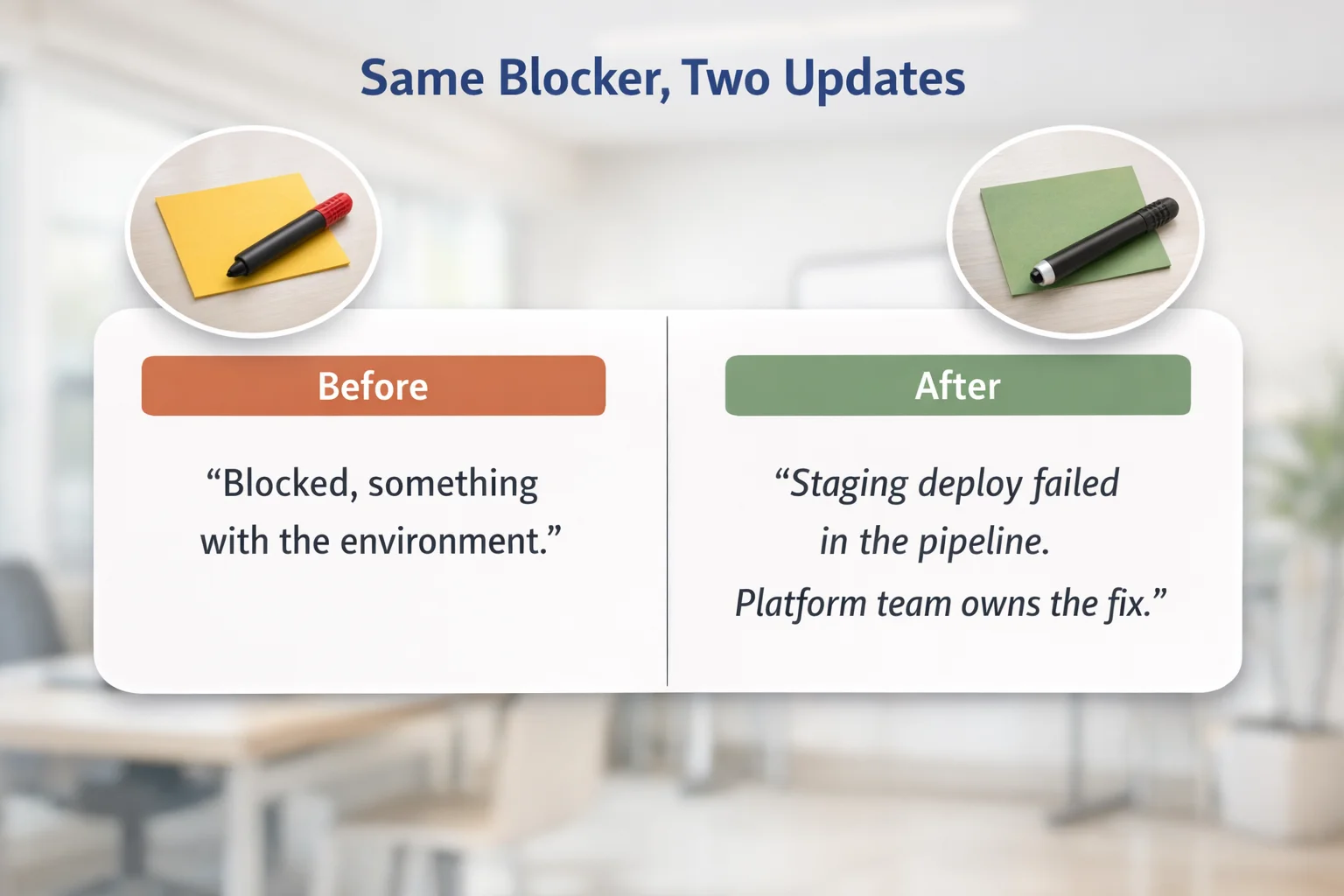
The Scrum Guide describes the Daily Scrum as a 15-minute event for the Developers. In 15 minutes a vague blocker costs the whole team time. A Scrum Master who can ask which environment is down, and who owns it, turns a vague blocker into one the right person can pick up.

Where Cloud Work Lands in Each Scrum Event
Cloud topics turn up inside the events you already facilitate, one question at a time.
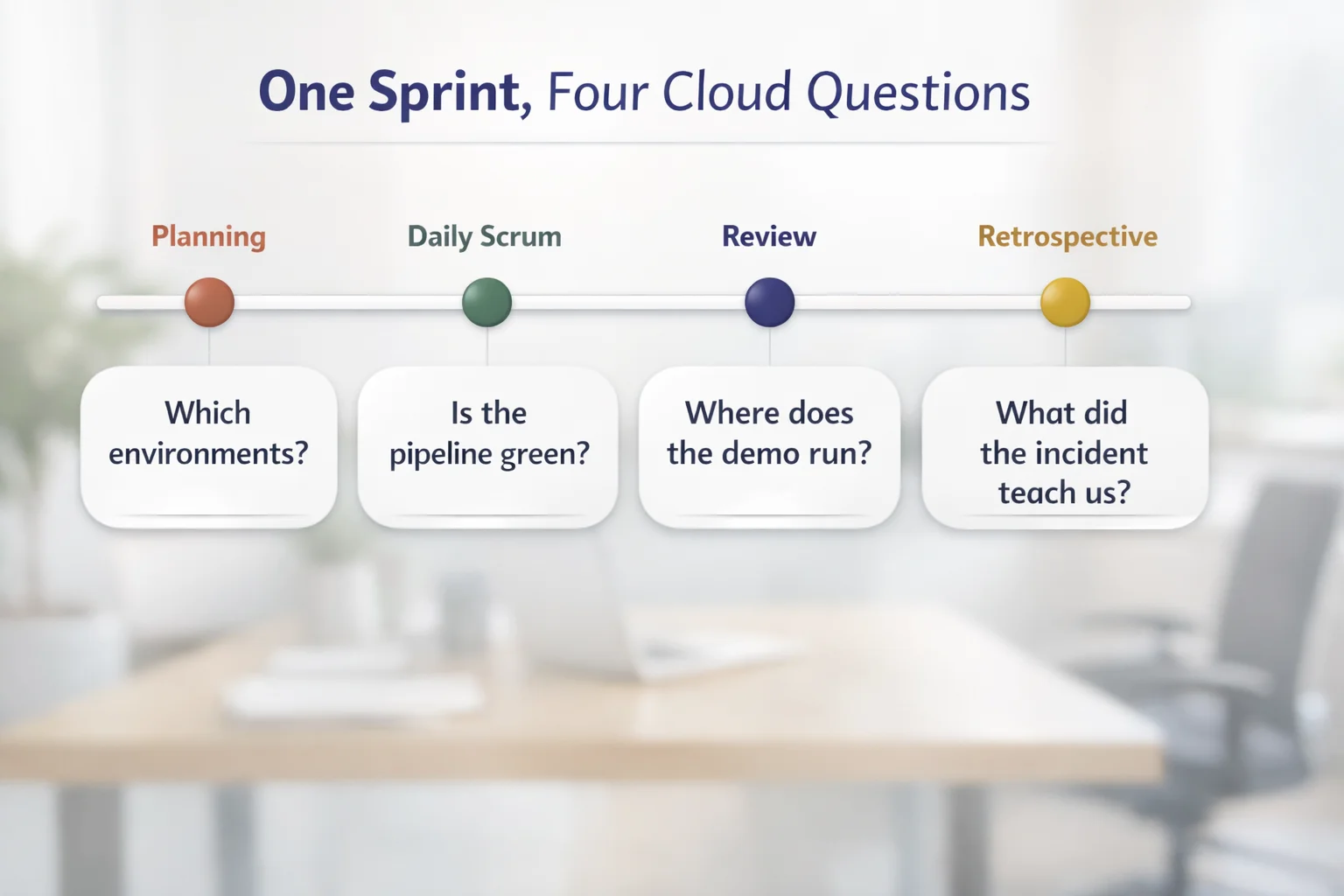
- Sprint Planning: ask which environments each story needs and whether they exist yet. A story that needs a new environment is bigger than it looks.
- Daily Scrum: ask whether the pipeline is green and who owns it when it is not. A failing pipeline blocks every story waiting behind it.
- Sprint Review: the Scrum Guide says the Review exists to inspect the outcome of the Sprint and determine future adaptations. Ask where the demo runs. A demo on one developer's machine says little about production.
- Sprint Retrospective: the Guide says it exists to plan ways to increase quality and effectiveness. Bring failed deployments, incidents and surprise costs as evidence for what to change.
- Definition of Done: the Guide describes it as a formal description of the state of the Increment when it meets the quality measures required for the product. If the product must be deployable, ask whether deployed, monitored and secured are part of Done.
Reading the Delivery Metrics Without Gaming Them
Sooner or later someone asks a Scrum Master for numbers. DORA (DevOps Research and Assessment) describes five software delivery performance metrics in two groups: throughput and instability.
| Metric | What DORA says it measures | Group |
|---|---|---|
| Change lead time | How long a change takes to go from committed to version control to deployed in production | Throughput |
| Deployment frequency | The number of deployments over a period, or the time between deployments | Throughput |
| Failed deployment recovery time | How long it takes to recover from a deployment that fails and needs immediate intervention | Throughput |
| Change fail rate | The share of deployments that need immediate intervention afterwards | Instability |
| Deployment rework rate | The share of deployments that are unplanned and happen because of a production incident | Instability |
DORA also warns about misuse. It says that making a metric a goal makes teams more likely to game it, that comparing very different applications can mislead, and that the aim is to improve your own team over time, not to compete with other teams. A Scrum Master who knows this can answer a request for a league table with a trend for one team instead.
The Cost Conversation
Pay-as-you-go pricing means that a forgotten test environment keeps costing money. The FinOps Foundation describes FinOps as an operational framework and cultural practice that maximizes the business value of technology, and says it creates financial accountability through collaboration between engineering, finance and business teams. You do not need to run FinOps. Getting those groups into the same conversation is a facilitation job. Our beginner guide to public and private cloud explains where the costs come from.
- Which environments run all night and at weekends, and do they need to?
- Does this sprint goal change what we run, and what will that cost per month?
- Who sees the bill, and when do they see it?
Security and Responsibility: Who Owns What
AWS describes a shared responsibility model. AWS is responsible for protecting the infrastructure that runs its services, which it calls security of the cloud. The customer's responsibility depends on the services it chooses, and customers are responsible for managing their data, including encryption options. In other words, when something goes wrong in a team's cloud setup, it is not automatically the provider's problem. Ask where responsibility sits for each piece, and whether security checks are part of the pipeline. Our guides to AWS security best practices and to securing a CI/CD pipeline go deeper.
Seven Questions to Ask the Team This Sprint
- Which environment will this story be tested in, and does it match production?
- Who owns the pipeline when it fails?
- What does done include for deployment and monitoring?
- How do we undo this release if it goes wrong?
- Which resources will this create, and roughly what will they cost each month?
- Who is on call, and what counts as an incident?
- What did the last incident teach us, and where is that written down?
You do not have to answer these yourself. A Scrum Master who asks them regularly makes the team's assumptions visible. If you want to understand the answers you get, our CI/CD basics guide is a good first read.
Where to Start Learning
Two entry-level certifications cover the vocabulary above. Both come straight from their providers' own pages, which I read in October 2026.
| Certification | Who the provider says it is for | Exam |
|---|---|---|
| AWS Certified Cloud Practitioner | People with no prior IT or cloud experience, and line-of-business roles such as sales, marketing, product or project management. Prior IT or cloud experience is not required. | 65 questions, 90 minutes |
| Microsoft Azure Fundamentals | A technology professional who wants to show foundational knowledge of cloud concepts. Microsoft expects some skills and experience in an area of IT, such as infrastructure, databases or software development. | 45 minutes |
Pick the platform your own company uses. Our AWS Cloud Practitioner guide and the cloud certification roadmap for 2026 cover both choices in more detail. If you would rather follow a guided path alongside your work, MicroDegree's learning programs are one option. A certificate is not required to ask these questions well. Reading one chapter a week and bringing one question from the list to each sprint is enough to start.
What Cloud Skills Do and Do Not Do for Your Pay
Pay data for Scrum Masters is thin. Flexiple, which publishes self-reported salaries, shows no Scrum Master figure at all, because it has too few records to publish one. Its rule is at least 25 disclosed salaries for a figure. Hyring does publish a Scrum Master figure for Bengaluru, but as a modelled estimate and not survey data. I read all of these sources in October 2026.
| Source and method | Role | Median in Bengaluru |
|---|---|---|
| Hyring, modelled estimate | Scrum Master | ₹16.5 LPA |
| Hyring, modelled estimate | DevOps engineer | ₹17.1 LPA |
| Hyring, modelled estimate | Cloud engineer | ₹17.1 LPA |
| Flexiple, self-reported pay | Cloud engineer | ₹9.8 LPA |
| Flexiple, self-reported pay | Scrum Master | Not published, too few records |
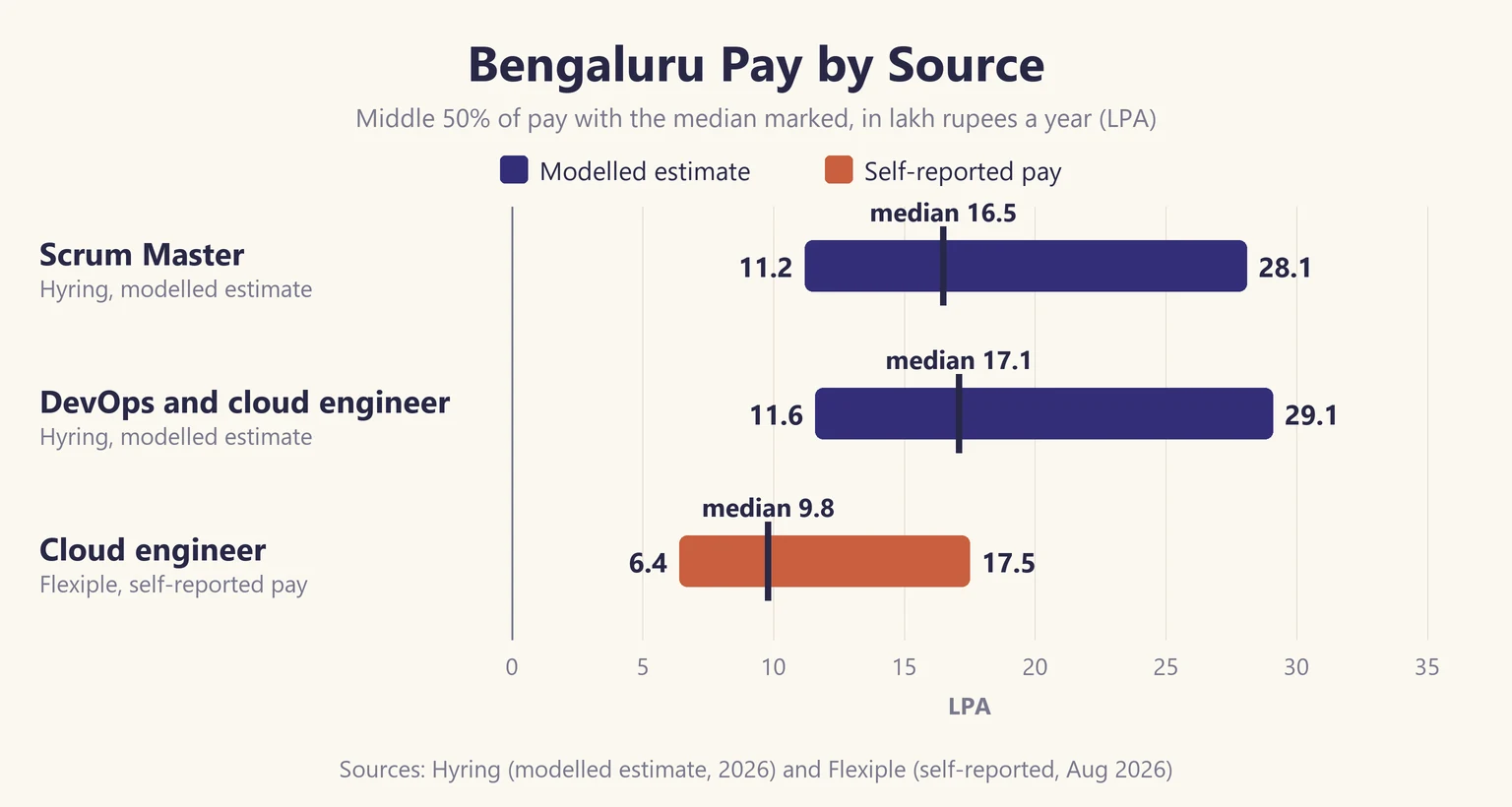
The sources do not agree. Hyring's Scrum Master figures run from ₹11.2 LPA to ₹28.1 LPA for the middle half, and its DevOps and cloud engineer figures run from ₹11.6 LPA to ₹29.1 LPA. Those two sets of numbers are identical to the last digit, so the model cannot tell the two roles apart. Flexiple's self-reported cloud engineer data, from 632 Bengaluru records, puts the middle half between ₹6.4 LPA and ₹17.5 LPA, which is far below Hyring's. When two sources differ by that much, no single number should be taken as the answer.
No source I found measures what Scrum Masters earn with cloud skills compared with those without. So treat cloud knowledge as a way to do the job better, and to qualify for technical Scrum Master and delivery roles, not as a reliable route to a raise. Pay depends on the company, your seniority and how interviews go. If you are weighing a move into a cloud role itself, our cloud engineer salary guide for India has more on that side.
Where to Stop: What Is Not Your Job
The Scrum Guide makes the Scrum Master accountable for establishing Scrum and for the Scrum Team's effectiveness. You do not need to choose the team's tools or review its architecture to do that. Your cloud knowledge is for asking better questions. The answers belong to the people who build and run the system, and if you find yourself deciding which cloud service the team should use, hand the decision back.
Conclusion
Cloud skills for Scrum Masters come down to three things: the vocabulary, a few delivery metrics used carefully, and the habit of asking about cost, security and ownership. Start with the seven questions this sprint. When you want more structure, read the guide for one foundational certification. For where this fits among other skills, see our guide to future-proof IT skills beyond 2026.
FAQs
1. Does a Scrum Master need cloud skills?▼
Not to run Scrum. The Scrum Guide's accountabilities are about the team's effectiveness and removing impediments. For a team that builds and runs software in the cloud, knowing the vocabulary makes both easier, because many impediments are about environments, pipelines and cost.
2. Which cloud certification suits a Scrum Master?▼
A foundational one on the platform your company uses. AWS Certified Cloud Practitioner says it is aimed at people with no IT experience, including project management roles. Azure Fundamentals expects some experience in an area of IT. Neither is required for the role.
3. Do I need to learn to code?▼
No. You need to understand what a pipeline does, read its status, and know the terms the team uses. Writing code or infrastructure files is the team's work.
4. Which delivery metrics should a Scrum Master use?▼
DORA describes five: change lead time, deployment frequency, failed deployment recovery time, change fail rate and deployment rework rate. DORA also warns against setting them as targets or comparing teams with each other, so use them to see one team's trend over time.
5. Will cloud skills raise my salary as a Scrum Master?▼
No source I found measures that. The available pay data for Scrum Masters is thin and the sources disagree, so treat cloud skills as a way to do the job better and to qualify for technical roles, not as a guaranteed raise.
6. How long does it take to learn enough cloud?▼
It depends on how much time you can give it. Regular reading and asking questions in your own team can build the vocabulary over a few weeks. A foundational certification takes longer, and the time depends on your starting point.
Weighing it up for your own team?Click here to take a free Cloud & DevOps demo