
Which Is Easier to Start Learning from IT Support: Cloud, DevOps or GenAI?

Table of Contents
▼The Short Answer
Cloud vs DevOps vs GenAI for IT support depends on where you start. If you work a service desk or a support queue today, cloud is usually the easiest of the three to begin, because accounts, access, servers and outages are things you already handle from the user's side. GenAI is the easiest to try in an afternoon, but it often asks for some programming before it becomes a job. DevOps is the hardest to start from nothing, and it gets much easier once you have done some cloud and Linux.
That order is my judgement. No source I could find ranks the three for beginners, so this guide shows its working. It sets cloud vs DevOps vs GenAI for IT support against four tests, gives you a first task to try on each path, names the hard part of each, and puts pay for all three in one table from a named source.

What "Easier" Should Mean
"Easier" can mean three different things: easier to begin, easier to get good at, or easier to get hired. This guide uses four tests that look at the first stretch, because that is where most people give up.
- Carry-over: how much of your daily support work already counts on this path.
- Prerequisites: how much you must learn before the first useful thing works.
- Time to a first result: how quickly you can get something real running with a free or low-cost setup.
- The hard part: what makes people stall after the first week, and whether that is a knowledge gap or a judgement gap.
A Scorecard for a Support Background
| Test | Cloud | DevOps | GenAI |
|---|---|---|---|
| Carry-over from support | High. Access requests, account setup, outages and incident notes all have a cloud twin | Medium. Recurring faults and repeated manual fixes are the raw material, but the tooling is new | Medium. Writing clear replies, sorting tickets and knowing what users ask are directly useful |
| Prerequisites | Networking basics, one cloud platform, some Linux | Linux, Git, scripting and a cloud platform, before pipelines make sense | Light to start, a programming language such as Python for anything you build |
| Time to a first result | Hours. A storage bucket and a file upload | A day or two. A script, a repository and a pipeline that runs it | Minutes to use a chat tool. Longer to make something repeatable and tested |
| The hard part | Permissions and networking vocabulary, and watching cost | Several tools at once, and debugging a pipeline that fails for a reason far from the error | Answers that change between runs, and proving that the output is good enough to rely on |
This scorecard is a judgement
The cells describe how the skills overlap with support work. They do not come from a survey. A different background, such as a support role that already writes scripts every week, could move a cell.
The Same Ticket, Three First Tasks
The quickest way to feel the difference is to take one ordinary ticket and do a first task on each path. Imagine a new joiner who needs a shared place for monthly reports. Each task below takes roughly an hour, and none of them needs a company account.
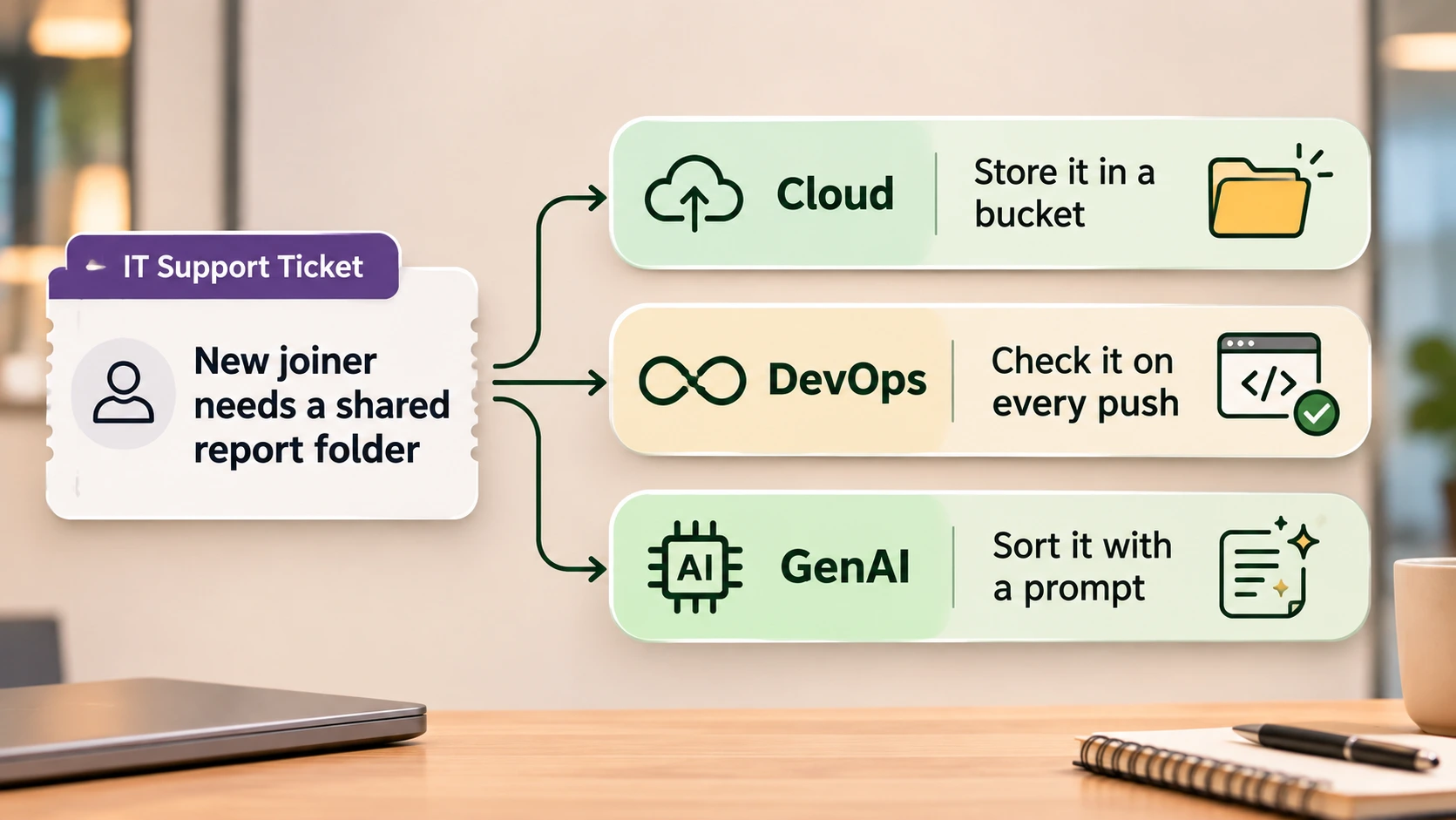
Cloud: store the file in a bucket
On AWS, a bucket is a storage container. The AWS CLI creates one with aws s3 mb, then copies and lists files with the other aws s3 commands. Bucket names are shared across all AWS accounts, so pick a name that is unlikely to be taken.
# A new joiner needs a shared place for monthly reports.
aws s3 mb s3://your-name-reports-demo --region ap-south-1
aws s3 cp march-report.pdf s3://your-name-reports-demo/
aws s3 ls s3://your-name-reports-demo/
The next question, who may read that folder, leads straight into identity and access. That is the cloud topic closest to your current work.
DevOps: check a script on every push
A GitHub Actions workflow is a YAML file in the .github/workflows folder of a repository. This one runs a script you have committed, such as a disk check, each time you push. If the script exits with an error, the run is marked as failed.
name: ticket-check
on: [push]
jobs:
  check:
    runs-on: ubuntu-latest
    steps:
      - uses: actions/checkout@v4
      - run: bash check.sh
You needed Git, a script and a YAML file before anything ran. That is why DevOps feels harder to start: the pieces arrive together.
GenAI: sort the ticket with a prompt
Paste the prompt below into any chat assistant your company allows. Remove names and other personal data from any real ticket first.
You are helping a service desk. Read the ticket and reply with:
1. Category: Access, Hardware, Software, Network or Other
2. Urgency: Low, Medium or High, with one sentence of reasoning
3. A first reply to the user in three sentences or fewer

Ticket: "I cannot open the shared finance folder since this morning. The month-end report is due at 5 pm."
The first answer takes a minute. Now run the same prompt on twenty old tickets and compare each answer with the category you would have chosen. How often the output is wrong is what you are really testing.
Where Each Path Gets Hard
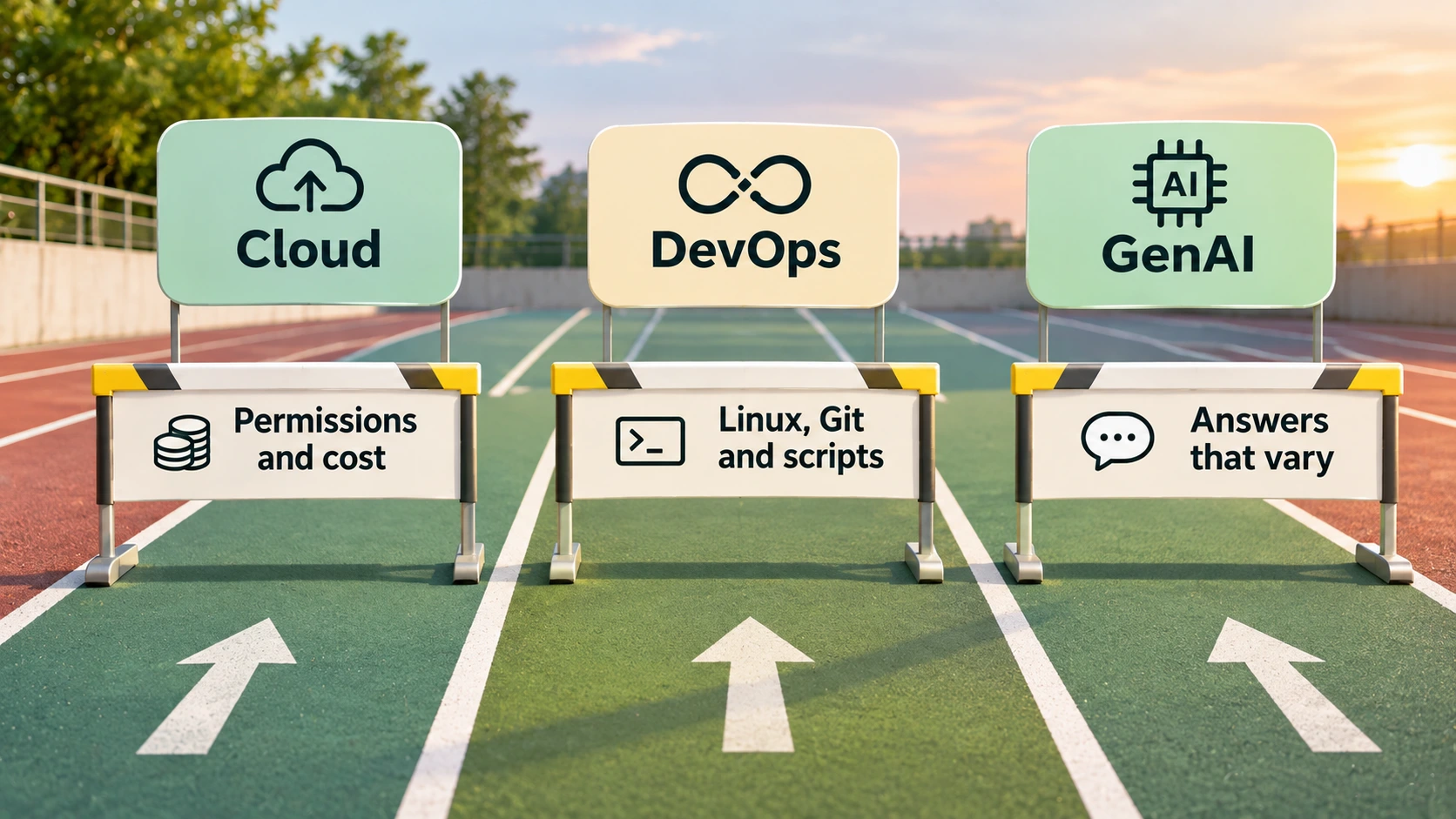
- Cloud: the vocabulary of permissions and networking arrives all at once, and a forgotten running resource can cost money. Read the cost page of your account before you build.
- DevOps: you need Linux, Git, scripting and a cloud platform together, and a failing pipeline often shows an error far from the cause. One staffing firm's roadmap puts Linux, Bash, Python, Git and cloud basics in the first six months before pipelines and Terraform.
- GenAI: using a model is simple, but building something others can rely on needs testing, because the same prompt can give different answers. One cloud-training guide notes that AI roles often work with managed cloud services and APIs rather than heavy maths or building models, so the maths requirement is often lighter for those roles.
Easier to Start Is Not Always Easier to Get Hired
Starting is one problem and being hired is another. A cloud route has more steps between a bucket and a job, so cloud basics are often done with a role change in view, such as a move from the service desk through a systems or cloud support role. Our guide on how to move from a service desk job to a cloud engineer role lays out that route.
For DevOps, the usual advice is to build on Linux and cloud first. If you already have three to five years of tickets, becoming a DevOps engineer after IT support experience shows how to use your own ticket history as project material. For GenAI, what you can show matters more than what you have read, and the pay table below shows why a small sample needs careful reading. This is general experience, not hiring data, and I have no job-count figures for any of the three.
What Do the Three Paths Pay Compared with Support?
The table uses Flexiple's pages for each role, read on 3 November 2026. Flexiple's figures are self-reported annual CTC. The level columns are India-wide medians in ₹ LPA (lakh rupees a year), and the last column is the Bengaluru all-levels median with the middle 50% range and the number of records. Technical support engineer is the closest match to IT support.
| Role | 0 to 3 years | 3 to 6 years | 6+ years | Bengaluru, all levels (middle 50%, records) |
|---|---|---|---|---|
| Technical support engineer (closest to IT support) | 4.2 | 6 | 10.7 | 6.9 (4.5 to 13, 237 records) |
| Cloud engineer | 5.3 | 7.8 | 16.6 | 9.8 (6.4 to 17.5, 632 records) |
| DevOps engineer | 5.7 | 8 | 18.3 | 12.9 (7.1 to 21.5, 1,509 records) |
| Generative AI engineer | 7 | 8.8 | 28 | 9.2 (6 to 22.3, 59 records) |
A few cautions before you read anything into the table. The level medians are India-wide, while the last column is Bengaluru only. Each Flexiple page's own FAQ gives different level medians for the same role (for example ₹5L, ₹6.7L and ₹14.2L for technical support engineer), so treat every figure as a rough guide. The generative AI row rests on small samples: 59 Bengaluru records, and 35 records behind the 6+ years median of ₹28L. That figure is the most uncertain number in the table. The figures are estimates that vary by company, skills and city. They are not offers, and I did not find a second source that could confirm them.
What the table does show is that each of the three paths has a higher median than technical support at every level on this site. It does not tell you how fast you will get from one row to the next. Our cloud engineer vs DevOps engineer salary comparison and AI engineer vs generative AI engineer salary guide go deeper on the pay for each.
Choose by Looking at Your Own Queue
Open your last month of closed tickets and sort them roughly into three piles. The biggest pile points to your easiest start.
- Mostly access, accounts, servers and "is it down?" tickets: start with cloud. Your queue already contains the problems cloud platforms exist to manage.
- Mostly the same fault again and again, fixed by hand: start with Linux and scripting, then pipelines. That is the route into DevOps, and the tech support to DevOps roadmap covers it step by step.
- Mostly repeated questions, status updates and ticket write-ups: start with GenAI, and learn enough Python to test what you build. The generative AI skills guide lists what to add.
A Four-Week Test Before You Commit
Test each path before you decide. Give each one a week of a few evenings, then use week four to decide. If you want a guided order alongside your job, MicroDegree's learning programs are one option to compare.
- Week 1, cloud: create a free-tier account with a budget alert, run the bucket commands above, then read about who may access it. Note whether the access part feels familiar or foreign.
- Week 2, DevOps: commit a small script to a repository and make the workflow above run it. Note how long you spent on errors that had nothing to do with your script.
- Week 3, GenAI: run the ticket prompt on twenty old tickets with personal data removed, and score the answers against your own. Note how often you disagree with the output.
- Week 4, decide: pick the week you wanted to keep going in, not the one that seemed most valuable on paper. Then plan the next month on that path only.
Conclusion
For most people coming from IT support, cloud is the easiest of the three to start, DevOps is the hardest to start from nothing and easier after cloud and Linux, and GenAI is the easiest to try and the hardest to prove. That is a judgement built on how the skills overlap, and it is not backed by data. Run the same ticket through all three, notice where you stall, and begin there.
Continue Learning with MicroDegree
If you want to build on the paths in this article, MicroDegree's e-learning platform is one place to explore them. You can look at courses across cloud computing, DevOps, Generative AI and other technology topics together on one platform, and follow whichever path held your attention in the four-week test.
FAQs
1. Is cloud easier than DevOps for someone in IT support?▼
Usually, yes. Cloud work builds on tasks you already know, such as access, accounts and outages. DevOps needs Linux, Git, scripting and a cloud platform together before pipelines make sense, so most people find it easier after some cloud practice.
2. Can I learn GenAI without coding?▼
You can use and test AI tools without coding. Building something repeatable, such as a ticket classifier, normally needs some programming, and Python is the usual choice. Start with the prompt, then add code when you need to run it on many tickets.
3. Which path pays the most?▼
In the Flexiple data above, DevOps and cloud engineers have higher medians than technical support at every level, and generative AI is highest at the entry and 6+ levels. The generative AI sample is small and the sources differ, so use it as a rough guide, not a promise.
4. Do I need a certification to start?▼
Not to start. A foundational certification can give you a study order, but a small thing you built and can explain is what you will discuss in an interview.
5. How long does it take to switch from IT support?▼
It depends on your hours, your starting skills and the role you aim for. One staffing firm's DevOps roadmap spans 6 to 18 months, but that is a single estimate. Measure progress by what you have built, not by a calendar.
6. Can I do all three?▼
Over time, yes, and the paths overlap. Most people find it easier to learn them one after another than all three at once. Pick one for the next month and treat the others as later steps.