
Frontend Developer to Cloud Engineer: Skills, Tools and Career Roadmap (2026)

You already ship software that people open every day, and you know the sinking feeling when a page loads fine on your machine and comes up blank in production. Often the cause sits below the code: a cache that served an old file, a deploy that went to the wrong place, a certificate that expired. Cloud engineers work on that layer.
A frontend developer to cloud engineer roadmap does not have to depend on your framework. The four stages below apply whether you write React, Angular, Vue or something else, and each one ends with something you can show.
Table of Contents
▼How the Work Differs Day to Day
These differences are typical, not universal. Job content varies by company, so treat the table as a starting picture.
| Question | Frontend developer | Cloud engineer |
|---|---|---|
| What do you ship? | Screens, components and behaviour in the browser | Environments, networks, pipelines and the services applications run on |
| How does it break? | A bug in the interface, a failed API call, a slow page | An outage, a failed deployment, a wrong permission, a cost spike |
| Who notices first? | Usually testers and users | Usually monitoring and alerts, then users |
| What do you work with? | A browser, a framework, a bundler, an editor | A cloud console and command line, infrastructure files, a CI system, dashboards |
| How do you know it works? | The page renders and the tests pass | The deployment succeeds, the checks pass and the system stays healthy under real traffic |

What Carries Over From the Front End
Every time you run your build command you already do the first half of a pipeline. A CI system runs the same install, test and build steps automatically on every push, and then goes on to deploy the result. The commands are ones you know. What changes is who runs them and what happens when they fail.
Caching is the other strong link. Build tools such as Vite put a hash in every output file name, for example app-3f2a9c.js. That is the cache-busting pattern MDN describes: put a version or hash in a file's URL and never change the file, so a long max-age together with immutable is safe. MDN also warns that the no-cache directive does not mean don't cache. It means the response can be stored but must be checked with the origin before each reuse. Cloud engineers set these headers on CDNs and storage, and you already know why they matter.
The Roadmap in Four Stages
Each stage ends with something you can show. Take them in order, because each one depends on the one before.
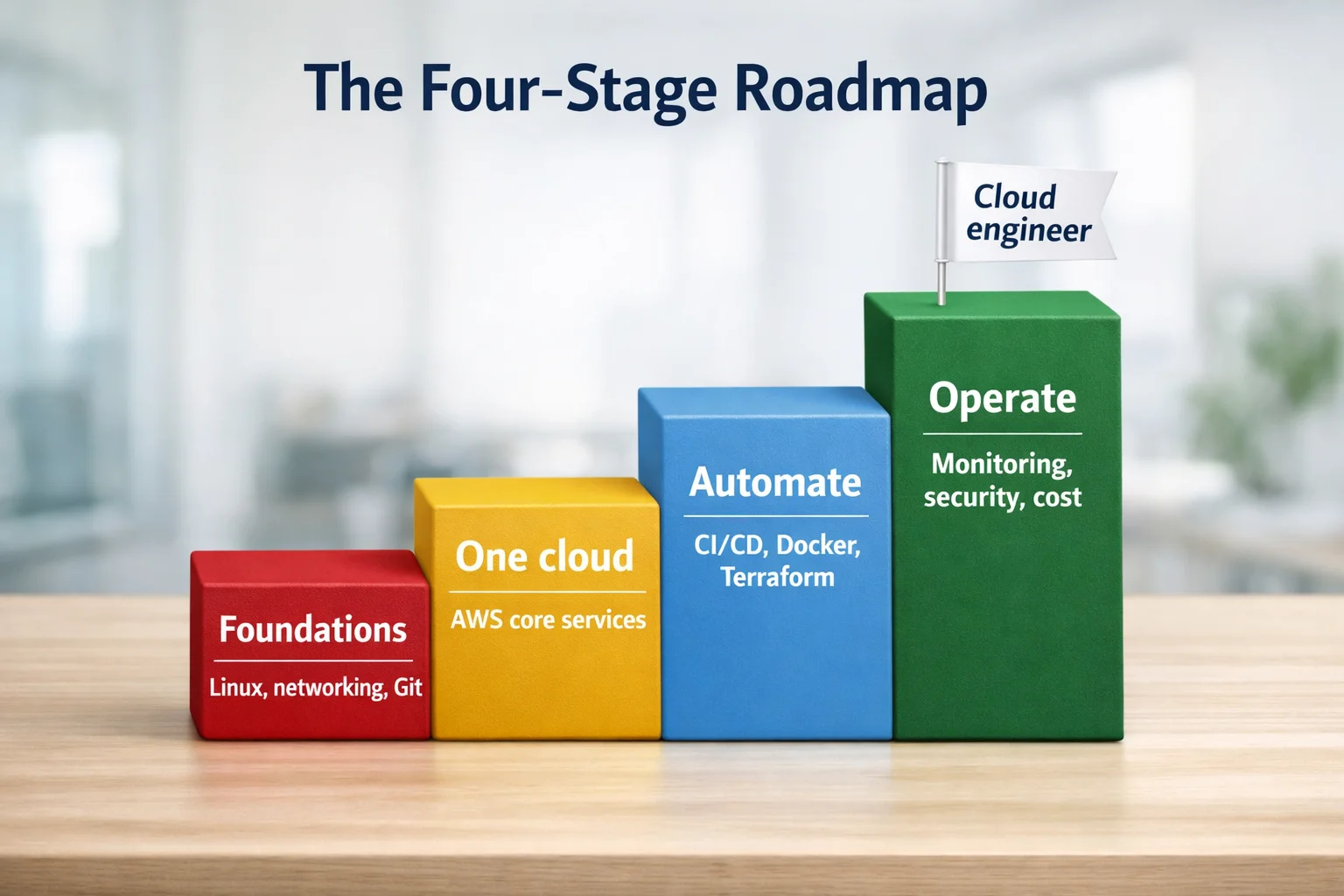
Stage 1: Foundations
- Skills: Linux commands, files, permissions, processes and logs. Networking basics such as IP addresses, DNS, ports, HTTP and TLS. Git beyond commit and push.
- Tools: a Linux shell (on Windows, WSL works), plus curl, dig, ssh and Git.
- Milestone: you can explain what happens between typing a web address and seeing a page, and you can read a server log to find an error. Our guide to Linux for cloud covers the commands.
Stage 2: One Cloud Platform
- Skills: AWS defines cloud computing as the on-demand delivery of IT resources over the internet with pay-as-you-go pricing. Learn the core services: identity and access (IAM), virtual networks (VPC), compute (EC2), storage (S3) and a CDN (CloudFront).
- Shared responsibility: AWS says the customer's responsibility depends on the services selected, and that customers manage their own data, including encryption options. Learn which side of the line each service puts you on.
- Tools: the AWS console and the AWS command line.
- Milestone: a front end of yours served from AWS under your own domain. See our list of AWS services to know and the AWS Cloud Practitioner guide.
Stage 3: Automate and Package
- CI/CD: pipelines that test, build and deploy on every change. See CI/CD basics and our guide to CI/CD best practices with GitHub Actions.
- Containers: Docker describes a container as an isolated process with all the files it needs to run, with no reliance on dependencies installed on the host. It says containers can run anywhere.
- Infrastructure as code: HashiCorp describes Terraform as a tool that lets you build, change and version cloud resources, with a write, plan and apply workflow. The plan step previews what will be created, changed or destroyed before anything happens. Our Terraform roadmap goes further.
- Milestone: the pipeline project in the next section.
Stage 4: Run What You Ship
- Skills: monitoring, logs and alerts. Security basics such as least privilege and keeping secrets out of the repository. Cost awareness, because pay-as-you-go pricing means a forgotten resource keeps costing money.
- Tools: CloudWatch or a similar dashboard and alerting tool. See best AWS monitoring tools and what observability means.
- Milestone: an alarm that tells you when your project breaks, and a short write-up of how you found a failure you caused on purpose. Our AWS security best practices cover the first things to check.
Choosing a Direction: Cloud, DevOps or Platform
Job titles overlap between companies, so read each description for what you would actually do. In many teams a cloud engineer designs and runs cloud infrastructure, a DevOps engineer focuses on delivery pipelines and operations, and a platform engineer builds internal tools that other developers use. Our comparison of the cloud engineer and DevOps engineer roles and our article on platform engineering and DevOps explain the differences.
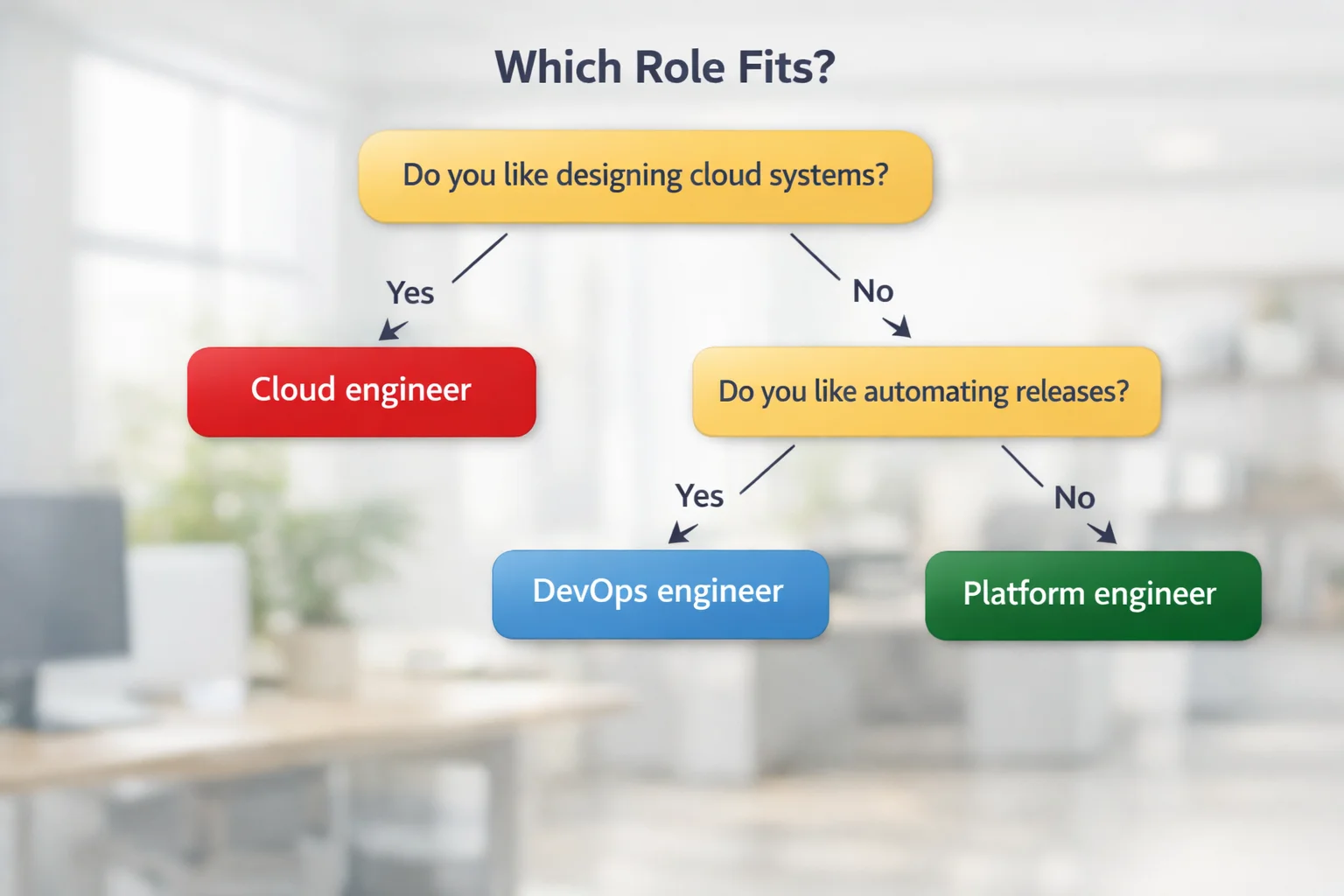
Front-end developers sometimes find the platform route natural, because the people they serve are other developers.
A First Project: A Pipeline With a Staging Stage and an Approval Gate
This project is deliberately not another static-site hosting exercise. If you have not hosted a front end on AWS yet, our guide for React developers moving to the cloud walks through it. Here you build the delivery system around any front end: a test, a staging deploy, and a production deploy that waits for a person.
- Put the front-end project in a GitHub repository. In the repository settings, create two environments, staging and production, and add required reviewers to production. GitHub's documentation says an environment can require approval from named people or teams, and that one reviewer's approval is enough for the job to proceed.
- Write a workflow with a build job that installs dependencies, runs the tests, builds the app and uploads the build as an artifact.
- Add a staging job that downloads that artifact and deploys it. Add a production job that needs staging and uses the production environment, so it pauses until a reviewer approves.
- Give the hashed asset files a long cache lifetime and the HTML entry file a short one or no-cache, following MDN's guidance.
- Break something on purpose, such as a failing test, and watch the pipeline stop. Write down what you saw.
name: deploy-frontend
on:
  push:
    branches: [main]

jobs:
  build:
    runs-on: ubuntu-latest
    steps:
      - uses: actions/checkout@v7
      - uses: actions/setup-node@v7
        with:
          node-version: 24
          cache: npm
      - run: npm ci
      - run: npm test
      - run: npm run build
      - uses: actions/upload-artifact@v7
        with:
          name: site
          path: dist

  staging:
    needs: build
    runs-on: ubuntu-latest
    environment: staging
    steps:
      - uses: actions/download-artifact@v8
        with:
          name: site
          path: dist
      - run: echo 'deploy dist/ to the staging bucket here'

  production:
    needs: staging
    runs-on: ubuntu-latest
    environment: production  # required reviewers are set in the repository settings
    steps:
      - uses: actions/download-artifact@v8
        with:
          name: site
          path: dist
      - run: echo 'deploy dist/ to the production bucket here'
The two deploy steps are placeholders. Replace them with whichever target you chose in Stage 2. The action versions above were the current major versions shown on each project's own page in October 2026, so check them before you copy the file. If you would rather follow a guided path alongside your job, MicroDegree's learning programs are one option.
Frontend Developer vs Cloud Engineer Pay in Bangalore
The table below uses one source for all three roles, so the comparison is like for like: Flexiple's published salary pages for frontend developers, cloud engineers and DevOps engineers in Bengaluru, which I read in October 2026. The figures are self-reported annual pay (CTC) in lakh rupees a year (LPA).
| Experience | Frontend developer (median) | Cloud engineer (median) | DevOps engineer (median) |
|---|---|---|---|
| 0 to 3 years | ₹4.2 LPA | ₹5.3 LPA | ₹5.7 LPA |
| 3 to 6 years | ₹7.6 LPA | ₹7.8 LPA | ₹8 LPA |
| 6+ years | ₹17.1 LPA | ₹16.6 LPA | ₹18.3 LPA |
| Bengaluru, all levels | ₹11.3 LPA | ₹9.8 LPA | ₹12.9 LPA |
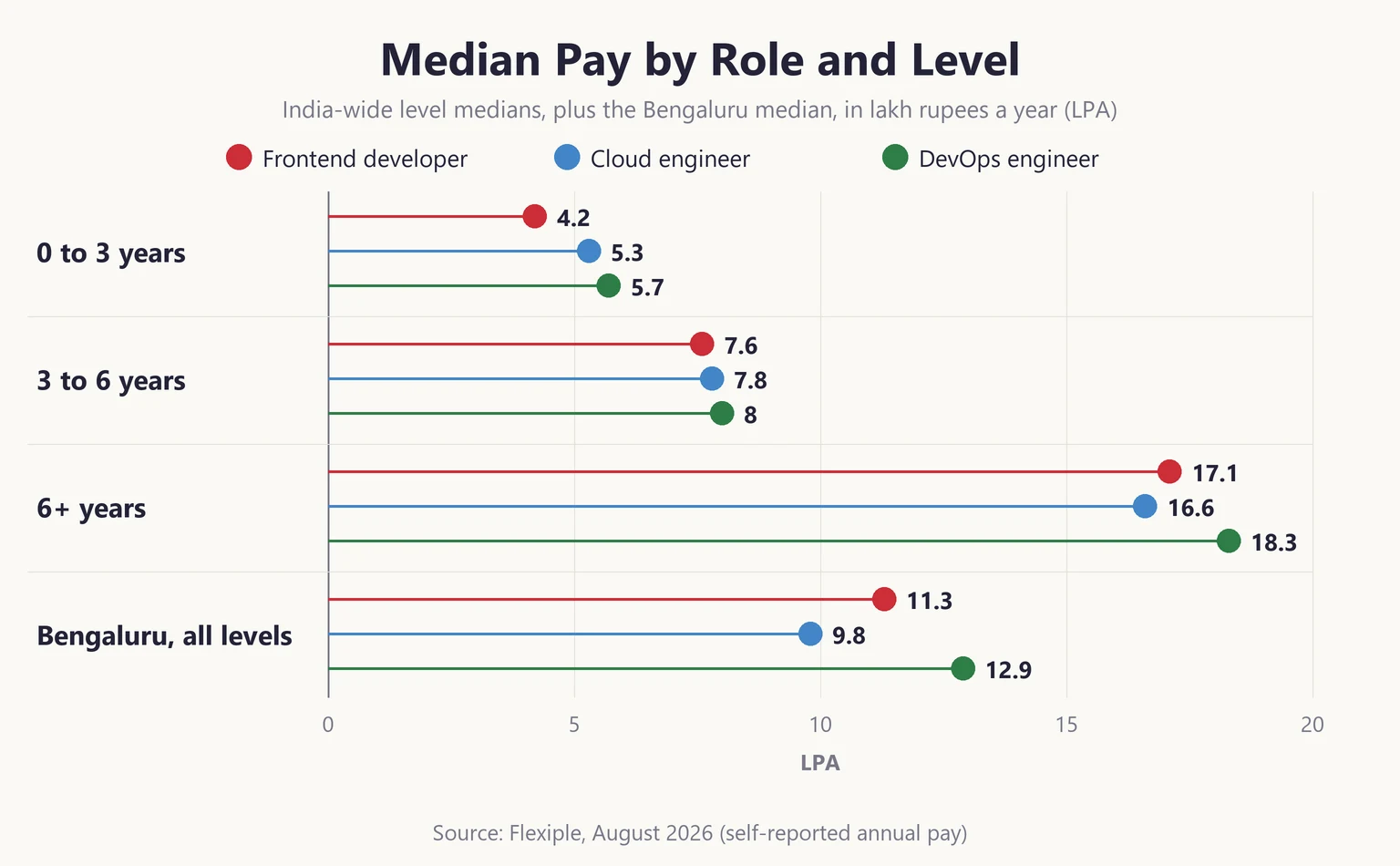
In this data the three roles sit close together. At 0 to 3 years the frontend median is below the other two. At 3 to 6 years all three are within a few tenths of a lakh. At 6+ years the frontend median is above the cloud engineer median and below the DevOps one. For Bengaluru at all levels, the frontend median is above the cloud engineer median, the reverse of the entry-level gap. The two kinds of row use different bases: the three experience rows are India-wide medians that Flexiple does not re-cut to Bengaluru, and only the last row is specific to the city. The spreads are also much wider than the gaps. The middle 50% of Bengaluru pay runs from ₹5.5 LPA to ₹23.1 LPA for frontend developers, from ₹6.4 LPA to ₹17.5 LPA for cloud engineers, and from ₹7.1 LPA to ₹21.5 LPA for DevOps engineers.
Sample sizes are 1,215 Bengaluru records for frontend developers, 632 for cloud engineers and 1,509 for DevOps engineers, so the cloud engineer figure is the least certain. Flexiple's FAQ sections also give level medians that differ from its tables, so even one source is not fully consistent. As a cross-check on the frontend side, PayScale lists an average base salary of ₹664,713 a year for a Front End Developer / Engineer in India, from 872 profiles updated in July 2026. It has no matching cloud engineer page, so there is no second source for that role.
In this data the move is not a clear pay jump. Someone changing roles may also be hired at a more junior level than their years of experience suggest, and pay depends on the company, your skills and how interviews go. Choose the move for the work and the direction it opens. Our guide to the cloud engineer salary in India has more on the cloud side, and the React-specific numbers in our React developer guide use Flexiple's separate React page.
Tools to Put Off Until Later
- Kubernetes: learn Docker and one simple way of running a container first. Kubernetes adds a lot to learn on top.
- A second cloud platform: go deep on one before adding another.
- Service meshes and advanced networking add-ons: they matter in large systems, not in your first project.
- Certifications beyond the entry level: build the projects first, then decide which certificate adds something.
Conclusion
The roadmap is four stages: foundations, one cloud platform, automation and packaging, and running what you ship. Your build tooling and your knowledge of caching give you a head start on the third. You can begin this week by reading a real server log and finding one error in it. For another way into cloud work from your current job, see our guide on how to switch to cloud computing without quitting your job.
FAQs
1. Can a frontend developer become a cloud engineer?▼
Yes. You need Linux, networking, one cloud platform, automation and monitoring, which are new. Your experience with build tools, version control and caching carries over and shortens the third stage.
2. Do I need to learn a backend language first?▼
Not strictly. Much cloud work uses the command line, infrastructure files and pipeline definitions. Basic scripting in Python or Bash helps, and knowing how a client and a server talk to each other helps more.
3. How long does the move take?▼
It depends on the hours you can give and how much of Stage 1 you already know. Use the milestones as the measure, not a calendar. Plan for several months of steady practice.
4. Does a cloud engineer earn more than a frontend developer?▼
In the Flexiple data used above, the medians are close at each level, with the cloud engineer slightly higher at 0 to 3 years and the frontend developer higher for Bengaluru at all levels. The ranges are wide and the sources differ, so pay alone is not a reason to move.
5. Which cloud platform should I learn first?▼
Choose the one your company or your target employers use, and go deep before adding another. AWS is a common first choice, and the project in this guide works on any platform.
6. Can I stay in front-end work and still learn cloud skills?▼
Yes. Owning your own team's delivery pipeline is a good first step, because it uses your front-end knowledge and builds the Stage 3 skills. Some developers stay in that hybrid role.
Thinking about the move from the front end?Click here to take a free Cloud & DevOps demo