
How to Become an MLOps Engineer in 2026: Skills, Tools & Roadmap
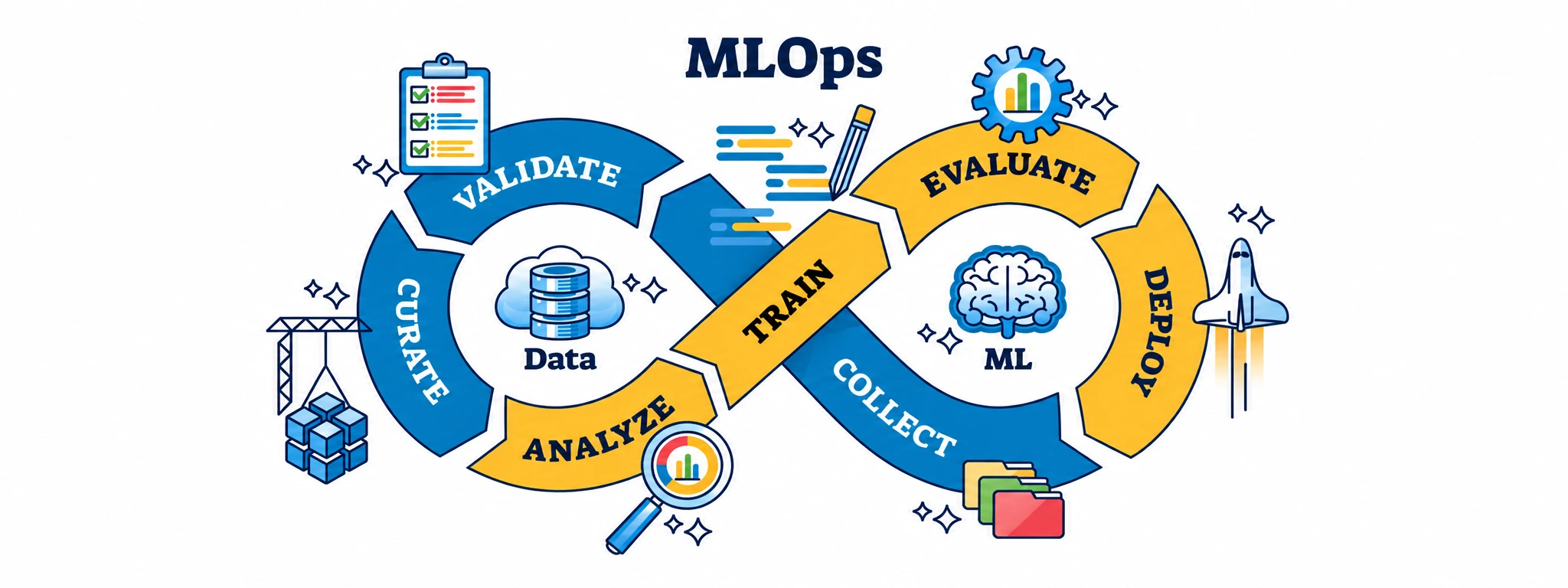
The guide explains how to become an MLOps Engineer in 2026 by combining machine learning, software engineering, DevOps, cloud, automation, and monitoring. It covers key skills such as Python, ML fundamentals, Linux, Docker, Kubernetes, CI/CD, Terraform, cloud platforms, and model monitoring. The roadmap progresses from building foundational skills to developing ML pipelines, deploying models to the cloud, and managing production systems. It also highlights career paths such as MLOps Engineer, ML Platform Engineer, AI Infrastructure Engineer, and LLMOps Engineer.
Table of Contents
▼Machine learning models often perform well inside notebooks but become hard to handle when they move to production. The data changes, model loses accuracy, infrastructure fails, and teams find it difficult to reproduce results. An MLOps Engineer tackles these challenges by blending machine learning, software engineering, DevOps, cloud, automation and monitoring.
Looking to build practical skills in Cloud, DevOps, GenAI, and other in-demand technologies? Explore MicroDegree's self-paced e-learning courses in Kannada. Explore MicroDegree E-Learning Courses
For working IT professionals, MLOps can be a practical career transition. DevOps engineers already know about CI/CD, infrastructure, containers and cloud platforms. Software engineers contribute programming skills and API development knowledge. Data engineers understand pipelines and data quality. These foundations can be extended into machine learning operations.
This guide explains how to become an MLOps Engineer in 2026, including the required skills, tools, learning roadmap, interview preparation, and salary considerations.

What Does an MLOps Engineer Do?
An MLOps Engineer helps move machine learning models from experimentation to reliable production systems. The role covers the complete model lifecycle: data preparation, training, validation, packaging, deployment, monitoring, retraining, and retirement.
A data scientist may develop a model, but the model still needs an operational system around it. That system must handle versioning, testing, deployment, scaling, security, observability, and rollback. MLOps provides the engineering practices required to make that possible.
Typical responsibilities include:
- Creating repeatable machine learning pipelines.
- Automating model training and validation.
- Managing model and dataset versions.
- Building CI/CD workflows for ML applications.
- Deploying models for batch or real-time inference.
- Monitoring latency, errors, accuracy, drift, and resource usage.
- Managing cloud infrastructure and compute resources.
- Improving reproducibility and governance.
- Working with data scientists, software engineers, and platform teams.
An MLOps Engineer is not simply a DevOps Engineer who knows one machine learning library. The role requires an understanding of how data, models, code, infrastructure, and business requirements interact.
MLOps and DevOps: What Is the Difference?
DevOps focuses mainly on software applications. MLOps applies similar principles to systems where model behavior also depends on data and statistical performance.
| Area | DevOps | MLOps |
|---|---|---|
| Main artifact | Application code | Code, data, models, and configuration |
| Testing | Unit, integration, and performance tests | These tests plus data and model validation |
| Deployment | Application releases | Model and application releases |
| Monitoring | Uptime, errors, latency | These plus drift, quality, bias, and accuracy |
| Rollback | Previous application version | Previous model, code, data, or pipeline version |
| Retraining | Usually not required | Often triggered by new data or performance decline |
Why MLOps Matters in 2026
Many organizations have moved beyond machine learning experiments and now need dependable AI systems. A model that works in a notebook has limited business value unless users and applications can access it consistently.
MLOps reduces the gap between experimentation and production. It helps teams create repeatable workflows instead of relying on manual commands, local environments, and undocumented steps.
MLOps is also becoming increasingly important for generative AI applications. Teams need systems for prompt and model versioning, evaluation, tracing, latency measurement, cost control, safety checks, and deployment. These responsibilities overlap with traditional MLOps but may also be described as LLMOps.
A strong MLOps Engineer helps an organization answer practical questions:
- Which model version is currently in production?
- What data was used to train it?
- Can the model be reproduced?
- What happens if prediction quality declines?
- How quickly can a new version be tested and deployed?
- Can the system scale during higher traffic?
- How are sensitive data and model endpoints protected?
The field is especially relevant to professionals who already work with cloud infrastructure, automation, data platforms, or production support. These backgrounds provide valuable experience with reliability and operational ownership.

Which MLOps Engineer Skills You Need
1. Python and Software Engineering
Python is widely used in data science and machine learning workflows. You do not need to become a research-level Python developer, but you should be comfortable writing maintainable production code.
Learn:
- Functions, classes, modules, and packages.
- Virtual environments and dependency management.
- Logging and exception handling.
- Unit and integration testing.
- REST API development.
- Type hints and configuration management.
- Git workflows and code reviews.
You should also understand basic software design. A model-serving application should not be a single notebook converted into an API. It should have clear modules for loading the model, validating inputs, generating predictions, handling errors, and recording useful metrics.
2. Machine Learning Fundamentals
An MLOps Engineer does not always build models from scratch, but must understand enough machine learning to operate them correctly.
Important concepts include:
- Supervised and unsupervised learning.
- Training, validation, and test datasets.
- Classification and regression.
- Overfitting and underfitting.
- Feature engineering.
- Precision, recall, F1 score, and ROC-AUC.
- Data leakage.
- Model calibration.
- Batch and online inference.
- Model and data drift.
You should be able to understand a model's input features, expected outputs, evaluation metrics, and limitations. Without this knowledge, it is difficult to design meaningful validation or monitoring.
3. Linux, Networking, and APIs
Production ML systems depend on the same foundations as other applications. Linux, networking, authentication, storage, and APIs remain essential.
Focus on:
- Processes, permissions, services, and shell scripting.
- HTTP, DNS, TLS, ports, and load balancing.
- REST and JSON.
- Authentication and authorization.
- Message queues and event-driven systems.
- Object storage and databases.
- Basic troubleshooting using logs and metrics.
These skills become particularly valuable when a model endpoint works locally but fails behind a gateway, service mesh, private network, or cloud load balancer.
4. Containers and Kubernetes
Docker helps package a model-serving application with its dependencies. Kubernetes helps deploy, scale, and manage containerized workloads. Kubernetes is designed to automate the deployment, scaling, and management of containerized applications.
You should understand:
- Dockerfiles and image optimization.
- Image registries.
- Kubernetes Pods, Deployments, Services, and ConfigMaps.
- Secrets and resource limits.
- Health checks.
- Horizontal scaling.
- Persistent storage.
- Ingress and networking.
- GPU scheduling at a conceptual level.
You do not need to start with complex Kubernetes operators. First deploy a small inference API, expose it through a Service, configure health checks, and create a basic autoscaling setup.
5. CI/CD and Infrastructure as Code
MLOps pipelines should automatically test and package code, validate data, build images, and deploy approved versions.
Common concepts include:
- Continuous integration.
- Automated testing.
- Build artifacts.
- Environment promotion.
- Approval workflows.
- Rollbacks.
- Secrets management.
- Infrastructure as Code.
- Policy and security scanning.
Terraform is frequently used to define cloud infrastructure as code, while GitHub Actions, GitLab CI/CD, Jenkins, or cloud-native services can automate workflows. The specific tool matters less than your ability to design a safe, repeatable delivery process.
6. Cloud Platforms
Choose one cloud platform and learn it deeply before exploring others. For many professionals, AWS is a practical choice because it combines compute, storage, networking, identity, monitoring, containers, and managed machine learning services.
Relevant AWS services may include:
- Amazon S3 for data and artifacts.
- IAM for access control.
- ECR for container images.
- ECS or EKS for container workloads.
- Lambda for selected event-driven use cases.
- CloudWatch for logs and monitoring.
- SageMaker AI for managed ML workflows.
Once you've picked a platform, MicroDegree's Cloud Certification Guide can help you map out the right certification path.
What are the MLOps Tools to Learn
You do not need to learn every tool in the ecosystem. Build a coherent toolchain and understand why each component exists.
| MLOps area | Tools to consider | What to learn |
|---|---|---|
| Programming | Python | Production ML and automation code |
| Version control | Git, GitHub, GitLab | Collaboration and change tracking |
| Containers | Docker | Reproducible packaging |
| Orchestration | Kubernetes | Deployment and scaling |
| Experiment tracking | MLflow, Weights & Biases | Parameters, metrics, and artifacts |
| Model registry | MLflow Model Registry | Model lifecycle management |
| Pipelines | Airflow, Kubeflow Pipelines, Prefect | Workflow orchestration |
| Serving | FastAPI, BentoML, KServe | Real-time inference |
| Cloud ML | SageMaker, Vertex AI, Azure ML | Managed training and deployment |
| Monitoring | Prometheus, Grafana, Evidently | System and model observability |
| IaC | Terraform | Reproducible infrastructure |
| CI/CD | GitHub Actions, GitLab CI/CD, Jenkins | Automated delivery |
MLflow supports experiment tracking, model packaging, registry management, and deployment workflows. Its Model Registry provides a centralized store, APIs, and user interface for managing model versions and lifecycle states.
MLOps Engineer Roadmap for 2026
Phase 1: Strengthen the Foundations
Start with Python, Linux, Git, networking, and basic software engineering. If you already work in DevOps or cloud engineering, assess your gaps instead of repeating topics you already know.
Your target outcome should be a small Python service stored in Git, tested automatically, packaged with Docker, and exposed through an API.
Phase 2: Learn Practical Machine Learning
Study the complete workflow from dataset preparation to evaluation. Use scikit-learn for classical machine learning before moving into advanced deep learning or large language models.
Practice:
- Load and validate a dataset.
- Split it correctly.
- Train a baseline model.
- Track metrics.
- Save the model.
- Create a prediction API.
- Test valid and invalid inputs.
- Document limitations.
Phase 3: Build Reproducible Pipelines
Convert manual steps into a pipeline. A useful pipeline may include data validation, feature preparation, training, evaluation, model registration, and deployment.
Add:
- Configuration files.
- Dataset versioning.
- Reproducible dependencies.
- Automated tests.
- Experiment tracking.
- Quality thresholds.
- Approval gates.
For example, a deployment can be blocked automatically if the new model's F1 score falls below the approved baseline.
Phase 4: Deploy to the Cloud
Deploy the model in at least one realistic environment. Begin with a managed service or a simple container deployment, then progress to Kubernetes if your target roles require it.
Your deployment should address:
- Authentication.
- Secure secrets.
- Logging.
- Health checks.
- Autoscaling.
- Cost control.
- Monitoring.
- Rollback.
A production-oriented project should explain why you selected batch inference or real-time inference. Not every model needs a continuously running endpoint.
Phase 5: Add Monitoring and Governance
Monitoring is where many beginner projects remain incomplete. Track both system and model behavior.
System metrics include:
- Request latency.
- Error rate.
- Throughput.
- CPU and memory usage.
- GPU utilization.
- Availability.
Model-related metrics include:
- Input distribution changes.
- Prediction distribution changes.
- Feature drift.
- Data quality failures.
- Delayed ground-truth performance.
- Bias or fairness indicators where relevant.
Also document model ownership, intended use, known limitations, data sources, and retraining conditions.
Phase 6: Prepare for Production-Level Design
At this stage, learn to design systems rather than only execute commands. Practice explaining trade-offs such as:
- Batch versus real-time inference.
- Kubernetes versus a managed endpoint.
- Retraining on schedule versus event-based retraining.
- Centralized versus decentralized model registries.
- Cost versus latency.
- Simplicity versus flexibility.
This design ability separates candidates who have followed tutorials from engineers who can contribute to production systems.
Conclusion
Becoming an MLOps Engineer in 2026 is not just about knowing a set of machine learning tools. It's about bringing together software engineering, cloud infrastructure, DevOps automation, machine learning basics, deployment, monitoring and security.
A practical MLOps Engineer Roadmap begins with Python and Linux. Then it moves into machine learning workflows and containers. After that you add CI/CD pipelines, cloud platforms orchestration tools, model registries and observability. The key is to build projects that show the lifecycle—from data to production—instead of stopping at model training.
For DevOps, cloud, data, and software professionals, MLOps can be a logical career path because it builds on existing engineering experience. Start with one end-to-end project, document your decisions, and gradually expand toward production-grade systems.
Ready to move toward an MLOps Engineer career? Start by selecting one practical project, such as a containerized model API with CI/CD, MLflow tracking, cloud deployment, and monitoring. Explore MicroDegree's Cloud & DevOps, Generative AI learning resources to strengthen the skills you need.
If you are already working as an IT Professional, share this guide with a colleague who is planning a transition into AI infrastructure or MLOps.
FAQs
Q1: How can a DevOps Engineer become an MLOps Engineer?▼
A DevOps Engineer already has useful foundations in Linux, Git, CI/CD, containers, cloud, monitoring, and infrastructure automation. The main gaps are usually machine learning fundamentals, data workflows, experiment tracking, model evaluation, model registries, and model-specific monitoring. Start by learning Python and practical ML concepts. Then build a project that trains, tracks, packages, deploys, and monitors a model. Add MLflow, a cloud platform, and Kubernetes gradually.
Q2: Which MLOps tools should I learn first?▼
Begin with Python, Git, Docker, one cloud platform, and a CI/CD tool. Then learn MLflow for experiment tracking and model lifecycle management. Add FastAPI or another serving framework for inference APIs. After that, study Kubernetes, Terraform, and Prometheus/Grafana if your target roles require them. Airflow, Kubeflow Pipelines, or Prefect can be added for workflow orchestration.
Q3: Is Kubernetes mandatory for an MLOps Engineer?▼
Kubernetes is not mandatory for every MLOps role, but it is valuable for teams that operate containerized ML workloads at scale. Smaller teams may use managed cloud endpoints, serverless services, or virtual machines. However, understanding Kubernetes concepts such as deployments, services, health checks, scaling, secrets, and resource limits can improve your career options.
Q4: Do I need advanced mathematics to become an MLOps Engineer?▼
Advanced mathematics is usually not the primary requirement for an MLOps Engineer. You should understand practical concepts such as model evaluation, probability basics, feature behavior, overfitting, data leakage, drift, and statistical changes in data. You also need to understand the limitations of the models you deploy.
Q5: Is MLOps a good career path in 2026?▼
MLOps can be a strong career path for professionals who enjoy automation, cloud systems, reliability, and collaboration with machine learning teams. Organizations need more than models; they need dependable systems that can deploy, monitor, govern, and improve those models. The role is also expanding into LLMOps and AI platform engineering.