
Why Big Tech Companies Are Investing Billions in AI Infrastructure
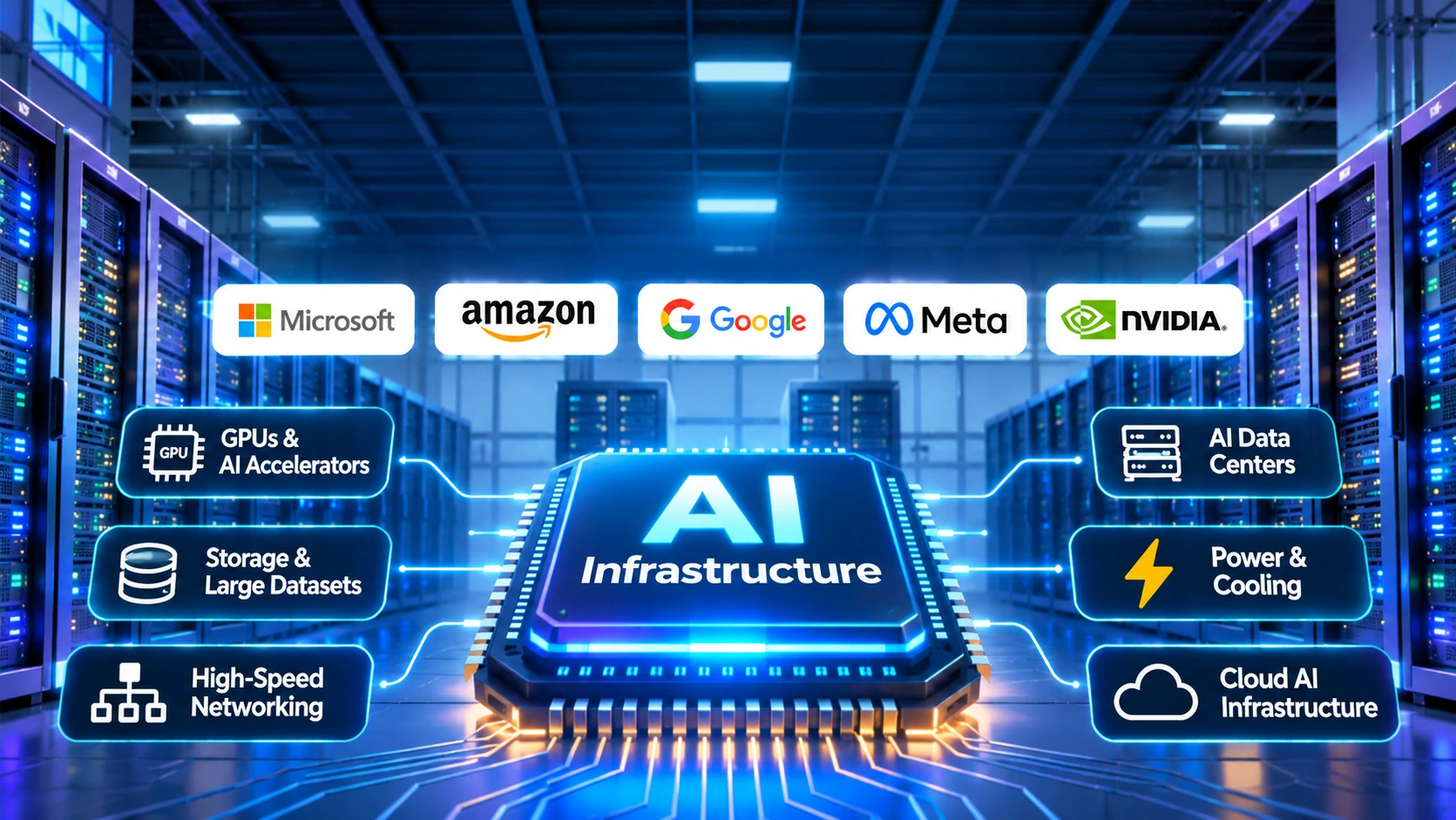
AI infrastructure investment has become one of the largest spending areas in technology. Microsoft, Amazon, Alphabet (Google) and Meta are each spending tens of billions of dollars a quarter on data centres, servers and chips, and NVIDIA, which sells much of the hardware, reported USD 89.0 billion of data centre revenue in a single quarter ended 26 July 2026. Every figure in this guide is in US dollars, and each one is tied to the period and definition the company used.
Building better AI models is not only a software problem. Training and running them takes powerful chips, large data centres, fast networks, storage, electricity and cooling. This guide explains what that infrastructure is, where the money is going, what the risks are and what it could mean for IT professionals in India. It covers the infrastructure behind AI, not how AI is used to run cloud operations. For that, see our guide to AI-powered cloud infrastructure.
Table of Contents
▼What is AI infrastructure?
AI infrastructure is the hardware, facilities and cloud services used to build, train, deploy and run AI systems. Four parts do most of the work.
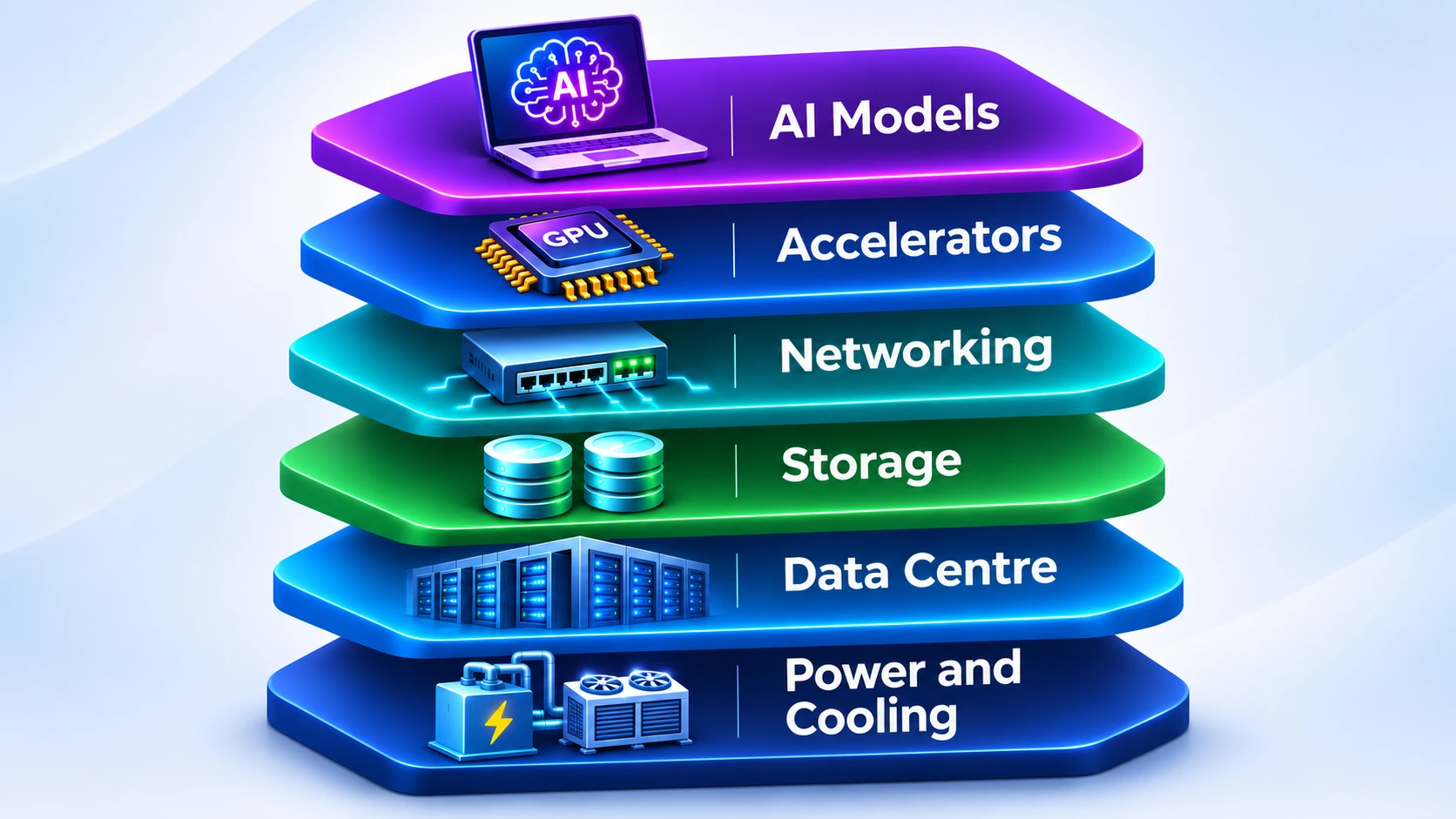
GPUs and AI accelerators
A CPU is built to do a wide range of tasks one after another very quickly. A GPU (graphics processing unit) has thousands of smaller cores that do many calculations at the same time. AI models are mostly huge amounts of matrix arithmetic, which suits that parallel design. That's why NVIDIA GPUs became the default for AI work.
Companies also design chips specifically for AI, called accelerators. Google describes its Tensor Processing Units (TPUs) as custom application-specific integrated circuits for machine learning, suited to matrix-heavy models and long training runs. AWS describes Trainium as a purpose-built AI chip for training and inference, and claims better cost per token at production scale, which is an AWS claim, not independent proof.
AI data centres
A conventional data centre is mostly racks of general-purpose servers. An AI data centre packs far more computing into each rack, in clusters of GPUs or accelerators that work together on one job. That raises how much electricity each rack needs and how much heat it gives off, so power delivery and cooling become design problems, not afterthoughts.
High-speed networking
Training a large model splits the work across many chips, and they must constantly exchange results. If the network is slow, expensive GPUs wait idle. So AI clusters need high-bandwidth, low-latency links between machines.
Storage and data infrastructure
Training uses very large datasets that must be stored, cleaned and fed to the chips fast enough to keep them busy. Running a model for users (inference) also needs quick access to the model and often to company data. Fast storage and reliable data pipelines keep the whole system moving.
| Component | Purpose | Why it matters for AI |
|---|---|---|
| GPUs and accelerators | Do the heavy calculations | Parallel arithmetic is the core of training and inference |
| AI data centres | House, power and cool the hardware | Dense racks need more electricity and cooling than conventional ones |
| Networking | Connect chips and servers | Slow links leave expensive chips waiting |
| Storage and data pipelines | Hold and deliver datasets and models | Chips can only work as fast as data arrives |
| Power and cooling | Supply electricity and remove heat | Limits where and how fast capacity can be built |

Why is AI infrastructure investment increasing?
- Training demand: building more capable models takes more computing, which means more chips for longer. Companies compete on model quality, and compute is a major input.
- Inference demand: after training, every user request also needs computing. A model used by millions of people needs infrastructure that runs continuously, so serving a model can cost as much as, or more than, training it over time.
- Enterprise adoption: companies are adding AI to customer support, software development, analytics and business applications, and much of that runs on cloud platforms. For context, Microsoft reported that Azure revenue rose 48% in the quarter ended 30 September 2026.
- Hyperscaler competition: cloud providers want to be where customers run AI workloads, so they expand GPU and custom-chip capacity to win and keep them. AWS, for example, reported AWS segment sales up 39% to USD 46.0 billion in the same quarter.
- Control of supply: companies want dependable access to chips and data centre capacity, which is why several design their own silicon (AWS Trainium, Google TPUs) instead of relying only on outside suppliers. This is a strategic motive companies describe; the exact weight of each reason differs by company.
Where are the big technology companies investing?
The table uses figures from company releases and filings, each with its period and definition. Don't read it as a ranking: the measures differ. Some are one quarter, some are nine months, some are company guidance for a full year. Amounts are in US dollars.
| Company | Main area of investment | Reported spending | Reporting period and type |
|---|---|---|---|
| Microsoft | Azure data centres, GPUs and CPUs | USD 39.4 billion additions to property and equipment (news coverage reports USD 45.2 billion including finance leases) | Quarter ended 30 September 2026 (fiscal 2027 Q1); actual cash spending |
| Amazon | AWS data centres, Trainium and other infrastructure, plus retail needs | USD 77.3 billion gross purchases of property and equipment, about USD 75.9 billion net of proceeds; about USD 220 billion expected for 2026 | Quarter ended 30 September 2026, actual; 2026 figure is company expectation of cash capex |
| Alphabet (Google) | Servers, data centres, TPUs and Google Cloud capacity | USD 131.95 billion purchases of property and equipment; 2026 guidance of USD 195 to 205 billion reported by news coverage | Nine months ended 30 September 2026, actual (10-Q); guidance is a full-year company figure from media coverage of its call |
| Meta | AI computing clusters, data centres and servers | USD 34.91 billion including finance lease principal; USD 135 to 145 billion expected for 2026 | Quarter ended 30 September 2026, actual; 2026 figure is a company outlook |
| NVIDIA | Supplier of GPUs, networking and computing platforms (revenue, not capex) | USD 89.0 billion Data Center revenue; next-quarter revenue outlook USD 108.0 billion plus or minus 2% | Quarter ended 26 July 2026 (fiscal 2027 Q2), actual; outlook is guidance |
Three cautions. First, capital spending isn't all AI: Amazon's figure covers the whole company, and the release doesn't split AI from retail or other cloud spending, while Microsoft, Alphabet and Meta also spend on broader cloud and infrastructure needs. Second, quarterly spending, nine-month totals and full-year guidance can't be added together. Third, Meta's release gave no 2027 figure and said it is still developing budget and capacity plans, so any 2027 number you see elsewhere is an estimate.
On the supplier side, NVIDIA's Data Center revenue rose 117% year over year, and the company said its outlook assumed no Data Center compute revenue from China. That shows how much of the infrastructure spending flows to chips and related equipment.
Why GPUs and AI data centres are so expensive
Buying AI capacity is different from adding more ordinary servers, and the costs show up in several places.
- Chips: high-performance GPUs and accelerators cost far more than standard server processors, and a cluster needs thousands of them working together.
- Networking: the links between them have to match the chips' speed, so networking equipment becomes a big line item.
- Buildings: each rack draws more power and gives off more heat, so facilities need stronger electrical systems and advanced cooling, and construction takes time.
- Electricity: running dense racks continuously is a large operating cost.
- Replacement and planning: AI hardware changes quickly, so companies plan for upgrades and, in Microsoft's case, much of its recent capital spending went to short-lived assets such as CPUs and GPUs according to news coverage of its call.
The biggest challenges of the AI infrastructure boom
- Power: U.S. data centers used about 4.4% of the country's electricity in 2023, and a Lawrence Berkeley National Laboratory report summarised by the U.S. Department of Energy projects roughly 6.7 to 12% by 2028. The IEA, in its Energy and AI report, puts global data centre use at about 415 TWh in 2024 (around 1.5% of the world's electricity) and projects about 945 TWh by 2030 in its base case. Projections carry uncertainty, and reliable grid power is a constraint on where capacity can go.
- Cooling: dense GPU racks produce a lot of heat, which is why more facilities look at liquid cooling and other advanced methods.
- Chip supply: AI depends on a small number of specialised chips, and supply limits and competition for capacity can delay projects. Microsoft said some third-party capacity deliveries were delayed in its latest quarter, according to news coverage.
- Cost and return: capital spending is large, and so is the cost of running inference for many users. Returns depend on future demand. Alphabet's nine-month purchases of property and equipment were USD 131.95 billion against USD 63.6 billion a year earlier, and its free cash flow was reported as negative for the quarter in news coverage.
- Environmental impact: electricity use brings carbon emissions unless the power is low-carbon, and cooling can use water. Companies point to renewable energy and efficiency work, but we haven't cited sourced figures for water use here.
- Underuse and overbuilding: if demand grows slower than capacity, some infrastructure could sit under-used. Nobody can say for sure whether the spending will pay off, and a risk of investing ahead of demand is widely discussed.
How AI infrastructure is changing cloud computing
Cloud providers now sell AI capacity as a core product: GPU-based instances, their own chips and managed platforms for building and running models. AWS offers Trainium chips and instances, and Google offers TPUs through Compute Engine and Google Kubernetes Engine. Microsoft reported that Azure revenue grew 48% in the quarter ended 30 September 2026.
| Aspect | Traditional cloud workload | AI workload |
|---|---|---|
| Compute | General-purpose CPUs, scaling out by many small servers | GPUs or accelerators, often reserved in large groups |
| Memory | Moderate per server | Large memory on the accelerator is a limiting factor |
| Networking | Ordinary data-centre networking is usually enough | High-bandwidth, low-latency links between accelerators |
| Storage | Application data and databases | Large datasets, model files and fast data pipelines |
| Cost | Billed by instance time, easy to scale down | Expensive per hour, so utilisation and scheduling matter a lot |
Because accelerators are costly, teams also need cost monitoring and capacity planning. Many organisations spread AI work across more than one cloud, which adds complexity in networking, security and cost tracking. Our guide to what FinOps is and why cloud engineers need it covers the cost side.
What does the AI infrastructure boom mean for IT careers?
More infrastructure to build and run can mean more work for people who can build and run it. We don't have current employment data that says how fast any of these areas is growing, so treat them as skill areas where demand may rise, not as forecasts.
- Cloud Engineers: provision and manage GPU-based and other scalable resources on AWS, Azure and Google Cloud.
- DevOps and Platform Engineers: deploy infrastructure, automate and orchestrate it, run container platforms, monitor reliability and support AI applications. Our posts on platform engineering and Kubernetes go deeper.
- MLOps Engineers: deploy and monitor models, build ML pipelines, version models and manage the infrastructure for training and inference. See how to become an MLOps engineer.
- Linux and infrastructure administrators: manage servers and operating systems, operate GPU servers and troubleshoot performance.
- FinOps professionals: track cloud spend, analyse GPU utilisation, manage budgets and optimise the cost of AI workloads.
- Data centre and infrastructure engineers: work on servers, networking, storage, power and cooling.
For the wider picture of how AI and cloud are changing IT roles, read our guide to emerging IT career opportunities.
Skills IT professionals should learn
You don't need every skill at once. Start with the foundations and add the specialised ones as your role needs them.
- Cloud skills (foundation): AWS, Azure or Google Cloud fundamentals, including compute, storage, networking and cloud architecture. Pick one first.
- Infrastructure and operating systems (foundation): Linux administration, server management, networking and storage basics, monitoring and troubleshooting.
- DevOps and platform skills (next): containers, Kubernetes basics, CI/CD, infrastructure automation and observability.
- AI and MLOps fundamentals (specialised): the machine learning lifecycle, model deployment and monitoring, ML pipelines and GPU computing basics.
- FinOps and cost management (specialised, useful early): cloud billing, resource utilisation, cost optimisation and budget monitoring.
If you'd like structured practice, MicroDegree's e-learning platform teaches in Kannada and lists AWS, Azure, Kubernetes, DevOps and Linux among the skills it covers.
What could happen next in AI infrastructure?
Some things are already happening, and others are forecasts. Keep them apart.
- Already happening: companies are building custom AI chips (AWS Trainium, Google TPUs), expanding cloud AI services, and adding liquid and other advanced cooling in dense facilities.
- Already happening: companies are paying more attention to utilisation and cost, because accelerators are expensive.
- Plausible but uncertain: more efficient models could reduce the computing needed per task, though cheaper AI could also increase the amount people use.
- Plausible but uncertain: inference could grow into a larger share of infrastructure demand as more people and businesses use AI.
- Forecast only: energy-efficient computing, edge AI infrastructure and further data centre growth. Treat any exact projection as an estimate, and note that Meta says it is still planning for 2027.
Conclusion
AI growth depends on computing infrastructure as much as on models. Chips, data centres, networking, storage and electricity have become strategically important, and the largest companies are spending accordingly, with some of the spending still ahead of proven returns. For IT professionals, the practical opportunity is in the skills that build and run that infrastructure: cloud, Linux, DevOps, MLOps, FinOps and infrastructure operations. Start with a foundation, one cloud and Linux, then specialise.
Build the Skills Behind AI Infrastructure
If you want to build cloud, DevOps and infrastructure skills, MicroDegree's e-learning platform teaches in Kannada, with AWS, Azure, Kubernetes, DevOps, Generative AI and Agentic AI among the skills it covers. You can explore them in one place and decide where to start.
FAQs
1. What is AI infrastructure?▼
It is the chips, data centres, networks, storage, power and cloud services used to build, train and run AI systems. GPUs and custom accelerators do the calculations, and the rest supports them.
2. Why are companies investing billions in AI infrastructure?▼
Training capable models takes large computing resources, and running them for many users needs capacity too. Cloud providers also compete to host AI workloads, and companies want reliable access to chips and data centre space.
3. Why do AI models need GPUs?▼
AI models are mostly large amounts of matrix arithmetic. GPUs do many calculations in parallel, which suits that work far better than a CPU that processes tasks mostly one after another.
4. What is the difference between an AI data centre and a traditional data centre?▼
An AI data centre packs more computing into each rack, in clusters of GPUs or accelerators with fast networking. Each rack needs more power and cooling than a typical conventional rack.
5. Which companies are investing the most in AI infrastructure?▼
Microsoft, Amazon, Alphabet and Meta report the largest spending among the companies covered here, and NVIDIA supplies much of the hardware. Their figures use different periods and definitions, so check the dated table instead of ranking them.
6. How does AI infrastructure affect cloud computing?▼
Cloud providers now sell GPU and custom-chip capacity and managed AI platforms as core products. AI workloads also push cost control, capacity planning and networking higher up the priority list.
7. What jobs are related to AI infrastructure?▼
Cloud engineers, DevOps and platform engineers, MLOps engineers, Linux and infrastructure administrators, FinOps professionals and data centre engineers all work on parts of it. We don't have data on how fast any of these is growing.
8. What skills are needed to work in AI infrastructure?▼
Start with one cloud platform and Linux, add networking, containers and Kubernetes and automation, then specialise in MLOps or FinOps as your role needs.
9. Why does AI infrastructure consume so much electricity?▼
Dense racks of GPUs run continuously and give off a lot of heat, which also has to be removed. U.S. data centers used about 4.4% of electricity in 2023, and projections for 2028 are higher.
10. Will AI infrastructure investment continue to increase?▼
Companies' own 2026 plans are large: Alphabet's nine-month purchases of property and equipment were more than double the same period of 2025, and Meta says it is still planning for 2027. Whether spending keeps rising depends on demand, returns, power and supply, so no one can say for certain.