
Is Generative AI a Good Career Option for Non-Coders?

Every week, someone in your team shares another AI demo, and every week you wonder the same thing: is this a career for me, or only for people who write code? If you work in testing, support, business analysis, operations or content, and the last thing you wrote was a spreadsheet formula, that question is fair.
A generative AI career for non-coders is real, and it takes work. Some roles need little or no coding, some still need Python, and you can build the skills while holding a full-time job.
Table of Contents
▼Is Generative AI a Good Career for Non-Coders?
Yes, with conditions. Companies adopting generative AI need people who can decide where AI helps, write clear instructions for it, check whether its output is right, and fit it into real work. Many of those tasks depend on domain knowledge and judgement more than on programming.
You still have to learn how these systems behave, you need hands-on practice with the tools, and the roles that build and deploy AI systems still require programming.

What Does Non-Coder Mean in Generative AI?
In this guide, a non-coder is someone who does not write production software for a living. You may still be comfortable with logic, data, spreadsheets and structured tools. That is enough to start in several AI-related roles, and it is a good base to add light scripting later if you choose to.
Generative AI Roles You Can Start Without Heavy Coding
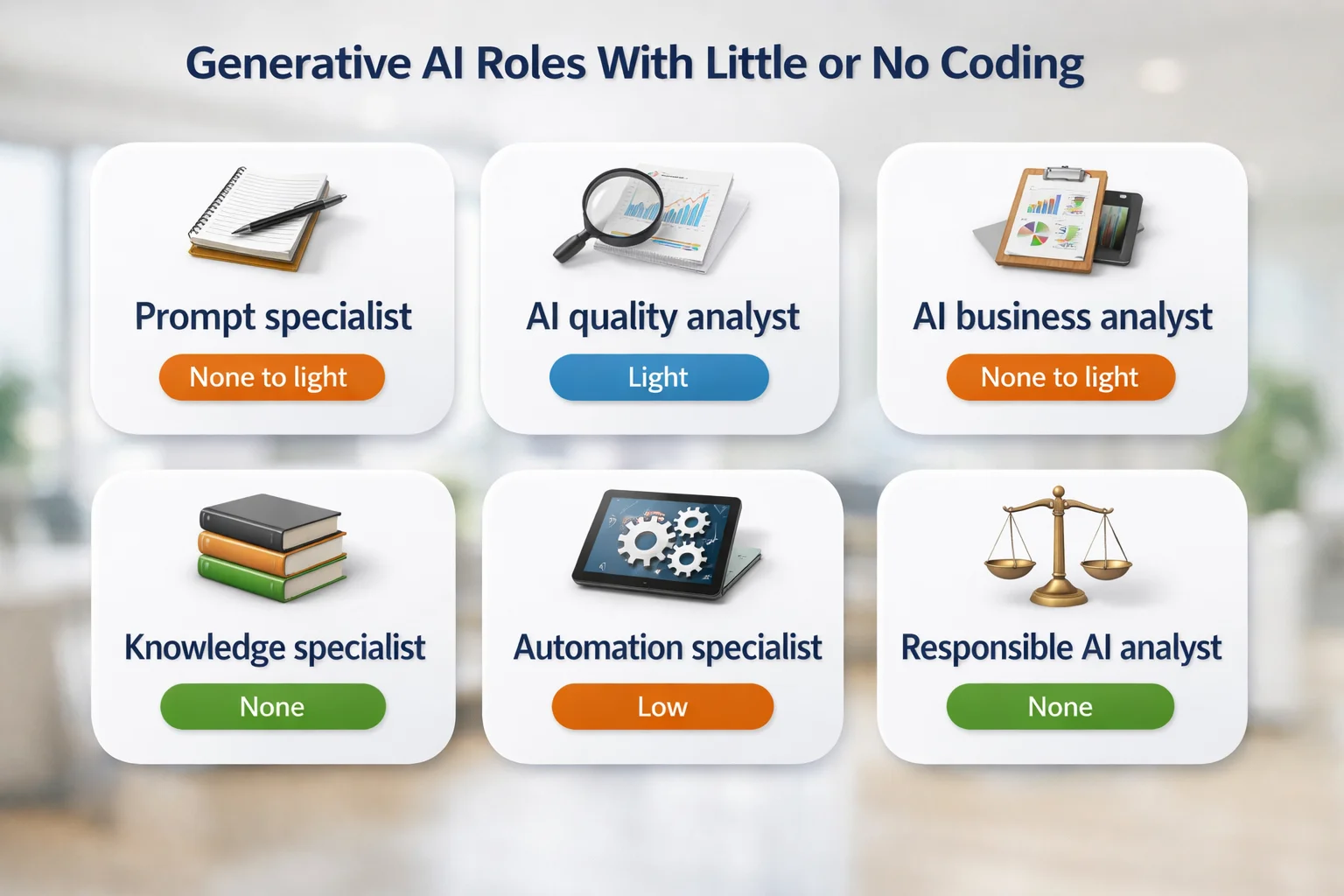
Job titles vary a lot between companies, so treat this table as a guide to the kind of work, not a list of fixed titles.
| Role | What you do | Coding needed | Often suits people from |
|---|---|---|---|
| Prompt and AI workflow specialist | Design, test and improve prompts and multi-step AI workflows for a team | None to light | Content, support, operations |
| AI quality and evaluation analyst | Test AI outputs for accuracy, safety and bias, and report failures | Light | Manual testing, QA |
| AI product or business analyst | Find use cases, write requirements and measure results for AI features | None to light | Business analysis, product, project management |
| AI knowledge and content specialist | Prepare and maintain the documents and knowledge bases that AI assistants answer from | None | Technical writing, support, training |
| AI automation specialist | Build workflows with no-code or low-code automation tools that call AI models | Low | Operations, IT support, administration |
| Responsible AI and compliance analyst | Review AI use against policy, privacy and legal requirements | None | Risk, audit, legal, security |
Where Coding Still Matters
Roles that train models, build retrieval systems or deploy AI applications need Python and cloud skills. If you later want that path, you can build up to it. Our comparison of the AI engineer and generative AI engineer career paths shows what those roles ask for.
The practical approach is to start in a role that uses your current strengths, then add technical skills one at a time as the work calls for them.
Skills to Build for a Generative AI Career Without Coding
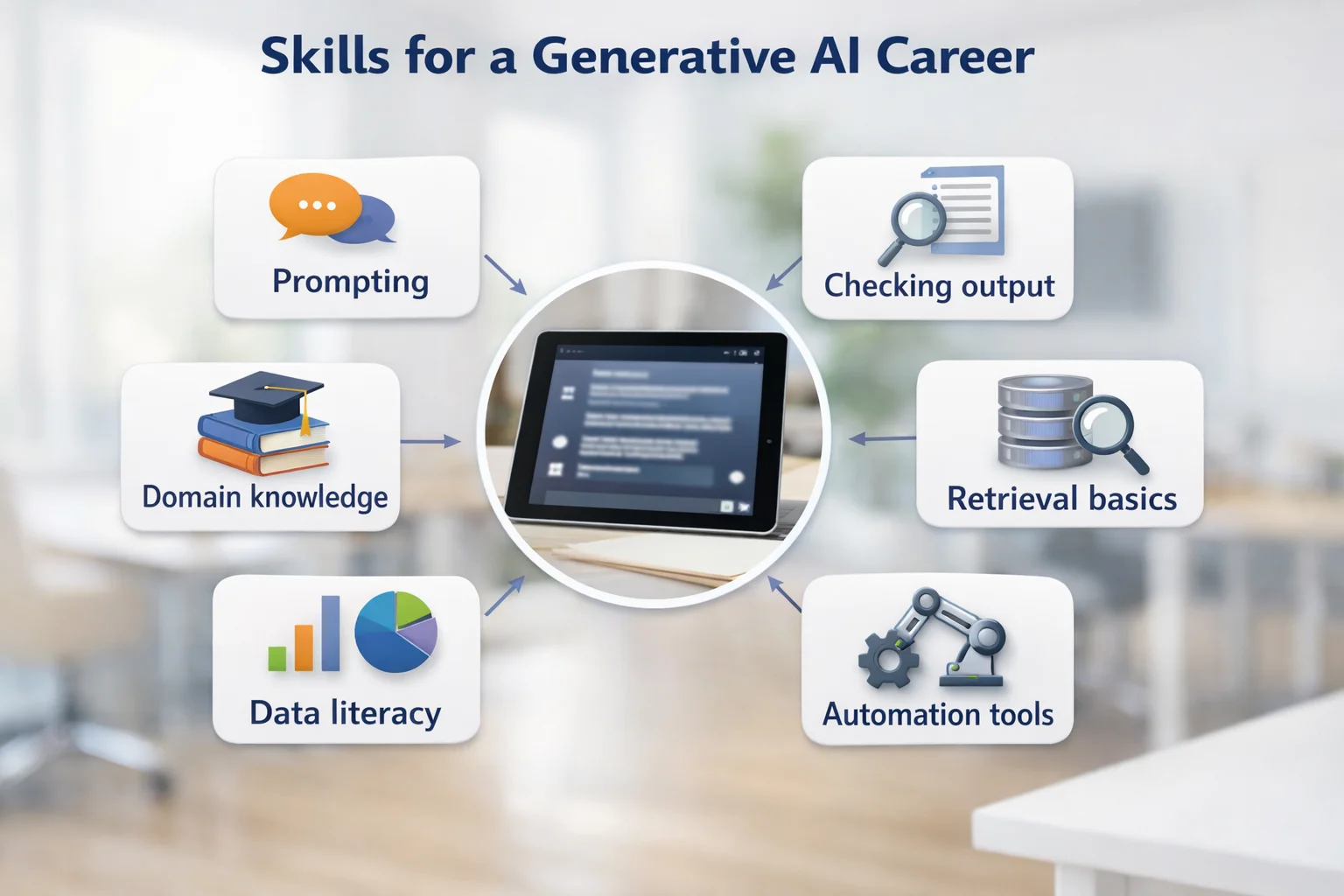
- How large language models work at a high level, including why they can sound confident and still be wrong.
- Prompting: giving clear context, examples and constraints. Our guide to prompt engineering techniques covers methods that apply well beyond developers.
- Checking output: spotting errors, and knowing why AI hallucinates and gives wrong answers.
- The idea of retrieval: how an assistant answers from your documents instead of guessing.
- One automation tool, so you can connect an AI model to the apps your team already uses.
- Data literacy: reading tables, spotting bad data and measuring whether a change helped.
- Domain knowledge in your own field. This is often what makes you more useful than a generalist.
- Responsible use: privacy, bias and when a human must review the result.
For a wider view of what employers ask for, see the most in-demand generative AI skills.
How Different Backgrounds Can Move Into Generative AI
These are illustrative examples of how existing skills can carry over, not guaranteed outcomes.
- Manual tester to AI quality analyst: you already know how to design test cases and find edge cases. Applying that to AI answers, such as checking accuracy and unsafe responses, is a natural fit.
- Support engineer to AI knowledge specialist: you know the questions customers ask and where documentation fails. That knowledge shapes how useful an AI support assistant can be.
- Business analyst to AI product analyst: you already turn needs into requirements. The new part is understanding what AI can and cannot do reliably.
- Operations professional to automation specialist: you know the repetitive tasks in your process, which are the first ones worth automating.
A Step-by-Step Path to Get Started
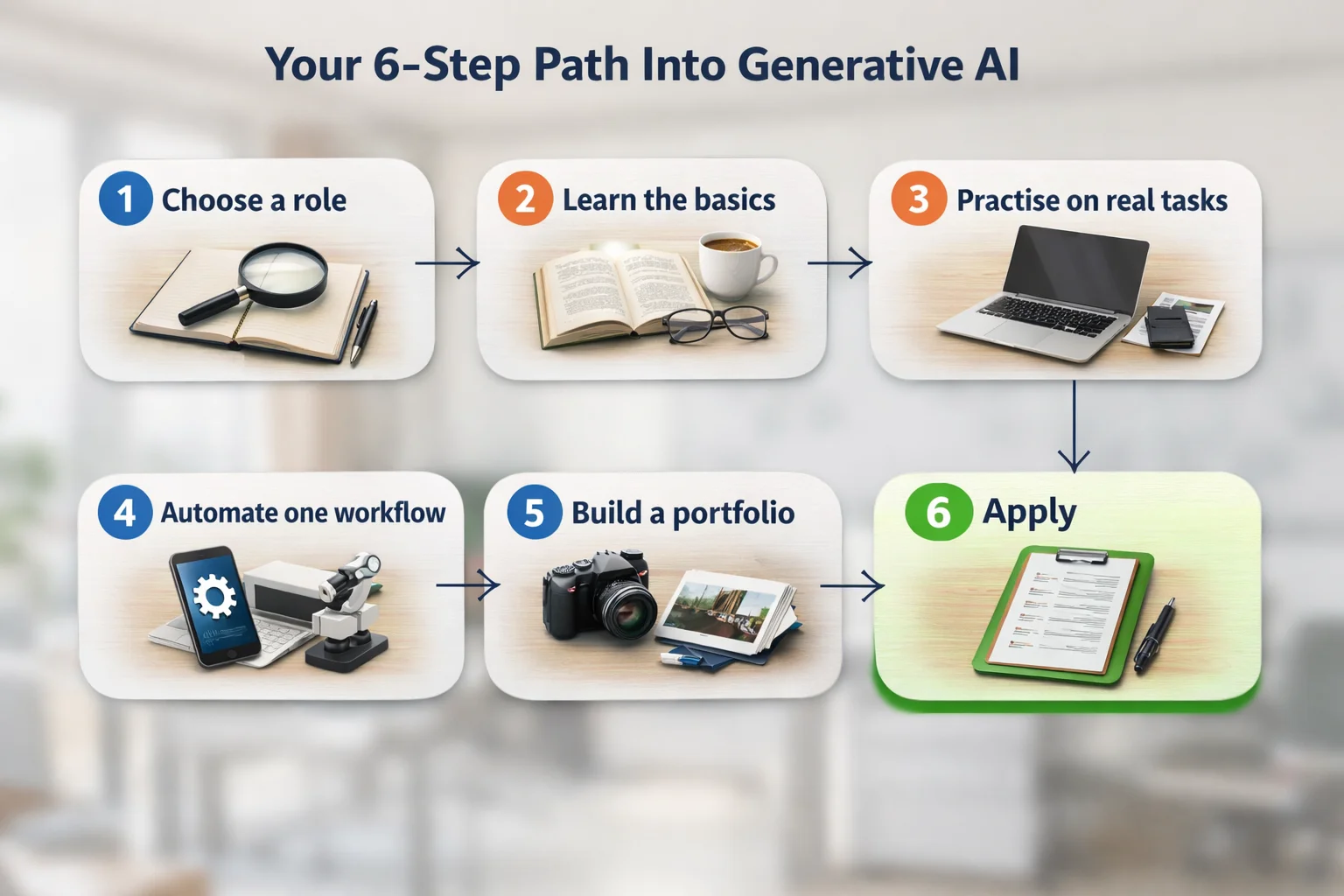
- Choose a target role from the table that is closest to your current job.
- Learn the basics of how generative AI works and where it fails. A few focused hours is enough to start.
- Practise daily on your own real tasks, such as summarising documents, drafting test cases or drafting replies, and keep notes on what worked.
- Learn one no-code automation tool and build a small workflow that saves you time at work.
- Build two or three portfolio pieces, such as a prompt library for your domain, an evaluation checklist for AI answers, or a documented workflow. The generative AI projects for your resume give you ideas, and you can pick the ones that need less code.
- Update your CV to show the results, not just the tools, and apply for roles at your current employer as well as outside.
With a steady 30 to 60 minutes a day, many working professionals can complete the first four steps within a couple of months. The time depends on your starting point and the role you choose. If you would like a guided route, MicroDegree's learning programs are one option.
Common Mistakes to Avoid
- Expecting zero learning. These roles use less code but still take real effort to learn.
- Learning only a list of prompts. Tools change quickly, while the habit of checking output carries over.
- Ignoring your domain. Experience in your own field is a real advantage.
- Chasing every new tool. Pick one or two, and use them on real work.
- Trusting AI output without checking it, especially for facts, numbers and legal or customer-facing text.
- Staying away from technical basics for ever. A little scripting or data skills later will open more roles.
Should You Learn Some Coding Anyway?
You do not need it to begin. But basic Python and an understanding of APIs widen your options, and they help you talk to engineers on your team. If you see yourself moving towards agents and automation later, read how AI agents think, plan and take action to see what you would be working with.
Conclusion
Generative AI can be a good career option for non-coders, as long as you treat it as a skill to build. Start from the strengths you already have, learn how AI works and fails, practise on real tasks and show your results. The broader shift in skills is covered in our guide to tech skills that protect your career in 2026.
FAQs
1. Is generative AI a good career option for non-coders?▼
It can be. Several roles, such as prompt and workflow specialist, AI quality analyst and AI business analyst, rely more on judgement and domain knowledge than on programming. You still need to learn how AI works and practise with the tools.
2. Can I get a generative AI job without knowing programming?▼
Yes, for certain roles. Roles that build or deploy AI systems usually need programming, but roles around using, testing, managing and governing AI often do not. Requirements differ by company, so read each job description carefully.
3. Which generative AI role is easiest for non-coders to start with?▼
The easiest route is usually the one closest to your current job. A manual tester may find AI quality analysis natural, while a support engineer may start with AI knowledge and content work.
4. Do freshers have a chance in a generative AI career without coding?▼
Freshers can start, but employers tend to look for proof of practical skill. Build a small portfolio, such as a prompt library or an evaluation checklist, and show what you improved.
5. Will AI replace non-coders in these roles?▼
No one can promise that. People who use AI well and check its output are in a stronger position than those who ignore it. Keep learning and keep your domain knowledge sharp.
Want a first look?Click here to take a free Generative AI demo