
From Cybersecurity Analyst to Cloud Security Engineer: A Practical Career Roadmap
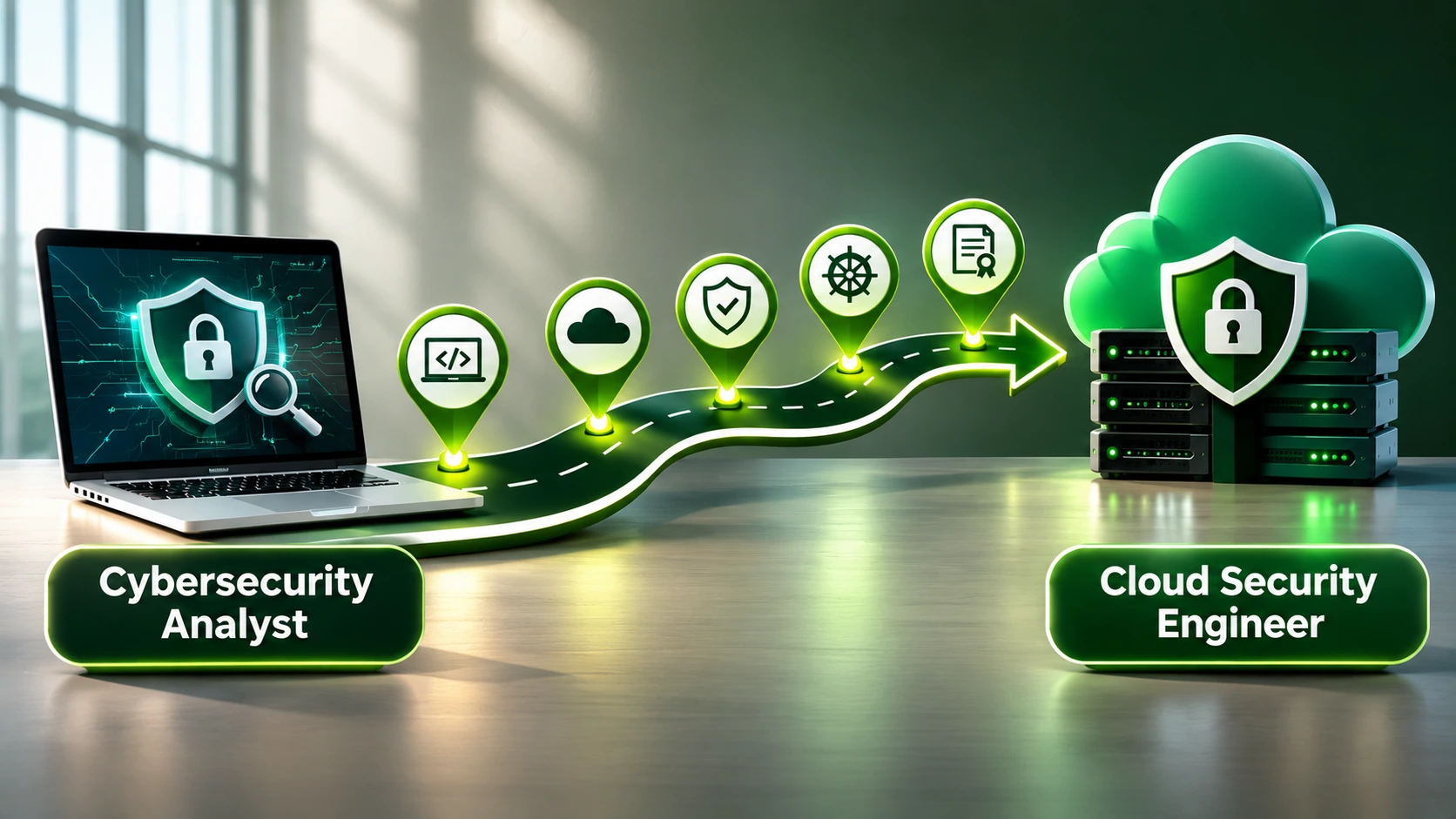
The move from Cybersecurity Analyst to Cloud Security Engineer starts from a strong position. You already know how attackers behave, how to read logs, how to triage an alert and how to run an incident. What the cloud changes is where the assets live: workloads, identities, networks and data sit in platforms such as AWS and Azure, and many of the controls are settings and code, not appliances.
As more systems run on cloud infrastructure, someone has to protect those workloads, identities, networks and data. Cloud security engineers do that, and they build on what analysts already know. The gap is cloud infrastructure and automation: you'll need to understand how the platforms are built before you can secure them. This guide shows the skills that transfer, the ones to learn, a seven-step roadmap, certifications (including one that has retired), tools, six projects and the common mistakes. It doesn't promise a job, a pay rise or a fixed timeline.
Table of Contents
▼Who is a Cloud Security Engineer?
A Cloud Security Engineer designs, builds and maintains the security controls of a company's cloud environment. Where an analyst usually responds to what security tools show, an engineer builds and configures the controls and the automation behind them. Typical responsibilities:
- Securing cloud infrastructure: hardening accounts, virtual machines, containers and managed services.
- Identity and access management: who and what can do which actions, with least-privilege permissions and multi-factor authentication.
- Cloud network security: private subnets, security groups, network rules and controlled paths in and out.
- Encryption and data protection: managing keys, encrypting storage and controlling access to sensitive data.
- Security monitoring and logging: collecting and watching activity logs and alerts.
- Vulnerability assessment: finding weak software and risky configurations in workloads.
- Incident response: investigating and containing cloud incidents.
- Infrastructure security automation: building checks and fixes into code and pipelines.
- Compliance and risk management: showing that controls meet internal and external standards.
A typical day mixes four kinds of work: reviewing new alerts and findings, helping a product team design a secure setup before launch, reviewing infrastructure code or pipeline changes for security problems, and improving automation such as a script that closes a risky setting everywhere. Some days are dominated by an incident, others by an audit request. The balance depends on the company and its size.

Cloud Security Engineer vs Cloud Engineer vs Cybersecurity Analyst
The three roles overlap, and job titles vary between companies, so treat this table as a general picture.
| Aspect | Cybersecurity Analyst | Cloud Engineer | Cloud Security Engineer |
|---|---|---|---|
| Primary responsibility | Detect, triage and respond to threats and vulnerabilities | Build and run cloud infrastructure and applications | Design and automate security controls in the cloud |
| Technical focus | Monitoring, investigation, vulnerabilities, policies | Compute, storage, networks, deployment and reliability | Identity, network and data protection, detection, posture and infrastructure as code |
| Common tools | SIEM, EDR, vulnerability scanners, ticketing | Cloud consoles, Terraform, CI/CD, monitoring tools | Cloud IAM, native security services, SIEM, scanners, policy tools |
| Daily tasks | Review alerts, investigate incidents, report on vulnerabilities | Provision resources, fix outages, improve pipelines | Review designs and code, tune detections, fix misconfigurations, automate checks |
| Skills required | Threat knowledge, log analysis, incident handling | Cloud platform, networking, Linux, automation | Security fundamentals plus cloud platform, IAM, networking and automation |
A Cloud Security Engineer sits between the other two. They share a vocabulary of alerts and incidents with analysts, and share infrastructure and automation work with cloud engineers. In smaller companies one person may do all three jobs.
What cybersecurity skills transfer to cloud security?
| Cybersecurity experience | Cloud security application |
|---|---|
| Threat modelling | Cloud architecture risk assessment |
| SIEM monitoring | Cloud activity monitoring |
| Incident response | Cloud incident investigation |
| Vulnerability management | Cloud workload and configuration assessment |
| Network security | VPC and VNet security |
| Access control | Cloud IAM |
| Compliance audits | Cloud security governance |
| Log analysis | CloudTrail and Azure activity logs |
- Threat modelling: you'd review a proposed design, such as a public web app that reads from a storage bucket, and ask what an attacker could reach and what would limit the damage.
- SIEM monitoring: the same detection thinking now applies to cloud sources. You'd send CloudTrail or Azure activity logs to a SIEM and write rules for risky actions.
- Incident response: the steps are familiar, but evidence is different. You'd ask which identity did what, from where and with which API calls, and contain it by disabling credentials and restricting permissions.
- Vulnerability management: instead of scanning a fixed server estate, you'd assess workloads that appear and disappear, plus risky settings such as an open storage bucket.
- Network security: firewall and segmentation habits translate to VPC and VNet design, security groups and private connectivity. Our guide to the AWS VPC covers the building blocks.
- Access control: it becomes IAM, where roles, policies and temporary credentials replace many manual permission lists. See our guide to how AWS IAM works.
- Compliance audits: the evidence now comes from configuration records and policy tools, so you can show a control is on everywhere, not only in a sample.
- Log analysis: you'd search CloudTrail on AWS, which records actions by users, roles and services, and the Azure activity log on Azure, to answer who changed a resource and when.
What skills do you need to become a Cloud Security Engineer?
Technical foundations
- Networking: TCP/IP, DNS, VPNs and firewalls. Cloud networks are virtual, but the concepts are the same.
- Linux fundamentals: most cloud servers, containers and build agents run Linux. Our list of Linux commands for cloud and DevOps engineers is a good start.
- Python or Bash scripting: to automate checks, call cloud APIs and process logs.
- Security fundamentals: authentication, authorisation, common attacks, hardening and secure design.
- Encryption and key management: what encryption at rest and in transit protect, and who controls the keys.
Cloud platform knowledge
- AWS or Azure fundamentals: accounts or subscriptions, regions, compute, storage and networking.
- IAM and least privilege: AWS recommends roles with temporary credentials, multi-factor authentication and permissions limited to the task.
- VPC and VNet: private subnets, routing and traffic filtering.
- Cloud logging and monitoring: knowing which logs exist, where they go and how long they last. CloudTrail's event history, for example, covers 90 days of management events per Region.
- Cloud-native security services: the detection, posture and key services covered in the platform section.
- The shared responsibility model: knowing what the provider covers and what you must configure.
Advanced cloud security skills
- Infrastructure as Code: defining cloud resources in files, which Terraform does with a write, plan and apply workflow. Our Terraform roadmap covers the basics.
- Terraform security: reviewing plans for risky settings and scanning code before it deploys. Checkov, for example, scans Terraform, CloudFormation, Kubernetes and other configurations for misconfigurations before deployment.
- Container and Kubernetes security: Kubernetes guidance includes Pod Security Standards, protecting Secrets, controlling access to the API and network policies.
- Vulnerability scanning: scanning images, instances and functions continuously.
- Security automation: turning a manual fix into a script or an automatic response.
- DevSecOps fundamentals: building security checks into pipelines, covered in our DevSecOps guide.
Soft skills matter as much. You'll explain risks to developers who want to ship, write short documentation others can follow, assess risk in business terms and work with cloud, platform and application teams. An engineer who can say no with an alternative gets more done than one who only blocks.
Which cloud platform should you learn?
Both major clouds have strong native security services, and the ideas map across. Here are the ones to know:
AWS security services
- IAM: controls who and what can do which actions on AWS resources.
- AWS CloudTrail: records actions taken by users, roles and services, which makes it the first stop for investigations.
- Amazon GuardDuty: a threat detection service that analyses sources such as CloudTrail management events, VPC flow logs and DNS logs and produces findings.
- AWS Security Hub: gathers and prioritises findings across accounts and services and checks them against standards such as CIS and NIST. AWS documents it as Security Hub CSPM, and it relies on AWS Config for most controls.
- AWS KMS: creates and controls encryption keys, with key policies that limit who can use them.
- AWS Config: records resource configurations over time and flags resources that break your rules.
- Amazon Inspector: scans EC2 instances, container images in ECR and Lambda functions for vulnerabilities and unintended network exposure.
Azure security services
- Microsoft Entra ID: Microsoft's identity service (formerly Azure Active Directory), used to authenticate users and applications.
- Microsoft Defender for Cloud: a cloud-native application protection platform with posture management, DevOps security and workload protection. It covers Azure, AWS, Google Cloud and on-premises, and its basic posture management is free.
- Microsoft Sentinel: a cloud-native SIEM for collecting data, detecting threats, investigating incidents and automating response. Microsoft says that after March 31, 2027 it will be supported only in the Microsoft Defender portal.
- Azure Key Vault: stores secrets, keys and certificates, with authentication through Entra ID and access through Azure RBAC.
- Azure Policy: evaluates resources against rules and can audit, deny or modify them. Microsoft advises starting with audit effects before enforcing.
- Azure Monitor: the monitoring and logging service that other Azure services, including Key Vault, can send logs to.
Google Cloud is a third option, and its security ideas (identity, logging, key management, posture) will feel familiar once you know one platform. Learn the first cloud in depth before adding another. Choosing is mostly practical: pick the one your employer or your target employers use, or the one that matches the tools you already work with, then repeat the same concepts on the second platform later.
Step-by-step roadmap from Cybersecurity Analyst to Cloud Security Engineer
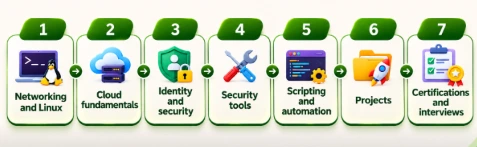
Treat the steps as an order of study. They overlap, and nobody can promise how long they take, because that depends on your starting point and the hours you have.
- Strengthen networking and Linux fundamentals. Cover TCP/IP, DNS, firewalls, Linux permissions and command-line use. Purpose: cloud problems are often networking or permissions problems. Outcome: you can trace a connection between two systems and explain why it fails.
- Build cloud fundamentals. Learn the cloud computing models, pick AWS or Azure, and understand regions, availability zones and cloud networking. Deploy a small environment. Outcome: you can build a virtual machine in a private network and explain every part.
- Learn cloud identity and security. Study IAM, least privilege, MFA, encryption, key management and secure storage. Purpose: identity is the main control in the cloud. Outcome: you can write a narrow policy and explain why it is narrow.
- Practise cloud security tools. Work with logging, monitoring, threat detection, vulnerability scanning and incident response in the platform's own services. Outcome: you can find who did something in the logs and investigate a finding.
- Learn scripting and infrastructure automation. Use Python or Bash, Terraform and automated security checks. Outcome: you can build an environment from code and have a scanner fail a risky change.
- Build practical cloud security projects. Secure an AWS or Azure environment, set monitoring and alerts, find misconfigurations and automate the secure setup. Outcome: a few documented projects that show what you can do.
- Prepare for certifications and cloud security roles. Choose certifications that fit, build a portfolio, update your resume, practise technical interviews and apply for transition roles. Outcome: a clear story from analyst work to cloud security work.
Tools and technologies used by Cloud Security Engineers
- Cloud IAM and identity tools: AWS IAM and Microsoft Entra ID control who can sign in and what they can do. You use them to enforce least privilege and review unused access.
- SIEM platforms: tools such as Splunk and Microsoft Sentinel collect logs, detect threats and run investigations. For cloud work you feed them cloud activity logs. Sentinel is a cloud-native SIEM with automation playbooks.
- AWS and Azure native security services: GuardDuty, Security Hub, AWS Config, KMS, Defender for Cloud, Key Vault and Azure Policy. They detect threats, check configurations against standards, manage keys and enforce rules.
- Vulnerability scanners: Amazon Inspector scans EC2, ECR images and Lambda; Defender for Cloud covers vulnerabilities on servers and containers. You use them to find and prioritise software flaws and exposure.
- Infrastructure as Code security tools: Checkov scans Terraform and other templates for misconfigurations before they deploy, so risky settings fail a pull request instead of reaching production.
- Container and Kubernetes security tools: Kubernetes has built-in controls such as Pod Security Standards, network policies and admission control. Cloud tools add detection, such as GuardDuty's EKS protection and Defender for Containers.
- CI/CD security integrations: scanners and policy checks that run in pipelines, and posture tools that read code repositories. Defender for Cloud connects to GitHub, Azure DevOps and GitLab for this. Our guide on securing a CI/CD pipeline and our list of DevSecOps tools go further.
You don't need to master every tool. Pick a stack that matches your target employers and learn it well enough to explain what each tool decides, what it can't see and what it costs. Our AWS security best practices guide is a good companion.
Practical cloud security projects
Do every project in a safe, isolated environment: a personal or training account with a budget alert, resources you delete afterwards and no scanning or testing of systems you don't own. Never commit credentials to GitHub.
1. Secure an AWS account with IAM, MFA and least-privilege policies
- Objective: lock down a new account so no one uses the root user day to day and every person or workload has only what it needs.
- Services and tools: AWS IAM, multi-factor authentication, IAM Access Analyzer.
- Implementation outline: enable MFA on the root user, create roles instead of long-term keys, write narrow policies for two sample jobs, and review what's unused.
- Expected learning outcome: you can explain least privilege with real policies and remove access safely.
- What to document in GitHub: the policy files, a diagram of roles and a short note on why each permission exists. Never include real account IDs or keys.
2. Configure CloudTrail and GuardDuty for security monitoring
- Objective: see and detect suspicious activity in an account.
- Services and tools: CloudTrail, GuardDuty, S3 for log storage, optionally EventBridge for alerts.
- Implementation outline: create a trail, enable GuardDuty, generate sample findings, and route one finding to an email or chat alert.
- Expected learning outcome: you understand what each service records and how a finding leads to an investigation.
- What to document in GitHub: your setup steps, a screenshot of a sample finding with identifiers removed and the investigation notes.
3. Secure an S3 bucket and implement encryption
- Objective: store data safely and prove it isn't publicly reachable.
- Services and tools: Amazon S3, AWS KMS, bucket policies, access logging.
- Implementation outline: create a private bucket, block public access, turn on encryption with a KMS key, restrict the key with a key policy and test access from an unauthorised role.
- Expected learning outcome: you can explain who can read the data, who controls the key and what is logged.
- What to document in GitHub: the configuration, the test cases and the result of each.
4. Build a Terraform-based secure cloud infrastructure environment
- Objective: build a small environment from code with security defaults built in.
- Services and tools: Terraform, a VPC with private subnets, security groups, encrypted storage, Git.
- Implementation outline: write the configuration, run plan, review it for risky settings, apply, then destroy.
- Expected learning outcome: you can review infrastructure code for security problems.
- What to document in GitHub: the repository with a README, the plan output and a list of the security decisions.
5. Configure vulnerability scanning and remediation
- Objective: find vulnerabilities and misconfigurations, fix them and prove the fix.
- Services and tools: Amazon Inspector or Defender for Cloud, and Checkov for infrastructure code.
- Implementation outline: deploy a deliberately outdated instance or image in a lab, scan it, rank the findings, patch one and re-scan, and run Checkov on your Terraform.
- Expected learning outcome: you can prioritise findings by exposure and explain why one matters more than another.
- What to document in GitHub: before-and-after results and a short remediation report.
6. Build a cloud security monitoring and incident response lab
- Objective: practise detecting and responding to an incident from cloud logs.
- Services and tools: CloudTrail or Azure activity logs, a SIEM such as Sentinel or Splunk, and an automated response script.
- Implementation outline: simulate a safe event such as creating an access key, detect it with a rule, investigate the logs and write a script that disables the key.
- Expected learning outcome: you can run an incident from alert to containment and write it up.
- What to document in GitHub: the detection rule, the playbook or script and an incident report with the timeline.
Career growth after becoming a Cloud Security Engineer
A common progression runs from Cybersecurity Analyst to Junior Cloud Security Engineer, then Cloud Security Engineer, then Senior Cloud Security Engineer, and on to Cloud Security Architect or Security Lead. Titles and steps vary by company, and some people skip a step.
- Junior Cloud Security Engineer: works on defined tasks such as finding fixes, tuning alerts and reviewing configurations, with guidance.
- Cloud Security Engineer: owns controls and automation for a platform or set of accounts.
- Senior Cloud Security Engineer: designs controls across teams, mentors others and leads response to serious incidents.
- Cloud Security Architect or Security Lead: sets the security design and direction for cloud platforms, or leads the team.
Two lateral paths are worth knowing. DevSecOps focuses on building security into pipelines and development workflows, and cloud governance focuses on policy, risk and compliance across accounts. Related roles such as SOC analyst and GRC remain distinct jobs, and this guide doesn't try to cover them in full.
Common mistakes to avoid
- Collecting certifications without practical experience: employers ask what you've built and investigated.
- Learning several cloud platforms at once: depth on one first makes the second easier.
- Ignoring networking and Linux: many cloud problems come back to routes, ports and permissions.
- Underestimating IAM: most serious cloud incidents involve an identity with too much access.
- Ignoring compliance and governance: engineers who can map controls to a standard are more useful to the business.
- Not learning automation: manual fixes don't scale across many accounts.
- Treating security as a final deployment step: build it into design and pipelines, not a check before release.
- Failing to document practical projects: a project nobody can read is hard to count.
Salary and career opportunities in India
The table shows median annual pay for Cloud Security Engineers in India by experience, from Flexiple's self-disclosed salary data for August 2026. The figures are estimates and vary by company, skills and city. Moving to cloud security doesn't guarantee these numbers.
| Experience | Median pay in ₹ LPA |
|---|---|
| 0 to 2 years | ₹5.2 |
| 2 to 5 years | ₹8.5 |
| 5 to 8 years | ₹18 |
| 8 to 12 years | ₹26.9 |
| 12+ years | ₹37.8 |
Across all levels the median is ₹11.1 LPA, with the middle half of reported salaries between ₹5.4 and ₹24.5 LPA. Bengaluru's median is ₹17.8 LPA, higher than the other cities listed. The median roughly doubles between the 2 to 5 and 5 to 8 year bands. For a comparison with the DevSecOps path, read our guide to DevSecOps Engineer vs Cloud Security Engineer salary.
The skills in this guide are also useful beyond this one title: DevSecOps, platform engineering and cloud governance roles draw on similar ones. If you'd like structured practice alongside your job, MicroDegree's e-learning platform teaches in Kannada, with AWS, Azure and Linux among the skills it covers.
Conclusion
A cybersecurity analyst moving into cloud security already has the hardest part: a security mindset, experience with alerts and incidents and a habit of questioning assumptions. What you add is the platform: cloud infrastructure, IAM, networking, automation and cloud-native security services. Choose one cloud, build and document a few of the projects above and use certifications to structure your study. The move expands what you already know.
Build Your Cloud Skills in Kannada
If you want to add cloud skills to your security background, MicroDegree's e-learning platform teaches in Kannada, with AWS, Azure, Kubernetes, DevOps and Linux among the skills it covers. You can explore them in one place and decide what to learn first.
FAQs
1. Can a Cybersecurity Analyst become a Cloud Security Engineer?▼
Yes. Threat knowledge, log analysis, incident response and vulnerability management carry over. You'll need to add cloud platforms, IAM, networking and automation, and show them in projects.
2. What skills should a cybersecurity analyst learn for cloud security?▼
Start with networking and Linux, then one cloud platform, IAM and least privilege, cloud logging and the native security services. Add scripting and Terraform, then container and pipeline security.
3. Should I learn AWS or Azure first?▼
Pick the platform your employer or target employers use. If you work with Microsoft tools such as Entra ID and Sentinel, Azure is a natural fit. If your company runs on AWS, start there. Learn one in depth before the other.
4. Is coding required for cloud security engineering?▼
Some. You don't need to be a software developer, but you'll read and write scripts, call cloud APIs and review infrastructure code. Python or Bash is a practical starting point.
5. Which certification should I pursue first?▼
A cloud foundation or associate exam on your chosen platform, such as AWS Solutions Architect - Associate, or Azure Fundamentals. Microsoft retired AZ-500 on August 31, 2026. Specialist exams such as AWS Security - Specialty and CCSP expect several years of experience.
6. Do Cloud Security Engineers need Linux?▼
Yes, the basics. Many cloud servers, containers and pipeline agents run Linux, so you need permissions, processes, networking commands and shell scripting.
7. Is Terraform necessary for cloud security?▼
Not on day one, but it's increasingly useful. Many teams define infrastructure in code, so reviewing and scanning that code for risky settings is part of the job.
8. How can I gain practical cloud security experience?▼
Build the projects in this guide in a safe lab account, document them on GitHub and volunteer for cloud-related security tasks at work, such as reviewing log sources or access permissions.
9. How long does it take to transition into cloud security?▼
There's no fixed time. It depends on your current cloud and networking knowledge, how many hours you study and how quickly you build projects. A realistic plan follows the roadmap steps, not a deadline.
10. What is the difference between a Cloud Security Engineer and a DevSecOps Engineer?▼
A Cloud Security Engineer focuses on securing cloud platforms and accounts: identity, networks, data, detection and posture. A DevSecOps Engineer focuses on building security into development pipelines and code. They overlap, and the split varies by company.