
Can a Full-Stack Developer Become a Cloud Engineer? Complete Transition Guide
Yes. If you have built web apps for a few years, the move from full stack developer to cloud engineer is shorter than it looks. You have shipped APIs, argued with databases and chased bugs that only show up in production. What you have not owned yet is the layer underneath: networks, permissions, machines someone else runs and a monthly bill that can jump for reasons you did not see coming.
This guide follows one app you have already built from localhost to production and shows which cloud skill each stop needs. It also covers an interview scenario, projects and certifications, pay data from a named source and how to start inside your current job. Nothing here guarantees a job, title or raise.
Table of Contents
▼The Short Answer
Yes, and it can be done in steps while you keep your job. The code you already write transfers best. What is new is the platform: networks, permissions, servers that someone else operates and a bill that depends on how you set everything up.
For planning, the cloud roadmap from Futurense estimates six to nine months for people coming from software, IT support or sysadmin roles who practise steadily, and a roadmap on DEV Community says about six months of focused study. Neither cites a source for its number, so treat both as one author's estimate, not data. Your pace and your starting point decide the real time.

What Changes When You Own the Platform
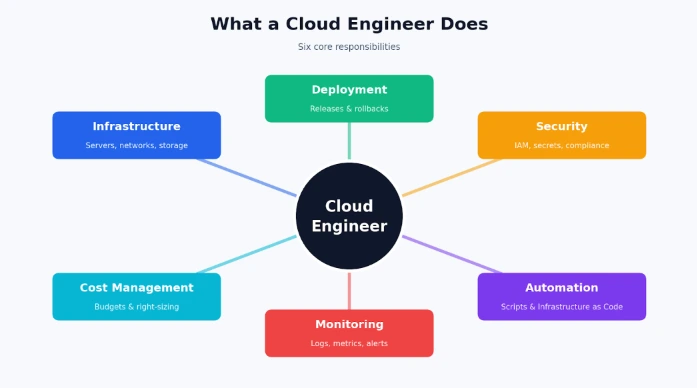
A full-stack developer builds the application. A cloud engineer builds and runs the platform that application sits on. In a restaurant, the developer writes the menu and the recipes, and the cloud engineer looks after the building: the wiring, the gas, the locks and keeping the place standing on a busy Saturday.
| Area | Full-stack developer | Cloud engineer |
|---|---|---|
| Focus | Features and user experience | Reliability, scale and cost |
| Typical tools | React, Node.js, Django, SQL | AWS, Azure or GCP, Terraform, Docker, Kubernetes |
| Main work | Writing and testing app code | Provisioning and maintaining infrastructure |
| Deployment | Pushes code into a pipeline | Designs the pipeline and the environments |
| Security | Authentication and input validation | IAM, network rules, encryption and compliance |
| Operations | Fixes application bugs | Uptime, scaling, backups and incidents |
The table is a general picture. On small teams and at cloud-native companies the roles blur, and developers often run their own deployments. You keep writing code after the move. Terraform files, pipeline definitions and automation scripts are code too, written for the platform instead of the product.
Follow One App From Localhost to Production
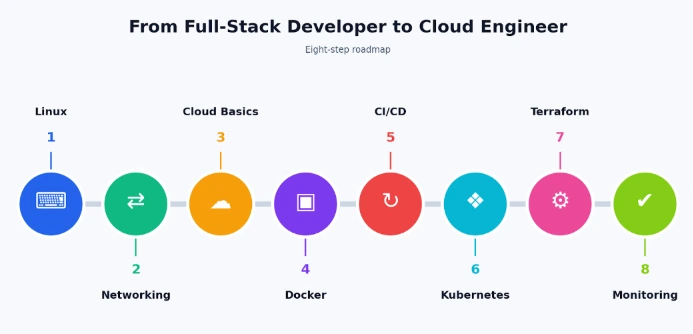
The quickest way to see what is new is to take an app you have already built, say a React front end, a Node API and a Postgres database, and follow it to production. Each stop below is a question you have probably left to someone else, with the skill that answers it.
- Where does it run? Start with one virtual machine, then try a managed container service or a serverless function. Our post on AWS Lambda vs EC2 explains which to try first.
- Where does the data live? Swap the database on your laptop for a managed one, and find out what a backup and a restart mean for it.
- Who can reach it? Put the app in a network with public and private parts, and give it an IAM role instead of keys in a
.envfile. Our guides to AWS VPC and AWS IAM go through both. - How does a change get there? Build, test and deploy on every push with a pipeline. See CI/CD pipeline best practices using GitHub Actions.
- How do you rebuild it? Describe the same setup in Terraform so another account can get the same environment. Our Terraform roadmap lists what to learn around it.
- How do you know it broke? Add logs, a few metrics and an alert that reaches you before a customer does. See AWS monitoring tools for DevOps engineers.
- What does it cost? Check the bill after each experiment and delete what you no longer need. AWS's Free Tier page said on 23 October 2026 that a new Free Tier account gets $100 in credits at once and can earn up to $100 more, and that the account closes on its own six months after you open it or when the credits run out, whichever comes first. The page does not mention budgets, so a budget alert on day one is general advice, not something it states. Terms change, so read the page before you sign up.
Stop five is the one that looks most like your daily work. Here is the shape of it, written from Terraform's documented syntax and not run against an account. Replace the bucket name with your own unique one:
terraform {
  required_providers {
    aws = {
      source = "hashicorp/aws"
    }
  }
}

provider "aws" {
  region = "ap-south-1"
}

resource "aws_s3_bucket" "assets" {
  bucket = "replace-with-a-unique-bucket-name"
}
Run terraform init to download the provider, then terraform plan to see what would change, then terraform apply, which shows the plan and asks you to confirm. HashiCorp's AWS get-started tutorial walks through the same steps with a virtual machine, and terraform destroy removes what you built when you are done practising.
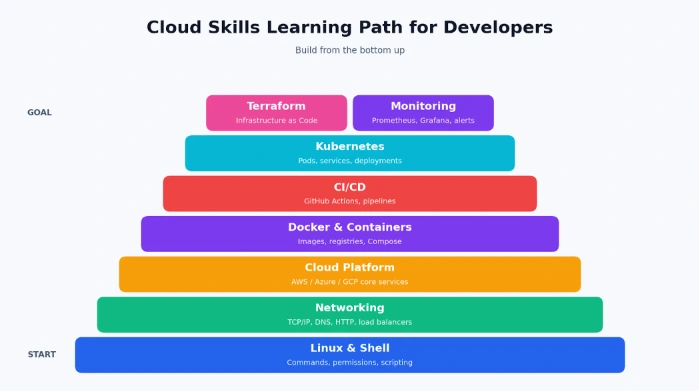
Pick One Cloud and Stay With It for a While
Choose one platform and stay with it long enough to finish the app above. The ideas (virtual machines, object storage, networks, roles, billing) carry across providers, so a second one is easier later, and learning two at once mostly slows you down. That is judgement, not a measured result. Futurense's roadmap defaults to AWS, and the DEV Community roadmap says to choose AWS or Azure. Azure is common in Microsoft-heavy companies, and the best check is the job listings in your own city. Our posts on AWS vs Azure vs GCP for career growth in 2026 and the cloud certification roadmap compare them.
Spend time in Linux and networking too, because Futurense starts there and many servers you will meet run a Linux shell (general knowledge, not a measured share). Linux for cloud covers the transition, and the Linux interview questions for cloud and DevOps engineers are a quick way to test yourself.
An Interview Scenario: the 502
A cloud interview can include a question like this: the site you deployed behind an Application Load Balancer returns a 502 Bad Gateway, so where do you start? AWS's troubleshooting guide for Application Load Balancers lists documented causes, and they point at the layers you have just met:
- The load balancer got a TCP reset, or an unexpected response such as host unreachable, when it tried to connect to the target. Check that traffic is allowed from the load balancer's subnets to the target port.
- The target closed the connection while a request was in progress. Check whether the target's keep-alive time is shorter than the load balancer's idle timeout.
- The target's response was malformed or had invalid HTTP headers.
- The load balancer hit an SSL handshake error when connecting to the target.
A sensible first step is to ask whether the targets are healthy. The CLI can show that:
aws elbv2 describe-target-health \
  --target-group-arn <your-target-group-arn>
The command and its --target-group-arn option were checked against the help of AWS CLI 2.15.36, but the command has not been run against an account. Use your own target group ARN in place of the placeholder. The same AWS page says a 503 usually means the target groups have no registered targets, and a 504 means the load balancer could not connect to the target or the target did not answer before the idle timeout. Reading the exact code narrows the search before you open a single log.
Projects and Certifications That Prove It
Four projects cover most of what an interviewer will ask about:
- Deploy a full-stack app with a managed database, HTTPS and a custom domain.
- Build a pipeline that tests and deploys on every push.
- Provision the network, servers and database with Terraform.
- Run a containerized app on Kubernetes with scaling and health checks.
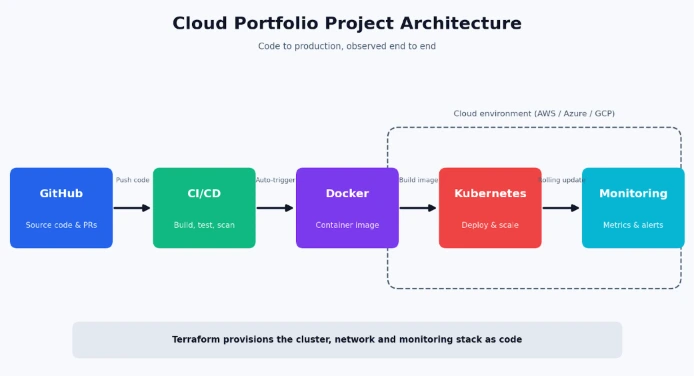
For each one, put the code on GitHub with an architecture diagram, the deployment steps and a few lines on one security choice, such as why you wrote a particular IAM policy. Reviewers want to see how you think. Top 10 AWS projects for resume has more ideas.
Certifications can help a résumé get noticed, but they come after the hands-on work. Futurense treats a certificate as a checkpoint once the basics are solid, and that is how we would use one. If you want one, the common choices on this route are the AWS Certified Solutions Architect Associate (SAA-C03 exam guide), the HashiCorp Terraform Associate (is it worth it?) and the Certified Kubernetes Administrator (CKA preparation). A deployment you can walk through shows more than the certificate does.
What It Does for Pay
The table shows pay in lakh rupees a year (₹ LPA) from Payscale's India pages for two titles that sit close to this move: Full Stack Software Developer and Cloud Solutions Engineer. The titles are not identical to "full-stack developer" and "cloud engineer", and the sample sizes differ a lot, so read the numbers as a rough picture. Payscale's pages were read on 23 October 2026 (last updated 26 September 2026 for the developer page and 16 September 2026 for the cloud page). The first five rows are India-wide. The Bangalore row comes from Payscale's separate Bangalore pages for the same two titles, read the same day.
| Measure | Full Stack Software Developer | Cloud Solutions Engineer |
|---|---|---|
| Average base pay, all experience | ₹6.7 lakh (734 profiles) | ₹7.1 lakh (74 profiles) |
| Middle 80% (10th to 90th percentile) | ₹2.95 lakh to about ₹20 lakh | ₹2.2 lakh to about ₹30 lakh |
| Entry level, under 1 year* | ₹4.0 lakh (125 salaries) | not enough data |
| Early career, 1 to 4 years* | ₹6.0 lakh (count not shown) | ₹5.0 lakh (44 salaries) |
| Mid career, 5 to 9 years* | not enough data | not enough data (15 salaries) |
| Bangalore, average base pay | ₹9.1 lakh (179 profiles, last updated July 2025) | ₹10.0 lakh (only 12 profiles, last updated August 2026) |
Marked figures (*) are experience-band figures that Payscale labels as total pay, which can include bonus, so do not compare them directly with the base-pay rows. Payscale shows its 90th percentile as a rounded figure (₹2m and ₹3m). Where a band had no figure, or only a handful of salaries, the table says not enough data rather than guessing. The chart uses the India-wide base-pay rows.
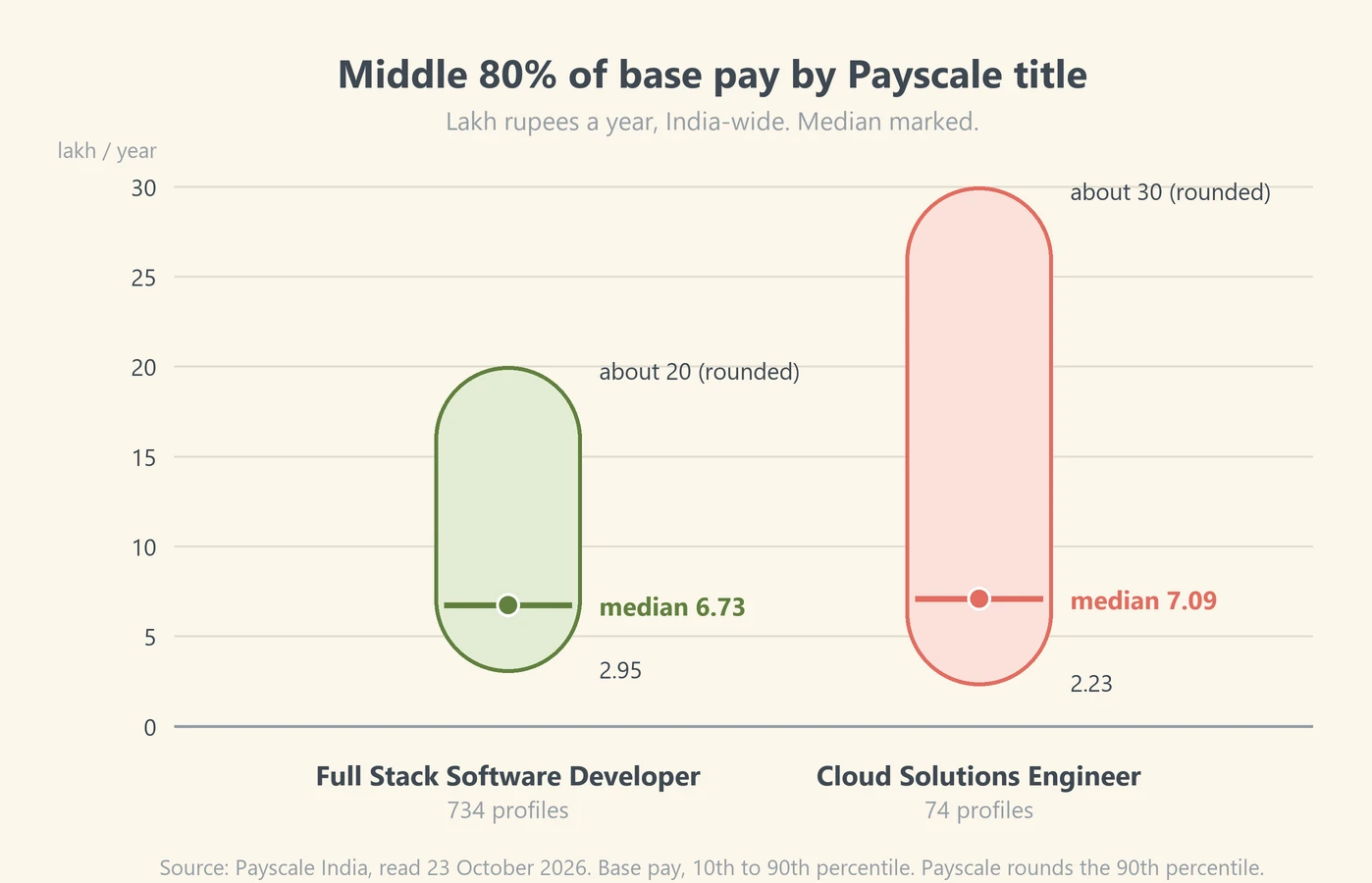
In this data the overall average for Cloud Solutions Engineer (₹7.1 lakh) is a little above Full Stack Software Developer (₹6.7 lakh), but at the early-career band the developer figure is higher (₹6.0 lakh against ₹5.0 lakh), and the spread inside each title is wide. The cloud page rests on 74 profiles and the developer page on 734. In Bangalore the cloud figure (₹10.0 lakh) rests on only 12 profiles, too few to say it is higher than the developer figure (₹9.1 lakh from 179). So the data does not show that moving to cloud raises pay. Pay depends on your employer, city, skills and what you can show. A separate Payscale page for Cloud Software Engineer in Bangalore showed ₹10 lakh, but it was last updated in October 2024 and gave no sample size, so it is not used. For more on cloud pay, see our post on cloud engineer salary in India.
Making the Move Without Leaving Your Job
You do not need a new title to start. Ask to take over your team's CI/CD pipeline, containerize one service, write the Terraform for the next environment or set up the dashboards and alerts. Work like that counts as cloud experience, and it gives you something concrete to describe later. Our post on moving from tech support to DevOps shows the same approach from another starting point.
Then change the résumé. Replace the plain headline with one that names the direction, and move the cloud projects above the application work. Use a number only if you measured it.
Expect interview questions on core cloud services, VPC and networking, IAM, pipeline design, Terraform basics and troubleshooting, and practise explaining your own projects out loud. Our DevOps CV guide and DevOps interview questions for experienced professionals go further. If you would rather follow a set order than build your own, MicroDegree lists its programs, and they are one option to compare.
Conclusion
A full-stack developer can become a cloud engineer, and the coding background is a real head start. Pick one app you have already built, deploy it to one cloud this week, then add the pipeline, Terraform and monitoring one at a time. Keep practice cheap and separate from work, and treat pay data as a rough guide. When you want a wider view, our DevOps learning roadmap is a good next read.
FAQs
1. Can a full-stack developer become a cloud engineer without operations experience?▼
Yes. Most people start without it. Build it with personal projects where you deploy, monitor, break and fix your own setups, and with small ownership tasks at work such as the pipeline or the dashboards.
2. Is cloud engineering harder than full-stack development?▼
It is different. You spend less time on interface work and more on how systems fit together, and the number of tools can feel like a lot at first. Following one app through the stops above keeps it manageable.
3. Should a full-stack developer learn AWS or Azure first?▼
Pick one and finish a project on it. The roadmaps we read name AWS or Azure, and Azure is common in Microsoft-heavy companies. Check the job listings in your city and decide from those.
4. Do cloud engineers need coding skills?▼
Yes. Scripts, pipeline definitions and infrastructure as code are part of the daily work, so a developer starts with an advantage there.
5. Are certifications enough to become a cloud engineer?▼
No. They can help your résumé get noticed, but employers also look for proof that you can deploy and troubleshoot a real system, so build projects alongside any exam.
Curious how the move would look for your own stack?Click here to take a free Cloud & DevOps demo