
How to Use Your Troubleshooting Skills in a Generative AI Career

You already know how to work a ticket. A user says something is broken, you ask for the exact steps, reproduce the problem, read the logs, work out which layer is at fault, fix one thing and write down what you did. Troubleshooting skills for Generative AI careers are those same habits, pointed at a system that can fail in more ways and does not always fail the same way twice.
Below: where each habit fits, one made-up ticket from report to regression test, a checklist for the step before you escalate, and pay for support and AI roles from named sources. Python, calling a model API and measuring answers are the usual gaps.
Table of Contents
▼Your Ticket Habits, Translated
Most of what a support engineer does has a direct counterpart when the thing that is broken is an AI application. The table pairs them.
| Support habit | In a generative AI system |
|---|---|
| Ask for the exact steps and the exact error | Capture the exact prompt, the exact reply and any error code, not a paraphrase of them |
| Reproduce the problem | Run the same input several times. Replies can vary from run to run, so one pass proves little |
| Read the logs | Read the request record: the prompt that was sent, the passages retrieved, the model used and the reply |
| Isolate the layer | Decide whether the fault is in the instructions, the retrieved documents, the model call, a tool call or the output handling |
| Check what changed | Compare the prompt version, the model version and the document set with the last time it worked |
| Write the knowledge-base article | Write down the cause and add the failing case to a test set |
| Escalate with context | Hand over the prompt, the logs and what you already tried |

Where a Generative AI System Breaks: Five Layers
A typical application, such as a support chatbot that answers from company documents, has five places where a fault can sit. Start at the top and rule each one out before you blame the model.
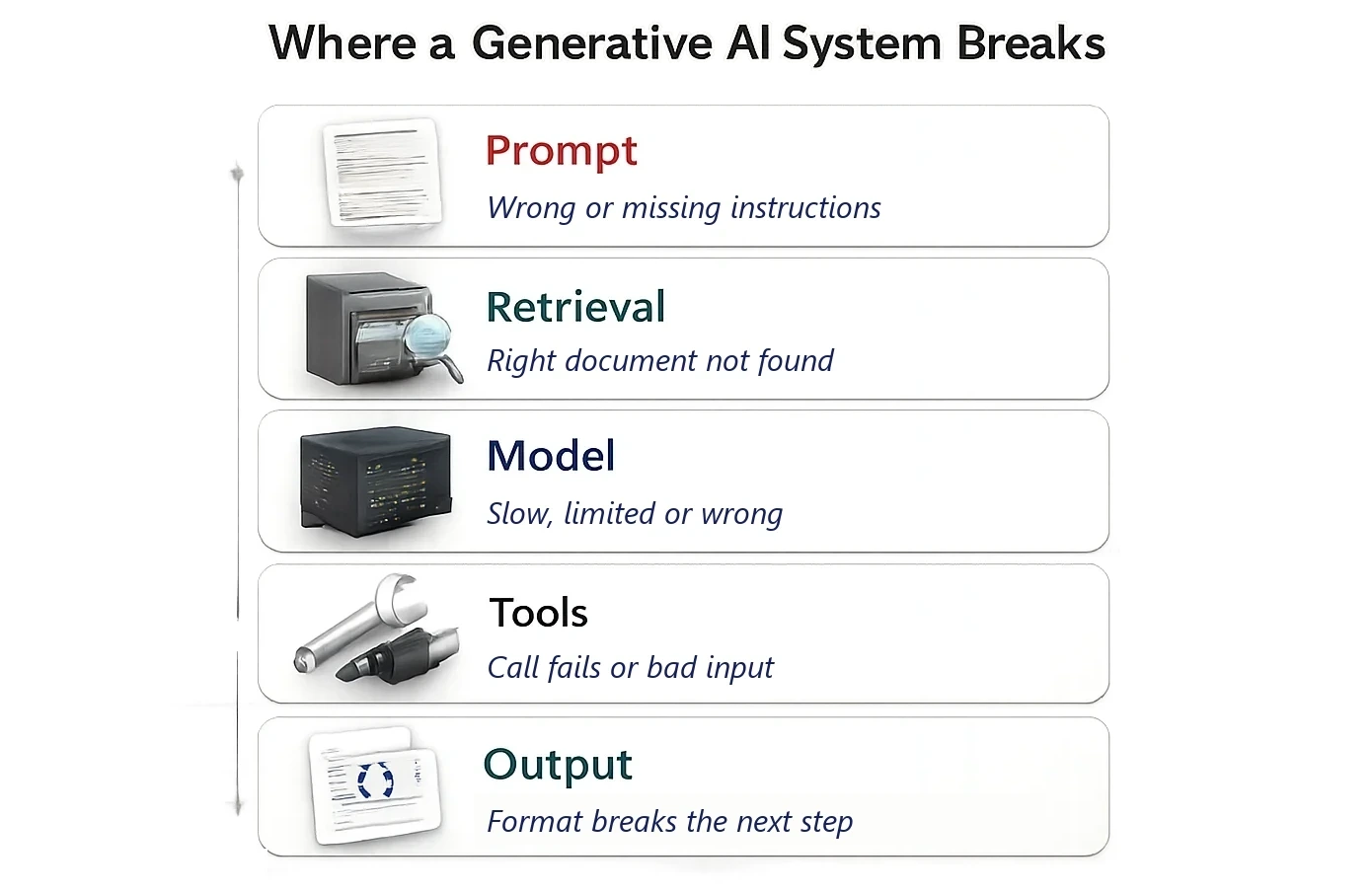
| Layer | What the ticket says | First check |
|---|---|---|
| Prompt | It ignores our tone rules, or answers in the wrong language | Read the instructions that were actually sent, including anything a template added or dropped |
| Retrieval | It quotes an old policy | Look at the passages retrieved for that question and see whether the right document was among them |
| Model call | It times out, or it stopped mid-sentence | Check the error code, the token limit and the rate limit before you change the prompt |
| Tools | It said it booked the slot but nothing happened | Compare what the model asked the tool to do with what the tool received and returned |
| Output handling | The page shows raw JSON | Check whether the reply was in the format the next step expects, and what the code does when it is not |
For the model call, start with the status code. OpenAI's documentation, for one provider, lists 401 for wrong or revoked credentials, 429 for rate limits and for spend or usage limits, and 500 or 503 for a problem on the provider's side or an overloaded model. It advises following the Retry-After header when one is present, and otherwise using exponential backoff with jitter and a capped number of retries. It also says that retrying billing or quota errors will not restore access. Other providers use similar ideas with different details, so read the documentation for the one you use.
When the reply is simply wrong and every layer above looks fine, the cause is often in how the model works. Our guide to why AI hallucinates lists common reasons.
A Ticket From Report to Regression Test
This ticket is made up to show the method and is not a real incident. A customer asks the company chatbot how long they have to request a refund and is told 30 days. The policy changed to 14 days last month.
- Reproduce it. Ask the same question five times and note how many replies say 30 days.
- Capture it. Save the exact prompt, the model name and version, and the full reply for each run.
- Check retrieval. Open the passages retrieved for the question. If the old policy page is in the list and the new one is not, the fault is in retrieval and not in the model.
- Check what changed. Find out when the policy document was last indexed.
- Change one thing. Index the new document, remove or mark the old page as outdated, and ask the question again.
- Record it. Write the cause and the fix in the ticket, and add the question and the expected answer to a test set.
{
  "ticket": "refund-window-wrong",
  "model": "model-name-and-version",
  "prompt_version": "support-bot-v7",
  "question": "How long do I have to ask for a refund?",
  "retrieved": [
    "policy-2025-old.md#3",
    "faq-returns.md#1"
  ],
  "reply": "You have 30 days to request a refund.",
  "finish_reason": "stop",
  "latency_ms": 1840
}
In this example record, the retrieved list holds the old policy file and no file for the new one, which points at retrieval. The field names are an illustration, not a standard. Log whatever lets you replay the request.
The Checklist Before You Escalate
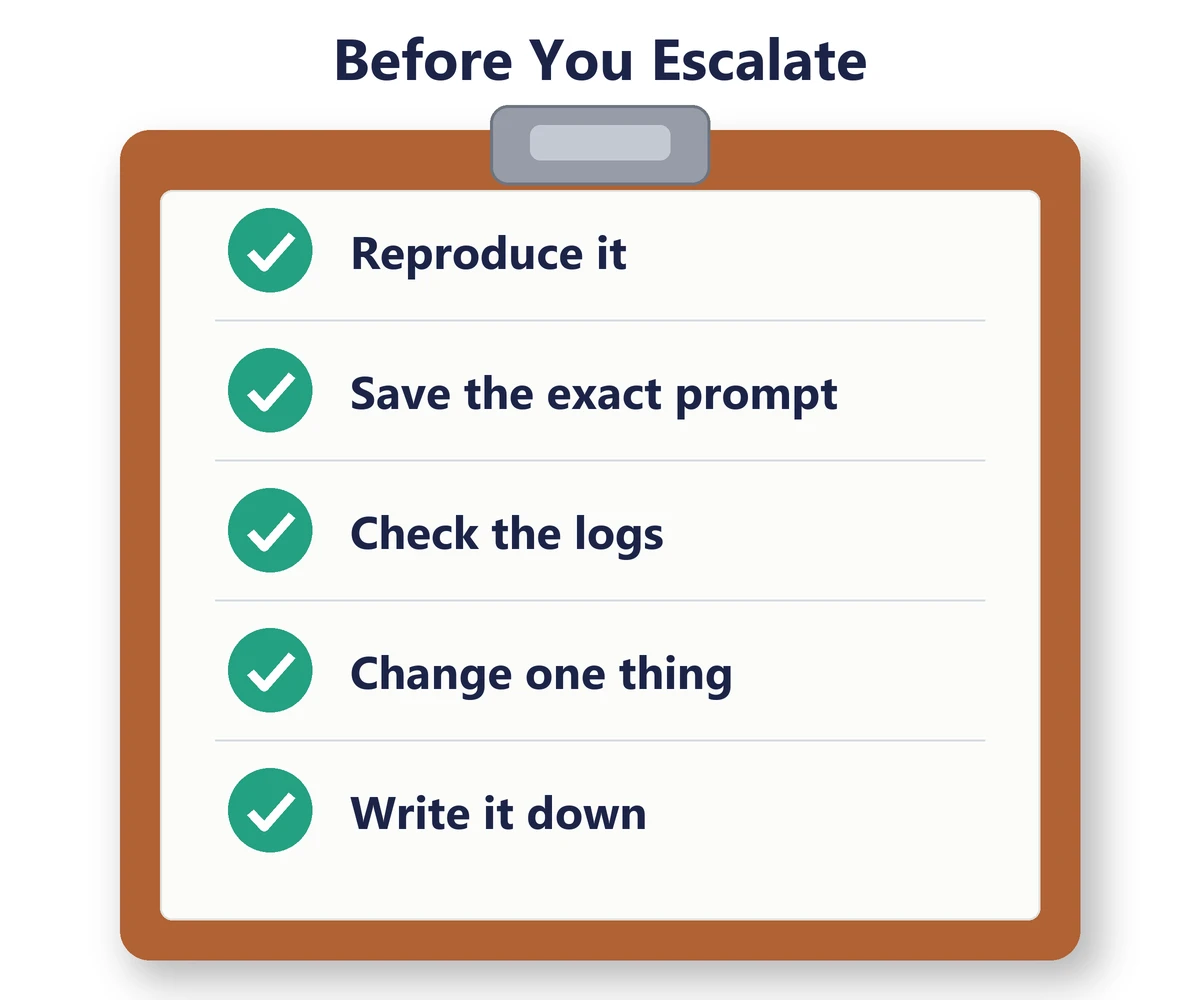
Copy the card into your ticket template so that whoever picks the ticket up can replay the problem without asking you anything.
Turn Fixed Tickets Into Tests
A fix you cannot re-check will break again. Anthropic's guide to building evaluations says to design tests that mirror your real tasks and include edge cases, to automate grading where you can, and that more questions with automated grading are better than fewer questions graded by hand. Your closed tickets are a ready supply of real cases. Each one becomes a row with the input, the expected answer or the rule the answer must meet, and how you will grade it. For a closer look at measuring retrieval, see our guide to RAG evaluation.
Security Tickets Are Troubleshooting Too
Some tickets report an attack instead of a bug. The OWASP Top 10 for LLM Applications, in its 2025 edition, puts prompt injection first, followed by sensitive information disclosure and supply chain risks. If a user can make the chatbot ignore its instructions or reveal data it should not, treat it as a security incident: capture the input, find the layer, and hand it to your security team.
What You Still Need to Add
- Basic Python: read and write short scripts and work with JSON.
- Calling a model API and handling its errors, including rate limits and retries.
- SQL, so you can look through logs and records yourself.
- How retrieval works: how documents are split, indexed and searched.
- Writing and running evaluations, so a fix stays fixed.
- Observability for model calls. OpenTelemetry has published conventions for spans, metrics and events from generative AI clients, and our guide to logs, metrics and traces is a good place to start.
If you want some structure while you keep your job, MicroDegree's learning programs are one place to compare options.
Roles Where These Habits Count
Job titles vary by company. A small sample of postings seen while researching this guide, mostly remote and international, so not a picture of the Indian market, asked support engineers for AI products for API and authentication debugging, root-cause analysis, log reading and documentation, and some added model evaluation or prompt work.
- AI support engineer: diagnoses problems for customers who use an AI product or API.
- AI operations or LLM application support: keeps a company's own AI features running and watches their quality.
- Evaluation or quality analyst: builds test sets and grades answers.
- AI engineer: builds the application, so it needs more coding. Our comparison of AI engineer and generative AI engineer explains the difference.
If you do not code today, read Is Generative AI a Good Career Option for Non-Coders? first. If cloud tooling attracts you more than models, the DevOps roadmap for application support engineers covers that route.
Support vs AI Roles: Pay in Bangalore and India
Flexiple's salary pages publish self-reported annual pay, counted as the total package a year (cost to company). The figures below are medians from pages updated in August 2026 and read in October 2026. The first three columns are India-wide medians by experience that Flexiple does not re-cut to Bengaluru. Only the last column is specific to the city. All figures are in lakh rupees a year (LPA).
| Role | 0 to 3 years | 3 to 6 years | 6+ years | Bengaluru, all levels (middle 50%) |
|---|---|---|---|---|
| Technical support engineer | 4.2 | 6 | 10.7 | 6.9 (4.5 to 13) |
| Machine learning engineer | 6.5 | 14.9 | 31 | 19.9 (9.2 to 35.6) |
| Generative AI engineer | 7 | 8.8 | 28 | 9.2 (6 to 22.3) |
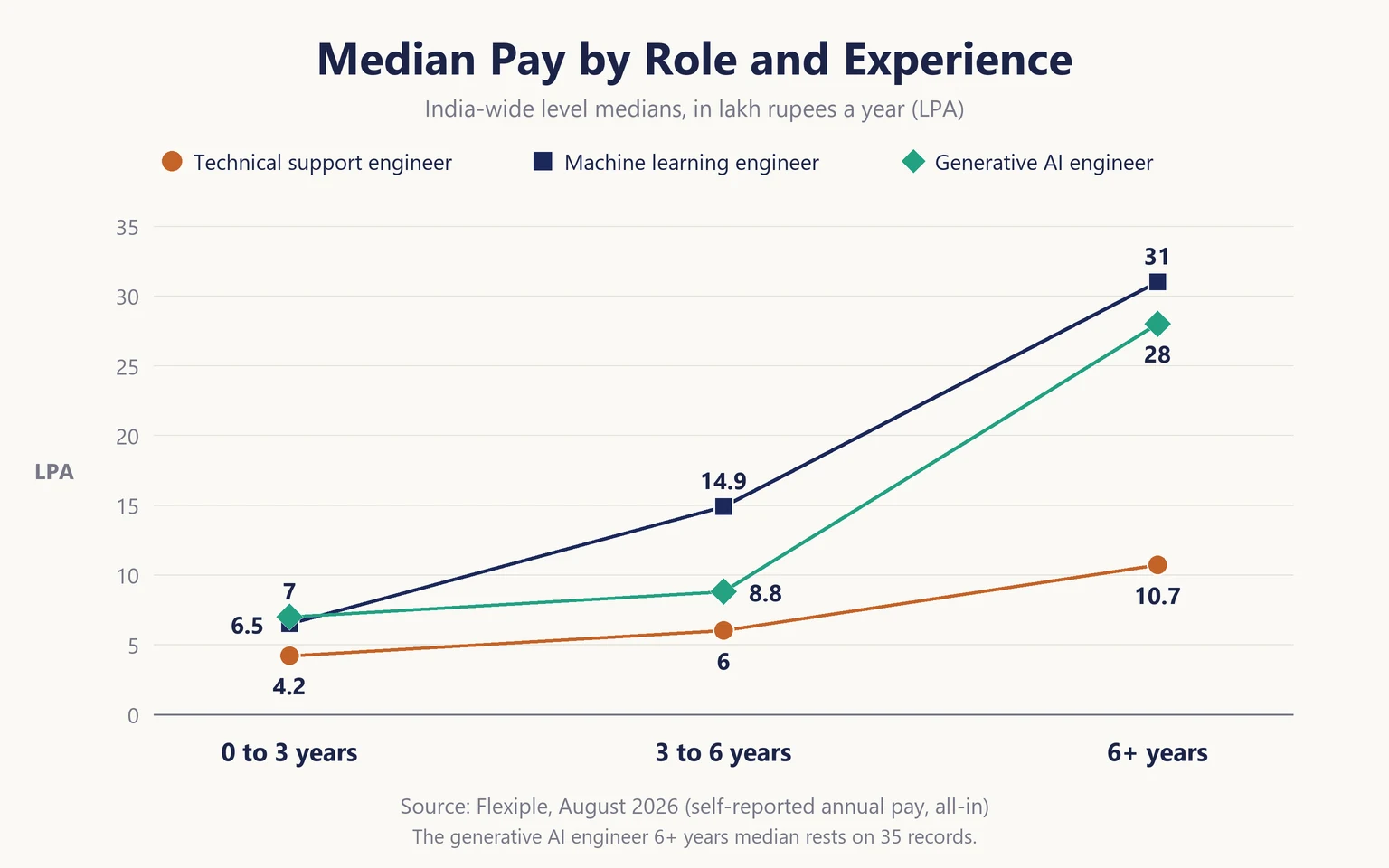
Treat these as estimates that vary with company, skills and city. The generative AI engineer page rests on far fewer records than the others (59 in Bengaluru, and 173, 95 and 35 across the three levels), so its senior figure is rough. Each page's own FAQ also gives different level medians from the main figures used here. PayScale's technical support engineer page for India shows an average base salary of ₹485,191 from 463 profiles, updated on 6 May 2026, which is a different basis from Flexiple's: base pay for India as a whole, not total package. Some other sites publish higher bands for generative AI roles, but their methods are unclear, so they are not used here.
In this data, at 0 to 3 years the support engineer and generative AI engineer medians are fairly close (₹4.2 and ₹7 LPA), and the bigger differences appear at 6+ years and for machine learning engineers. A move from support into an AI role is not a guaranteed raise. For more on AI pay, see Highest Paying AI Careers in India.
Conclusion
The habits that make you good at tickets are the habits that make AI systems easier to run: capture the exact input, reproduce it, find the layer, change one thing and write it down. What you add is the vocabulary of the new layers and enough Python to see inside them. Start with one small project, write up a ticket the way the walk-through above does, and keep the test that proves the fix.
FAQs
1. Do troubleshooting skills count in a generative AI career?▼
Yes. Reproducing a problem, reading logs, isolating the layer and writing up the cause all apply. You will still need to learn how the new layers work, such as prompts, retrieval and model calls.
2. Do I need to know Python?▼
Basic Python helps a great deal, because most of the logs, tests and scripts you will work with are written in it. Some support-style roles ask for less coding than an AI engineer role, but job requirements vary by company.
3. What should I learn first?▼
Start with the model-call layer: make one API call, read the response and handle an error. Then add retrieval, then evaluation. Each step gives you something to troubleshoot.
4. Is an AI support engineer the same as an AI engineer?▼
Not usually. Titles vary, but an AI support engineer diagnoses problems for people using an AI product, while an AI engineer builds the application and writes more code.
5. Will moving from support to generative AI raise my pay?▼
Not automatically. In the Flexiple data above, the medians for a support engineer and a generative AI engineer are fairly close at 0 to 3 years, and the larger gaps appear at 6+ years and for machine learning engineers. Ranges are wide and sources differ.
6. How can I show these skills without AI job experience?▼
Build a small project, such as a chatbot that answers from a few documents. Keep a log, write up two or three faults you traced, and add each one to a small test set. A short write-up shows how you work.
Ready to try a different kind of ticket?Click here to take a free Generative AI demo