
7 IT Careers Without Programming: Best Non-Coding Paths for 2026
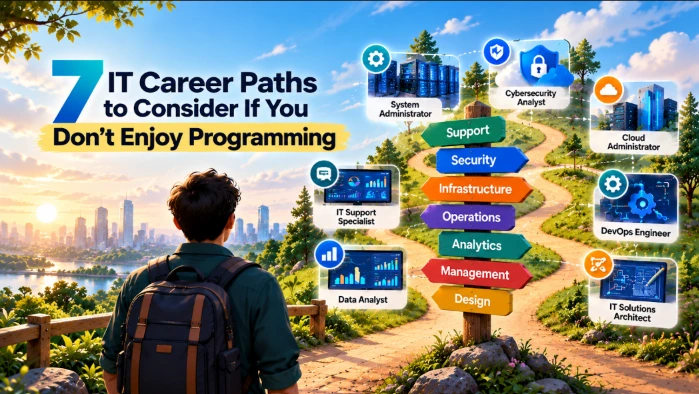
Table of Contents
▼Can You Build an IT Career Without Programming?
Yes. There are plenty of IT careers without programming, and they are built on troubleshooting, analysis, communication and planning instead of code. Coding is one skill among many in technology. Companies also need people who run infrastructure, protect systems, define requirements, support users, keep projects moving, test products and train teams.
This guide covers seven of the best IT careers without programming for beginners in 2026: what each role involves, the skills and certifications to start with, where it can lead, and how much coding still shows up. It also compares what these roles pay, from a named source with its weak points stated.
"No coding" rarely means "no technical learning." You will still need to understand how systems work, and a little scripting pays off as you grow. You just will not build software all day.
These non-coding IT jobs exist because software does not run itself. Someone has to manage the cloud account, investigate the alert, write the requirement, fix the laptop, test the release and teach the new hire. Not all seven paths are equally easy to enter, and none is free of technical work. Treat "low coding" as a starting point, not a promise.

The 7 Non-Coding IT Careers
1. Cloud Administrator: Running Infrastructure Without Building Software
A cloud administrator looks after a company's cloud setup on platforms such as AWS or Microsoft Azure. The job is keeping services up, access tight and the bill sensible. Nobody expects you to write applications.
Day-to-day work:
- Creating and managing virtual machines, storage and networks
- Controlling who can access what through identity and access management (IAM). Our guide to AWS IAM users, roles and policies explains the idea
- Monitoring performance and responding to alerts
- Handling backups and basic troubleshooting
Skills to build: cloud fundamentals, networking basics, Linux or Windows administration, and one major cloud platform.
Good starting certifications: AWS Certified Cloud Practitioner or Microsoft Azure Fundamentals (AZ-900), then the AWS Certified CloudOps Engineer Associate (which replaced the SysOps Administrator Associate in 2025) or the Azure Administrator exam (AZ-104). Our AWS Cloud Practitioner guide covers the first step.
Growth path: cloud administrator, then cloud engineer, then cloud architect. If you are unsure where the administrator role stops and the engineer role starts, read cloud administrator vs cloud engineer.
Coding reality: you can start with consoles and dashboards. Later, command-line skills and light scripting save you hours of repetitive clicking and open the door to DevOps work.

2. Cybersecurity Analyst: Investigating Threats and Reducing Risk
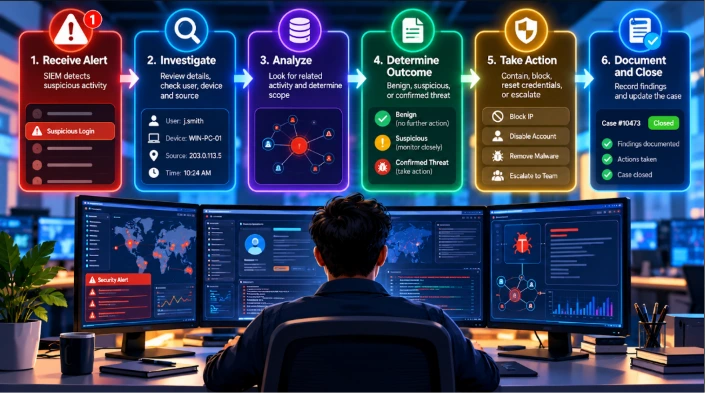
Picture an alert at 2 a.m. saying someone just logged in from a country where your company has no staff. A cybersecurity analyst works out whether that is a real problem or a false alarm. It is one of the more popular alternative IT career paths because the job feels closer to detective work than to building things.
What the day looks like:
- Watching alerts in a SIEM tool, a system that gathers security events from across the company and flags the odd ones
- Digging into suspected incidents to see what really happened
- Spotting weak access controls and unpatched systems
- Writing up what you found and what needs fixing
What to learn first: networking and operating systems. You cannot spot strange traffic if you do not know what normal looks like. After that come security basics and threat analysis. Practise in labs, because reading alone will not get you far.
Certifications to start with: CompTIA Security+ or Microsoft SC-900. CompTIA is bringing out a new Security+ version (V8, SY0-801). Training providers expect it around mid-November 2026, but I found no official date and the sources disagree, so check CompTIA's site before you book. The current SY0-701 is expected to stay available for a while after that.
Where it leads: security analyst, then incident responder, then security specialist.
How much coding? Not much at the start. Later roles, such as threat hunting or security automation, usually ask for scripting.
3. IT Business Analyst: The Bridge Between Business and Technology
An IT business analyst finds out what the business needs, then turns it into requirements the technical team can build from. If you enjoy asking "why?" and organising messy information, this role fits well.
Day-to-day work:
- Gathering requirements from stakeholders
- Mapping current and future workflows
- Writing user stories and requirement documents
- Coordinating between business teams, developers and testers
Skills to build: communication, analytical thinking, Excel, Jira and process mapping.
Portfolio idea: write a sample business requirements document for an everyday process, such as a leave-approval workflow, and include a flow diagram.
Certifications that help: IIBA's ECBA or CBAP, depending on experience.
Growth path: business analyst, then senior business analyst, then product owner.
Coding reality: usually low. Domain knowledge and problem-solving count for more. Basic SQL is a useful extra.
4. IT Support Specialist: The Most Accessible Entry Point
IT support, also called help desk, is where many people begin. One minute you are unlocking an account, the next you are working out why a laptop will not connect to Wi-Fi. It suits people who like solving problems and do not mind talking to the person who has them.
Day-to-day work:
- Resolving login, email, device and network issues
- Installing and configuring software
- Logging and tracking tickets
- Escalating complex problems to specialist teams
Skills to build: operating systems, networking basics, systematic troubleshooting and clear customer communication.
Good starting certifications: CompTIA A+ or the Google IT Support Professional Certificate. A small home lab, such as a virtual machine you set up and break on purpose, gives you real talking points.
Growth path: help desk, then systems administrator, then IT operations specialist. If you want to go from the desk toward the cloud, see how to move from a service desk job to a cloud engineer role.
Coding reality: low. You may run simple commands or scripts for troubleshooting, but you are not developing software. Google has added AI material to its IT Support certificate, including using generative AI to draft a support message, and it offers a separate IT Automation with Python certificate for people who want to script.
5. IT Project Manager or Scrum Master: Leading Delivery, Not Development
These two roles are related but different.
- IT project manager: owns the plan, timeline, budget, risks and stakeholder communication.
- Scrum Master: helps an Agile team follow Scrum, removes blockers and improves how the team works.
Skills to build: Agile and Scrum, Jira, risk management, stakeholder communication and clear status reporting.
Certifications that help: PMI's CAPM if you are starting out, or PMP once you have several years of project experience, and Certified ScrumMaster or Scrum.org's PSM I for Scrum.
Growth path: project coordinator, then project manager, then program manager.
Coding reality: low. Even so, engineers will take you more seriously if you understand how software is built and deployed. Our guide on cloud skills every Scrum Master should learn shows what that looks like.
6. Manual QA Tester: Protecting Quality Before Release
Manual QA testers make sure software works the way it should before users find the problems for them. They follow test cases, poke around the product and report defects clearly.
Day-to-day work:
- Writing and executing test cases
- Reporting bugs with clear reproduction steps
- Validating fixes and requirements
- Working with developers and business analysts
Skills to build: the software development life cycle (SDLC), the software testing life cycle (STLC), defect reporting and close attention to detail. Jira and test management tools are common.
Certification that helps: ISTQB Foundation Level.
Growth path: manual tester, then QA analyst, then QA lead.
Coding reality: low for manual testing. Automation testing typically needs scripting, and many teams now expect it, so check job descriptions in your target market. Testers who want to move toward pipelines can start with CI/CD projects for software testers.
7. IT Trainer: Teaching Technology to Others
An IT trainer helps employees, students or customers get comfortable with new tools and technologies. If you can explain a hard idea simply, this is one of the stronger technology jobs for non-programmers.
Day-to-day work:
- Preparing learning material and demos
- Running live or recorded sessions
- Answering questions and assessing progress
- Updating content as tools change
Skills to build: deep subject knowledge, presentation skills and instructional design. Credibility comes from having used the technology, so get hands-on experience first and teaching practice after.
Growth path: technical trainer, then learning consultant, then technical training manager.
Coding reality: depends on the subject. Teaching cloud administration or project tools needs little code. Teaching programming obviously does.
Comparison: Which Non-Coding IT Career Fits You?
| Career path | Coding requirement | Best suited for |
|---|---|---|
| Cloud administrator | Low initially; scripting helps later | Infrastructure and cloud operations |
| Cybersecurity analyst | Low to moderate, depending on role | Security and investigation |
| IT business analyst | Usually low | Communication and problem-solving |
| IT support specialist | Usually low | Troubleshooting and customer service |
| IT project manager or Scrum Master | Usually low | Coordination and leadership |
| Manual QA tester | Low for manual testing | Detail-oriented, systematic thinkers |
| IT trainer | Depends on subject | Teaching and communication |
"Low coding" does not mean zero technical skills. Requirements vary by employer, seniority and specialisation.
What Do These Non-Coding IT Careers Pay?
The table uses Flexiple's salary pages, read on 3 November 2026. Flexiple's figures are self-reported annual CTC. The level columns are India-wide medians in ₹ LPA (lakh rupees a year), and the last column is the Bengaluru all-levels median with the middle 50% range and the number of records. Flexiple has no page for cloud administrator, so the cloud engineer page is shown as the nearest match. The QA engineer page includes automation testers, so it is not manual QA alone.
| Role (nearest Flexiple page) | 0 to 3 years | 3 to 6 years | 6+ years | Bengaluru, all levels (middle 50%, records) |
|---|---|---|---|---|
| IT support (technical support engineer) | 4.2 | 6 | 10.7 | 6.9 (4.5 to 13, 237 records) |
| Cloud administrator (cloud engineer) | 5.3 | 7.8 | 16.6 | 9.8 (6.4 to 17.5, 632 records) |
| IT business analyst (business analyst) | 6.5 | 8.8 | 13.5 | 10.4 (6.6 to 16.5, 778 records) |
| QA tester (quality assurance engineer) | 4.9 | 7 | 15.3 | 10.5 (6.1 to 18.5, 686 records) |
| IT project manager (project manager) | 7 | 9.7 | 18.5 | 18.6 (10.6 to 29.4, 440 records) |
| Cybersecurity analyst, Scrum Master, IT trainer | Not enough data | Not enough data | Not enough data | Not enough data |
Read the table with care. The level medians are India-wide, while the last column is Bengaluru only. Each Flexiple page's own FAQ gives different level medians for the same role (for example ₹8.1L, ₹10.6L and ₹16.4L for business analyst against the ₹6.5L, ₹8.8L and ₹13.5L in the table). The project manager page also lists a 6+ years median of ₹18.5L beside a Bengaluru all-levels median of ₹18.6L, which shows how loosely the two sets of figures fit together. The figures are estimates that vary by company, skills and city, and I did not find a second source to confirm them.
What the table does show is that none of these roles sits at the bottom of the scale by default, and that entry pay is close across them while the gap widens with experience. It does not tell you how quickly you will move up. Cybersecurity analyst, Scrum Master and IT trainer had no matching Flexiple page, so there is no row for them and I have not estimated one.
How to Choose Among These IT Career Options Without Coding
Start with what you already do well, not with the job title that sounds best.
- You like fixing things: IT support or cloud administration.
- You like investigating: cybersecurity.
- You like organising people and information: business analysis or project management.
- You notice small details: QA testing.
- You like explaining: technical training.
Then check three things: how easy the role is to get into, how deep the learning goes, and how much scripting shows up in real job postings. Read 15 to 20 postings for your target role in your city. They will teach you more than any career guide, including this one.
How to Start an IT Career Without Coding
- Pick one path and check what you already bring. A support engineer already troubleshoots. A tester already reads requirements closely. You may have more of the skills than you think.
- Fill the gaps with a structured course, not scattered videos. MicroDegree's e-learning platform is one place to look at courses together.
- Practise on something real. A free cloud account, a lab, a sample requirements document or a small task at work will do.
- Take one entry-level certification, but only if the job postings you have read ask for it.
- Rewrite your resume around what you have actually done, not just your job titles.
- Apply widely, and ask about internal moves at your current company first.
- Keep learning. Light scripting and SQL help in almost every path above, and so do basic AI tool skills. The 2026 PMP outline now mentions AI, and Google has added AI material to its IT Support certificate.
You will rarely be starting from zero. Moves like application support into cloud administration, or testing into business analysis, are common, and your current job is usually the best proof you have.
Frequently Asked Questions
Conclusion
IT careers without programming are real, and they suit very different strengths. Whether you like investigating, organising, fixing or teaching, one of these seven paths probably fits.
You will still need to understand how systems work, and the people who do well keep learning. Pick the role you could see yourself in two years from now, spend this week reading real job descriptions for it, then build some hands-on proof and take the first certification that makes sense. If you are weighing alternative IT career paths, that beats waiting until you feel ready.
Continue Learning with MicroDegree
If you would like to build on what you have read here, explore MicroDegree's e-learning platform. You can look at courses across cloud computing, DevOps, Generative AI and other technology topics together on one platform, and start with the role you marked while reading this guide.
FAQs
1. Can I get an IT job without knowing programming?▼
Yes. Support, business analysis, QA testing, project coordination and cloud administration commonly do not ask for programming at entry level. You do need solid basics, such as operating systems, networking and the tools of the role. A bit of scripting helps once you start moving up.
2. What are the best IT careers without programming for beginners?▼
For someone new to the field, IT support, manual QA testing, business analysis and entry-level cloud administration are the usual starting points. Support and QA are often the easiest to get into. Cloud and security take longer to learn but tend to offer more room to grow. Pick the one that matches how you like to work.
3. Which non-coding IT jobs suit working professionals who want to switch?▼
Cloud administration, business analysis, project management and QA are common switches for people already in IT. Each builds on skills you probably use now, such as troubleshooting, documentation or coordination. Check what your current job already proves, then look for roles that value it.
4. Can I move into a non-coding role from support, testing or networking?▼
Yes. These backgrounds transfer well. Support experience helps in cloud administration and security, testing experience helps in business analysis, and networking is a strong base for both cloud and security. Expect to add a tool or a certification or two, not start over.
5. Which IT career requires the least coding?▼
IT support, project management and Scrum Master roles usually need the least. Manual testing and business analysis are close behind. Requirements still differ by employer, so read a few real job descriptions before you decide.
6. Can I earn a good salary in IT without programming?▼
Pay depends on the role, your skills, seniority, location and employer. In the Flexiple data above, entry pay is close across the roles with data and the gap widens with experience, with project manager the highest at 6+ years and Bengaluru all-levels. The sources differ and the figures are estimates, so treat them as a rough guide.
7. Is cloud computing a good career if I do not enjoy coding?▼
It can be. Cloud administration starts with managing services, access and monitoring through consoles. You do not have to love coding, but you should be willing to pick up command-line and scripting skills over time.
8. Which certifications can help me get a non-coding IT job?▼
Match the certification to the role: CompTIA A+ for support, AWS Cloud Practitioner or Azure AZ-900 for cloud, Security+ for security, ISTQB Foundation for testing, ECBA for business analysis, and CAPM, CSM or PSM I for delivery roles. Choose by what your target job postings ask for.