
Can Manual Testers Become AI Engineers Without a Machine Learning Background?
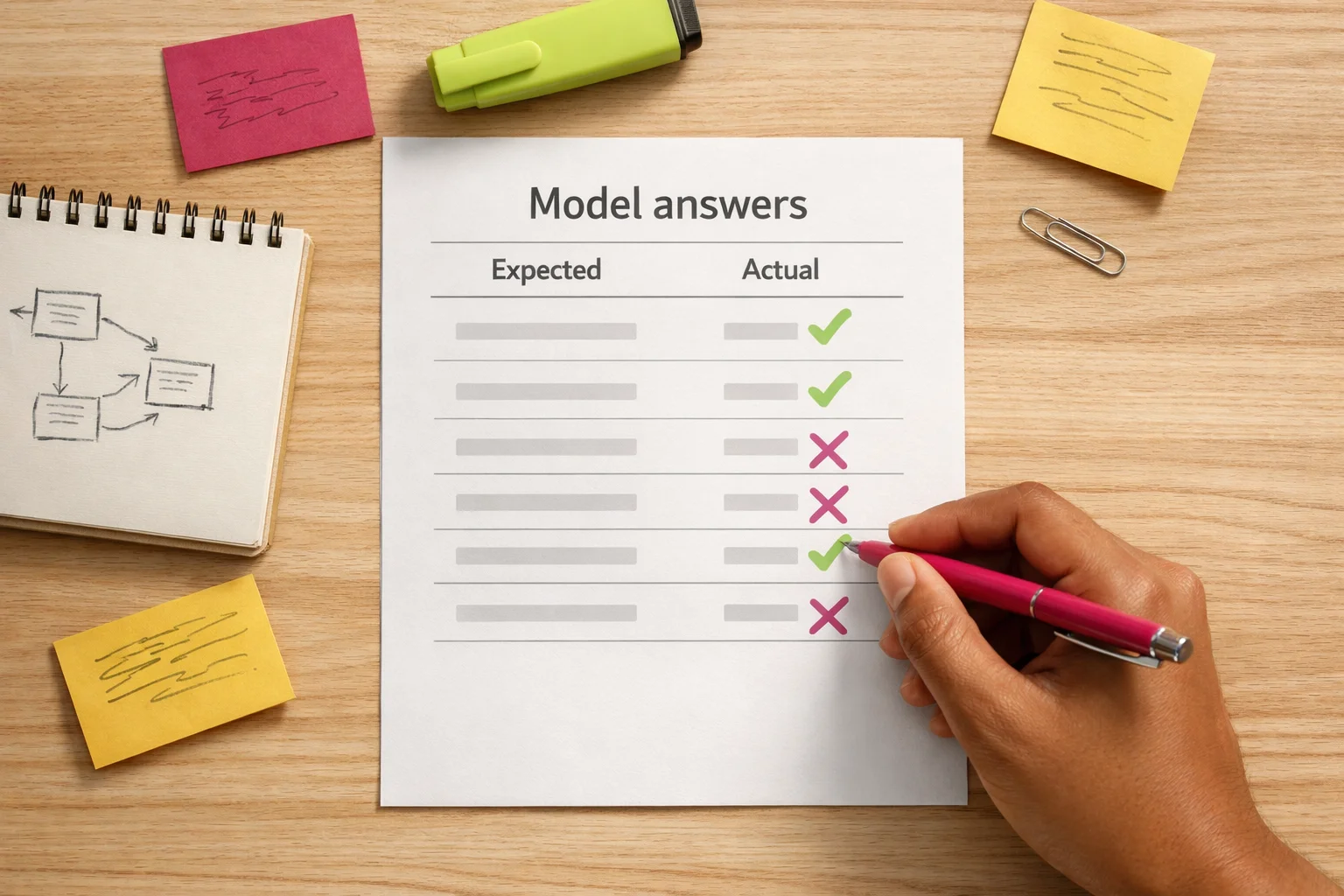
You have spent years finding the case nobody planned for: the input that breaks a form, the build that passes in one browser and fails in another. Then your team starts shipping features that call a language model, and the bugs look different. The same question gets a different answer each time, and nobody is sure whether a wrong answer counts as a bug.
The move from manual tester to AI engineer is realistic for one kind of AI engineer role, and that kind does not start with a machine learning degree. It does need programming. Testers also bring a skill the role relies on: judging whether a model's answers are right.
Table of Contents
▼Can a Manual Tester Become an AI Engineer Without Machine Learning?
Yes, if you mean the role that builds products on top of existing models. roadmap.sh describes an AI engineer as someone who uses pre-trained models and existing AI tools to improve user experiences, without building models from scratch, and says the role is different from AI researchers and ML engineers. An essay on the role from Latent Space goes further. It quotes Andrej Karpathy saying that one can be quite successful in this role without ever training anything.
The answer changes for roles that train or fine-tune models. Those are closer to ML engineering and do expect ML knowledge. Job titles are not consistent between companies, so read each description for what you would actually do. Our comparison of AI engineer and generative AI engineer career paths shows how the titles differ.

What an AI Engineer Does Day to Day
In most product teams the work is to call a model through an API, give it the right information, connect it to tools and data, and check that the results are good enough to ship. The last step is where testers have a head start.
- Call models through APIs and handle the responses in code.
- Write and refine prompts so the model answers in the format the product needs.
- Give the model the right documents to answer from, a technique known as retrieval. Our guide to RAG evaluation explains how that is measured.
- Connect the model to tools and data so it can act, which is where AI agents come in.
- Evaluate the results, and catch wrong answers before users do. See why AI hallucinates.
Skills You Already Have as a Manual Tester
Several things you already do map onto AI engineering work, and each one is something you can talk about in an interview.
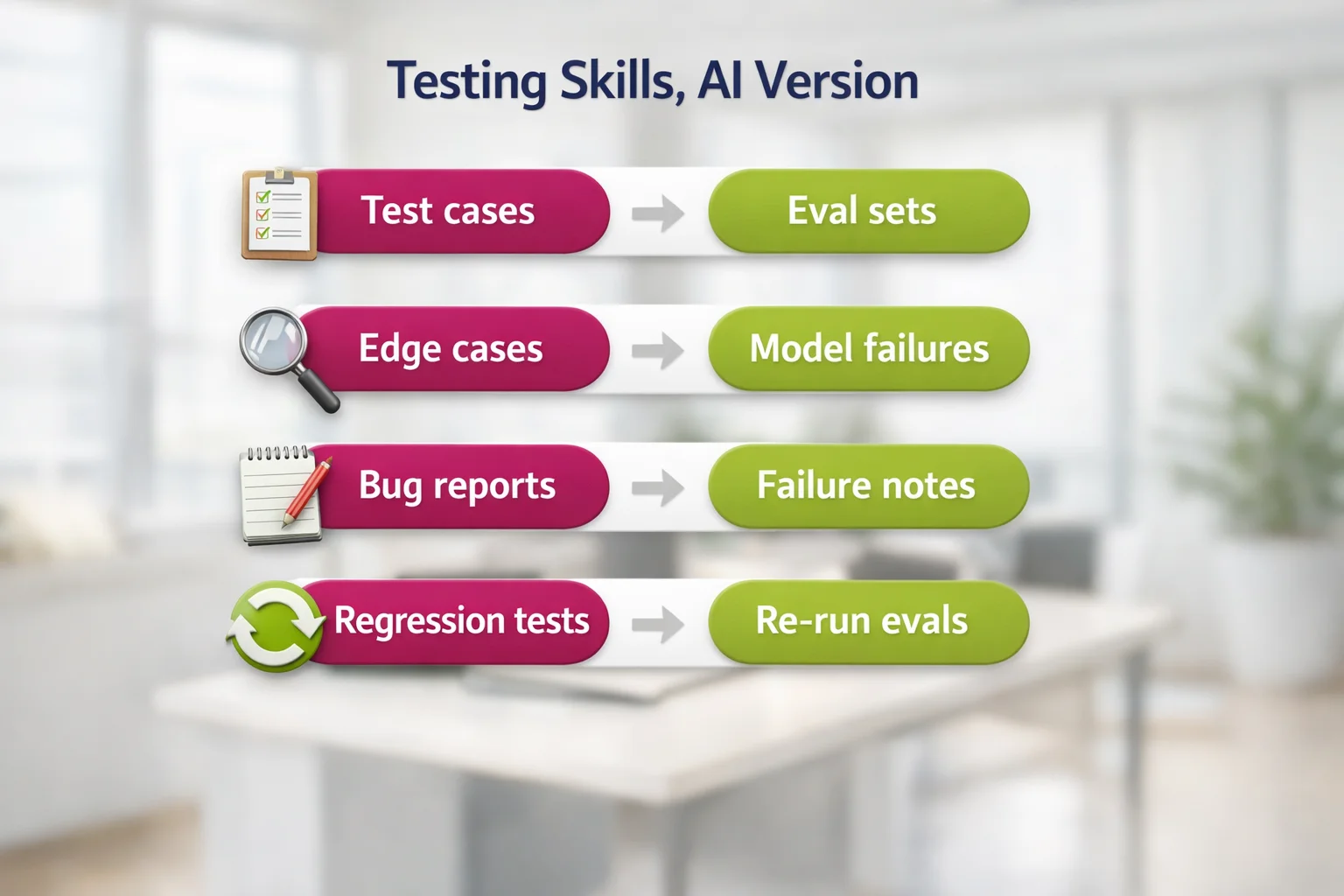
| What you do as a manual tester | The AI engineering counterpart |
|---|---|
| Writing test cases from requirements | Building evaluation sets with expected answers |
| Thinking of edge cases | Finding inputs where a model fails, such as empty, very long or ambiguous input |
| Writing clear bug reports | Describing a model failure so it can be reproduced and fixed |
| Running regression tests | Re-running the same evaluation after a prompt or model change |
| Knowing the product and its users | Judging whether an answer is right for the person asking |
Anthropic's guide to testing LLM applications says to define specific, measurable success criteria first, and to design evaluations that mirror the real task, edge cases included. The same guide advises favouring more test questions graded automatically over fewer questions graded by hand, which pushes you towards writing code.
What You Still Need to Learn
The gap is programming and the tooling around models. Learn it in this order, because each step makes the next one easier.
- Python: variables, functions, lists, dictionaries, files, and calling an API where you send JSON and read JSON back. JavaScript also works, but Python is a sensible first language.
- Git and the command line, so your work lives in a repository.
- How language models behave: why answers vary, and why they can sound confident and be wrong. Our guide to prompt engineering techniques is a good start.
- Prompting for structured output, so the model's answer can be checked by code.
- Retrieval: embeddings and vector search, enough to build a small question-answering app over your own documents.
- Evaluation in code: test sets, and grading by exact match, by rules, or by a second model for open-ended answers.
- Deployment basics: put a small app online, and log its requests, failures and costs.
- Just enough ML vocabulary: the difference between training a model and using one, what fine-tuning is, and why a test set must be kept apart from the examples you tuned on.
When You Do Need a Machine Learning Background
If you want to train or fine-tune models, or to do research, plan for maths, statistics and machine learning courses, and expect a longer route. A middle path is MLOps, which is about running models in production. See how to become an MLOps engineer for what that involves.
Build This First: An Evaluation Harness for an AI Feature
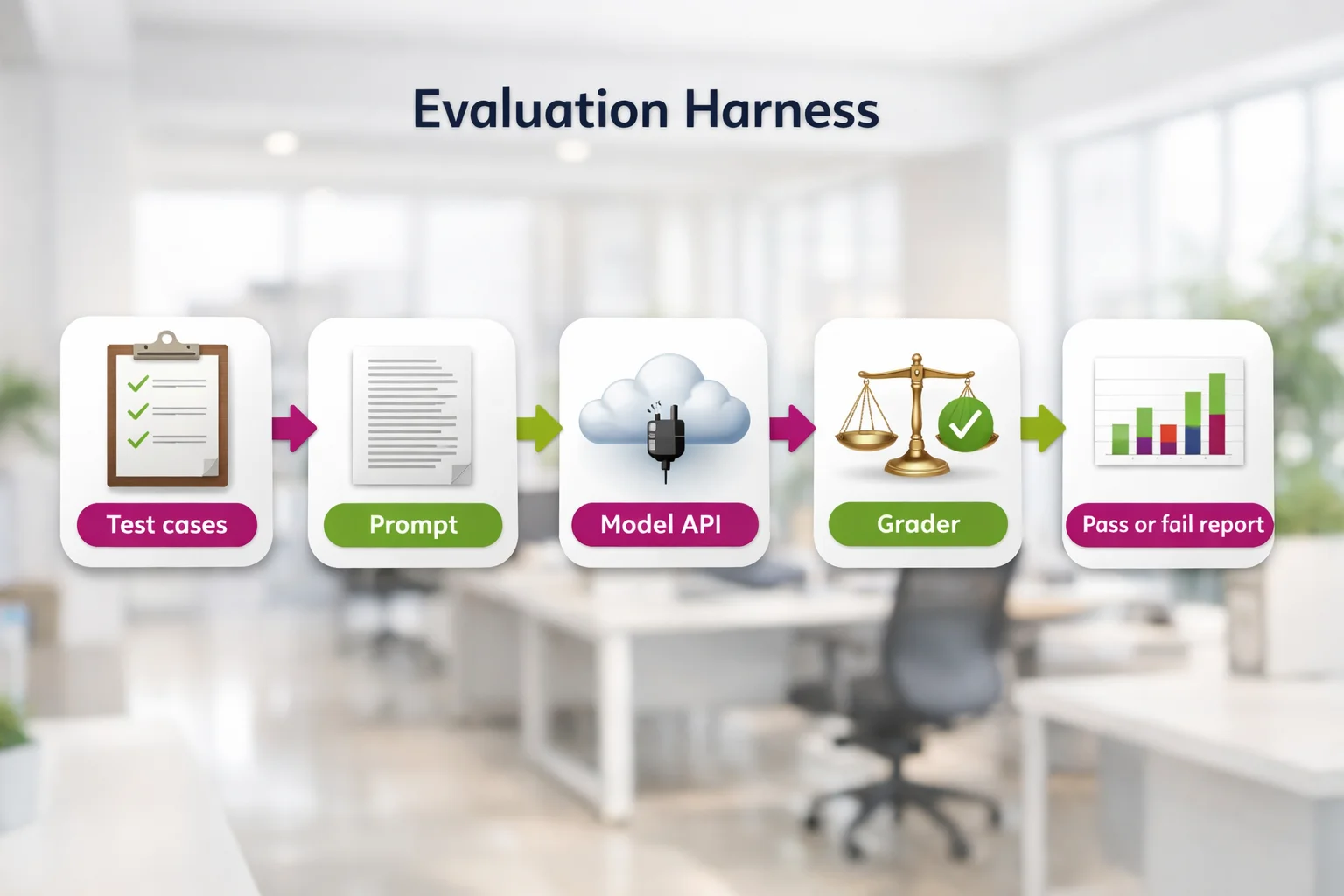
A good first project uses what you already do: write the tests for a small AI feature. A sentiment classifier is easy to grade, so it is a good place to start.
- Write 30 to 50 test cases with expected answers, including edge cases such as sarcasm, mixed opinions, empty input and very long text.
- Write a prompt that classifies each input as positive or negative.
- Call a model through its API for every test case.
- Grade the answers in code and print what failed.
- Change the prompt, run everything again, compare the scores, and keep a log of what improved and what got worse.
This is the core of the project in code. The model call is left for you to fill in with whichever provider you choose:
test_cases = [
    {"input": "Great product, fast delivery", "expected": "positive"},
    {"input": "Arrived broken", "expected": "negative"},
    {"input": "Oh sure, because waiting three weeks is exactly what I wanted", "expected": "negative"},
]

def ask_model(text):
    ...  # call your chosen model API here and return its answer as a string

passed = 0
for case in test_cases:
    answer = ask_model(case["input"]).strip().lower()
    if answer == case["expected"]:
        passed += 1
    else:
        print("FAILED:", case["input"], "->", answer)

print(f"{passed}/{len(test_cases)} passed")
Then extend it. Add retrieval over your own documents, log the failures you find, and use a second model to grade open-ended answers. Publish it on GitHub with a README that explains your test design. Our list of generative AI projects for your resume and the GenAI developer portfolio give more ideas.
A 6-Month Plan While Working
This plan assumes about 8 to 10 hours a week, split into short blocks. Treat the timings as a guide. If you already know Python, you can move faster.
| Month | Focus | What you should have by the end |
|---|---|---|
| 1 | Python basics, Git and the command line | Small scripts that read files and call a public API, in a GitHub repository |
| 2 | How models behave, prompting and structured output | A prompt that returns answers in a fixed format, and a note on where it fails |
| 3 | Your first evaluation harness | The sentiment project above with test cases, grading in code and a score log |
| 4 | Retrieval and a small question-answering app | An app that answers from your own documents, with a test set that measures it |
| 5 | Deployment, logging and a second project | The app online with request and failure logs, and a written summary of what you found |
| 6 | Portfolio, CV and applications | Two projects with test design explained, and a CV that leads with results |
For a view of the skills employers list, read our guide to the most in-demand generative AI skills in 2026. If you would rather follow a guided path alongside your job, MicroDegree's learning programs are one option.
Testing vs AI Engineer Pay in Bangalore
The table below compares two roles from one source, so it is like for like: Flexiple's published salary pages for test automation engineers and AI engineers in Bengaluru, which I read in October 2026. Flexiple has no page for manual testers, so test automation engineer is the closest testing role in the same data. The figures are self-reported annual pay (CTC) in lakh rupees a year (LPA).
| Experience | Test automation engineer (median) | AI engineer (median) |
|---|---|---|
| 0 to 3 years | ₹4.9 LPA | ₹6.7 LPA |
| 3 to 6 years | ₹6.3 LPA | ₹11 LPA |
| 6+ years | ₹14.2 LPA | ₹21.6 LPA |
| Bengaluru, all levels | ₹7.1 LPA | ₹11.1 LPA |
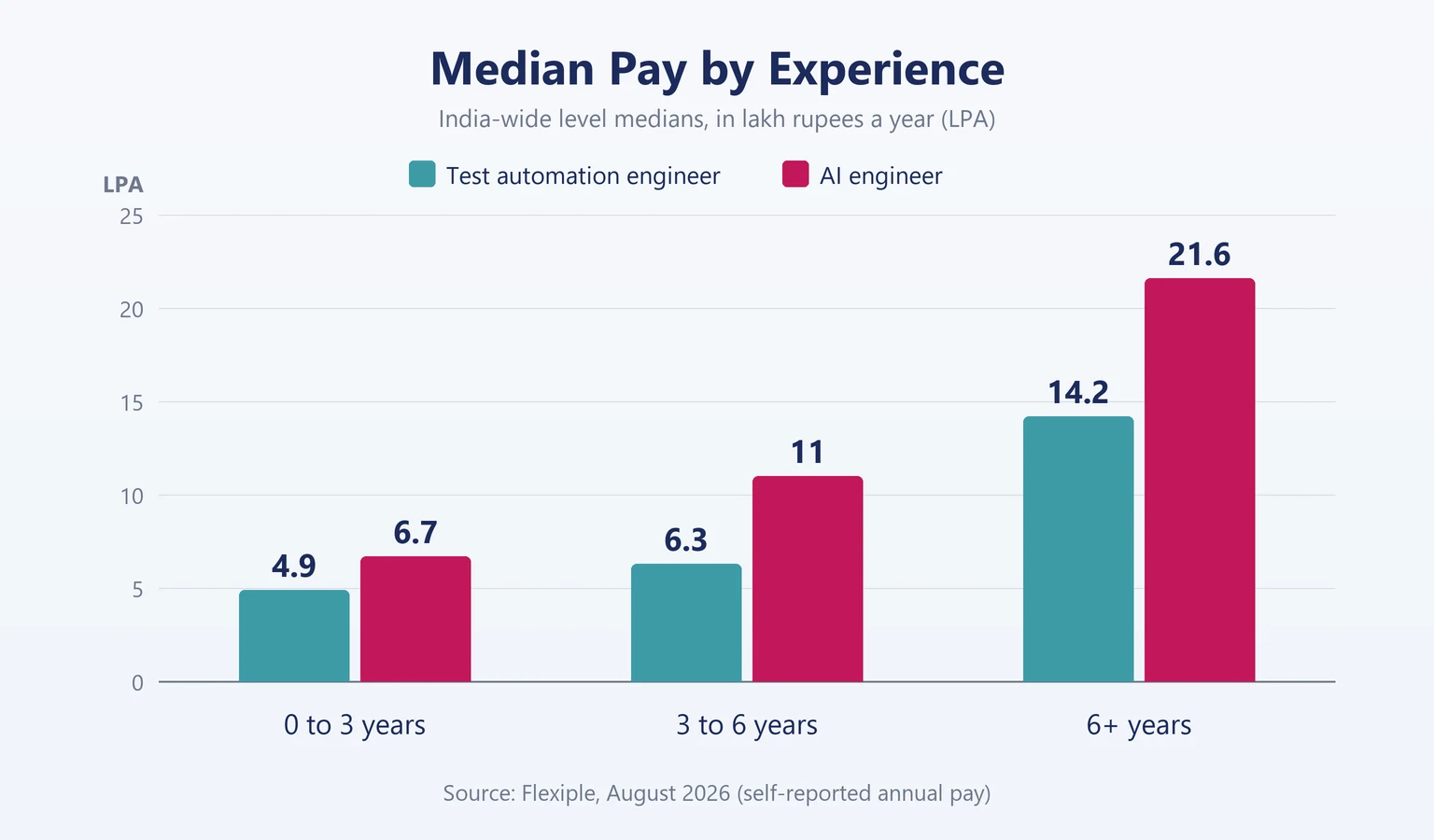
The three experience rows are India-wide medians, and Flexiple says it does not re-cut them to Bengaluru. Only the last row is specific to Bengaluru. The samples are small for AI engineers: the Bengaluru figure comes from 227 records against 238 for test automation engineers, and the India-wide senior figure for AI engineers rests on 76 records. Job titles also differ between companies, so an AI engineer in this data may be doing very different work. The middle 50% of Bengaluru pay runs from ₹4.9 LPA to ₹12.5 LPA for test automation engineers and from ₹5.7 LPA to ₹18.4 LPA for AI engineers, so the ranges overlap a lot.
For manual testers there is no like-for-like source. Hyring's 2026 model, which is a modelled estimate and not survey data, puts the Bengaluru median at ₹9.9 LPA, with the middle half between ₹6.7 LPA and ₹16.8 LPA. Cutshort says a manual tester with 2 years of experience in Bangalore earns 10 LPA on average, within a range of 8 to 17 LPA, and does not say where the numbers come from or when they were collected. Both sit above Flexiple's test automation median, which suggests the methods differ. Treat them as a rough guide only.
A second source for AI engineers is PayScale, which has no page under that exact title. For Artificial Intelligence Software Engineer it lists an average base salary of ₹1,013,674 a year in India from 43 profiles, updated in July 2026. That is a small sample and a related title, but it is in the same range as Flexiple's Bengaluru median.
In the Flexiple data, AI engineer medians are higher than test automation engineer medians at every level. That does not mean you would start at those numbers. Someone changing roles may be hired at a more junior level than their years of experience suggest, and pay depends on the company, your skills and how interviews go. Pay is one factor among several. For more on pay in AI roles, see our guide to the highest paying AI careers in India.
Show Proof Before You Apply
Two or three small projects you can explain usually count for more than a list of courses on a CV. Build these in order:
- The evaluation harness above, on GitHub, with a README that explains your test design and your results.
- A small retrieval app over a set of documents, with a test set that measures how often it answers correctly.
- A short write-up of failures you found in a model and how you measured the fix. This is the part that shows your testing background directly.
Roles such as AI quality analyst can also be a stepping stone while you build the programming skills. Our article on whether generative AI is a good career for non-coders describes those roles. Apply inside your own company first, because a team that already trusts your testing work may let you help with AI features.
Common Mistakes to Avoid
- Starting with a long maths or machine learning course before you have built anything against a model API.
- Learning a list of prompts and nothing else. Tools change, but the habit of checking output carries over.
- Skipping Python. AI engineering roles are software engineering roles.
- Believing an answer because it sounds confident.
- Building a chatbot demo with no tests. The tests are what show your strength.
- Applying only for jobs titled AI engineer. Read the descriptions, because roles such as AI quality and evaluation may fit you sooner.
Conclusion
A manual tester can become an AI engineer without a machine learning background if the role builds on existing models, and if you add programming and learn how to evaluate model output in code. Start with Python and one small evaluation project. You can begin this week by writing ten test cases for any AI tool you use. If AI turns out not to suit you, our guide to moving from manual testing to DevOps shows another route out of manual work.
FAQs
1. Can a manual tester become an AI engineer without machine learning knowledge?▼
Yes, for roles that build products on top of existing models. These need programming, API skills and the ability to evaluate output, but not model training. Roles that train or fine-tune models do expect machine learning knowledge.
2. Do I need to learn Python to become an AI engineer?▼
For engineering roles, yes. You can start with the basics: functions, lists and dictionaries, reading files and calling an API. JavaScript is another option, but Python is a sensible first language.
3. How long does it take to move from manual testing to AI engineering?▼
A working tester can plan for about six months of steady practice before applying, and some will need longer. It depends on how much programming you already know and how many hours you can study each week.
4. Is AI testing the same as AI engineering?▼
No. AI testing checks whether an AI system works correctly. AI engineering builds the system. A testing background fits AI testing directly and also helps in AI engineering, where evaluation is part of the job.
5. Will AI replace manual testers?▼
Nobody can promise either way. Testers who can write code and evaluate AI output have more options than those who only run scripted checks by hand.
6. Does an AI engineer earn more than a tester?▼
In the Flexiple data used above, AI engineer medians are higher than test automation engineer medians at every level. The samples are small, titles vary and pay depends on company and skills, so check current listings for your own level.
Wondering what building with AI feels like?Click here to take a free Generative AI demo